European shares decline as markets turn wary ahead of Trump’s Iran deadline
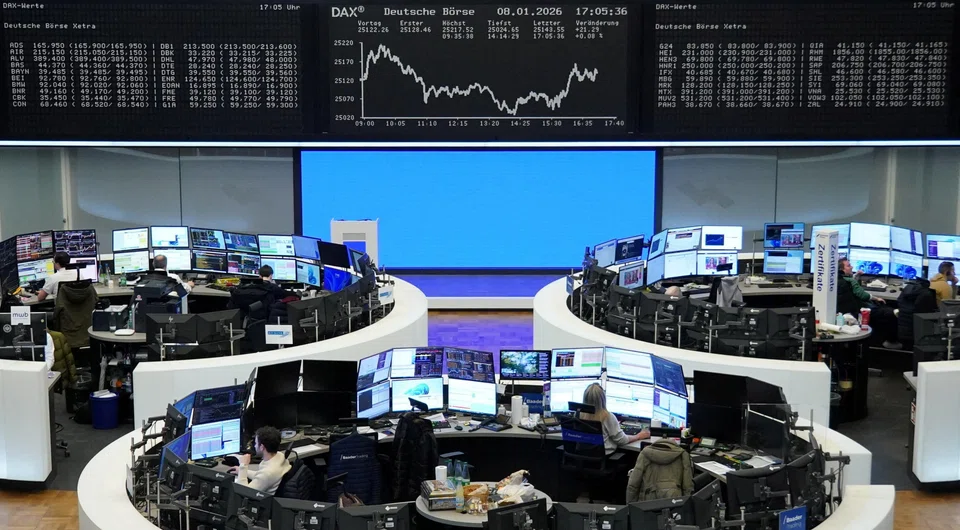
EUROPEAN shares retreated on Tuesday, led by declines in defence and healthcare stocks, as investors turned cautious ahead of US President Donald Trump’s deadline for Iran to reopen the Strait of Hormuz.
Oil prices edged up past US$110 per barrel with both US and Teheran showing no signs of reaching an agreement, while strikes on Iran intensified.
The Stoxx 600 index ended down 1 per cent at 590.59, giving up earlier gains. Trading resumed after Europe’s extended Easter weekend, which included the Good Friday and Easter Monday holidays.
Most regional bourses also traded in negative territory, with Germany’s DAX falling 1 per cent, while Britain’s FTSE 100 was off 0.8 per cent.
“The situation has evolved into a near-term binary outcome: either escalation through direct strikes on Iranian infrastructure, or a last-minute de-escalation that could trigger a sharp reversal in risk assets,” said Daniela Hathorn, senior market analyst at Capital.com.
“For now, the absence of a clear path forward is keeping markets volatile and indecisive.”
The US-Israeli war with Iran has rattled global markets and sent oil prices soaring, with the Stoxx 600 declining more than 5 per cent since the conflict began over a month ago.
Teheran’s effective closure of the strait has stoked inflation concerns and shifted monetary policy expectations.
Despite hopes for a diplomatic breakthrough, negotiations have so far failed to yield progress. Trump has imposed a deadline of 8 pm ET Tuesday (0000 GMT Wednesday) for a deal to be reached.
Among sectors, aerospace and defence dropped 2.4 per cent with Italy’s Leonardo falling 8 per cent after sources told Reuters CEO Roberto Cingolani could be replaced. Britain’s Rolls-Royce and Germany’s Rheinmetall lost 3.9 per cent and 2.5 per cent, respectively.
Healthcare fell 2.1 per cent with Novo Nordisk and AstraZeneca off 0.8 per cent and 2.3 per cent, respectively.
Information technology stocks lagged, with semiconductor equipment leader ASML falling 4.1 per cent, after a cross-party group of US politicians proposed a law to impose further restrictions on exports of computer chipmaking equipment to China.
Media shares were a bright spot, gaining 3.7 per cent as Universal Music Group soared 11.4 per cent after Pershing Square proposed a cash-and-stock takeover valued at about 55.75 billion euros (S$82.5 billion).
On the monetary policy front, ECB policymaker Dimitar Radev warned that inflation expectations could rise faster than in the past and said the central bank must be prepared to raise rates swiftly if price pressures persist.
Traders are now pricing in about three rate hikes by the end of the year, according to LSEG data.
Meanwhile, euro zone PMI figures showed private sector expansion weakened sharply in March as the Middle East conflict drove up energy costs and disrupted supply chains, with overall demand falling for the first time in eight months. REUTERS
Decoding Asia newsletter: your guide to navigating Asia in a new global order. Sign up here to get Decoding Asia newsletter. Delivered to your inbox. Free.
Share with us your feedback on BT's products and services