

Asian shares slip as Fed rate-hike bets keep US yields elevated
Analysts argue a series of hikes is needed to shore up the yen, which again slid past 160 per US dollar on Aug 28
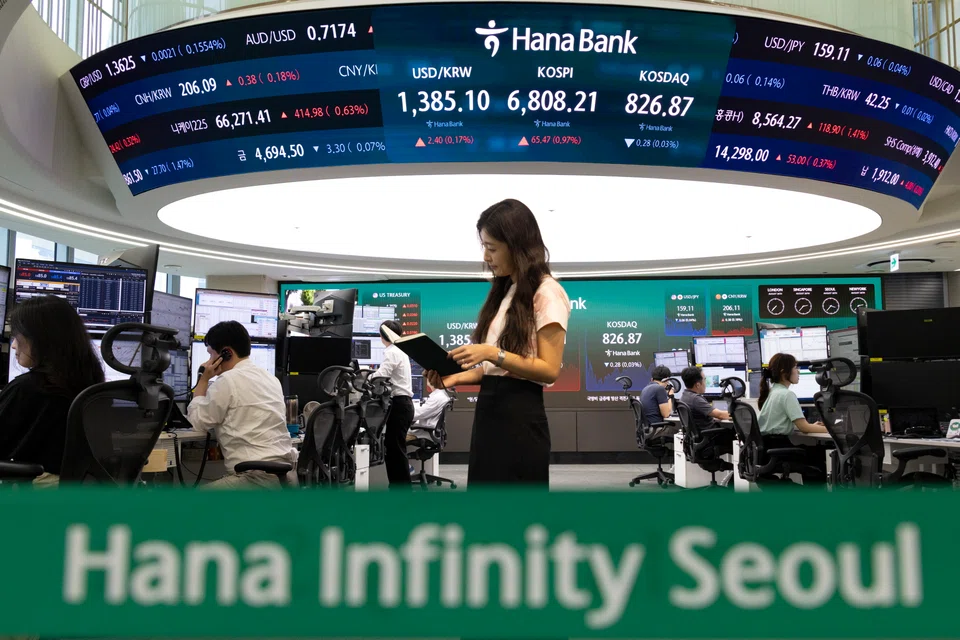
[SYDNEY] Share markets slipped in Asia on Monday (Aug 31) as fresh fighting broke out between the US and Iran, lifting oil prices, while US bond yields stayed painfully elevated after investors narrowed the odds on a US rate hike.
Brent futures climbed 2.7 per cent to US$90.51 a barrel after US forces struck two of Iran’s launchers on its island of Larak on Sunday. In response, Iran attacked US forces stationed in Jordan and claimed to have hit a tanker moving through the strait.
US President Donald Trump later posted that Kharg Island, Iran’s main oil terminal, was being “blown to smithereens,” though there was no confirmation of this from the military.
The resulting risk to inflation kept bond markets on edge after US Federal Reserve chair Kevin Warsh emphasised on Friday the US central bank had work to do to control inflation.
Markets reacted by lifting the probability of a September rate increase to 57 per cent, shoving short-term Treasury yields sharply higher and flattening the curve.
“We continue to expect that a hike won’t come until December, though agree that the September meeting is live,” said Michael Feroli, chief US economist at JPMorgan.
“Moreover, regardless of the exact timing of hikes, Warsh’s speech suggested a chair more willing to translate his concern about inflation into a policy tightening.”
Barclays, for one, now expects the US Fed to raise rates by 25 basis points in both September and December.
Key to the chance of an early hike will be the outcome of Friday’s US August payrolls report and consumer price data due on Sep 11.


Analysts are forecasting a bounce of 58,000 in jobs, following July’s shock drop of 23,000, with US unemployment holding at 4.1 per cent. It would probably need a much weaker outcome to greatly lessen the risk of a September rate move.
The inflation threat is expected to spur New Zealand’s central bank to hike rates for a second straight meeting on Wednesday, while the Bank of Canada is seen on hold, given the damage a trade war with the US could do to the economy.
Higher yields combined with geopolitical stress to push Japan’s Nikkei down 0.4 per cent, while South Korean stocks fell 0.1 per cent. MSCI’s broadest index of Asia-Pacific shares outside Japan lost 0.6 per cent.
Chinese blue chips eased 0.4 per cent, with property developers under pressure after Beijing announced regulatory changes. A survey also showed the official manufacturing purchasing managers’ index picked up to 49.8 in August from 49.2 in July, though services remained subdued.
In Europe, Eurostoxx 50 futures dropped 0.3 per cent, while Dax futures eased 0.2 per cent. On Wall Street, S&P 500 futures dipped 0.2 per cent and Nasdaq futures fell 0.1 per cent.
US dollar back around 160 yen
Inflation and interest rates will be high on the menu when G20 finance ministers and central bankers meet in North Carolina on Monday and Tuesday.
In an interview with Reuters on Sunday, US Treasury Secretary Scott Bessent said he planned to meet the head of the Bank of Japan amid speculation that it, too, will raise interest rates in September.
Analysts argue a series of hikes is needed to shore up the yen, which again slid past 160 per US dollar on Aug 28.
Asked about the yen, Bessent said the move was “pretty well contained,” suggesting the slide was not disorderly enough to trigger a repeat of joint Japan-US intervention.
The US dollar was 0.1 per cent lower at 159.78 yen, still some way from the July top of 163.99. Japanese bonds followed Aug 28’s sell-off in Treasuries as 10-year yields again hit their highest since 1996.
Two-year Treasury yields held at 4.34 per cent, after jumping almost 12 basis points on Aug 28. Yields on 30-year bonds were more contained at 5.208 per cent, with investors taking some comfort from Warsh’s emphasis on fighting inflation.
The euro was a shade firmer at US$1.1590, having slipped 0.6 per cent on Aug 28 after Warsh’s speech.
Data on EU inflation due this week is expected to cement market pricing for another hike from the European Central Bank when it meets on Sep 10.
In commodity markets, US crude rose 2.6 per cent to US$85.57 a barrel. Gold lost 0.6 per cent to US$4,425 an ounce, having shed 3.2 per cent on Aug 28 as yields spiked. REUTERS
Decoding Asia newsletter: your guide to navigating Asia in a new global order. Sign up here to get Decoding Asia newsletter. Delivered to your inbox. Free.
Share with us your feedback on BT's products and services






