South Korea’s once-hot AI stocks struggle for buyers as doubts grow over memory-chip boom
Semiconductor hub of Taiwan gaining favour due to its wider and deeper linkages across the AI supply chain
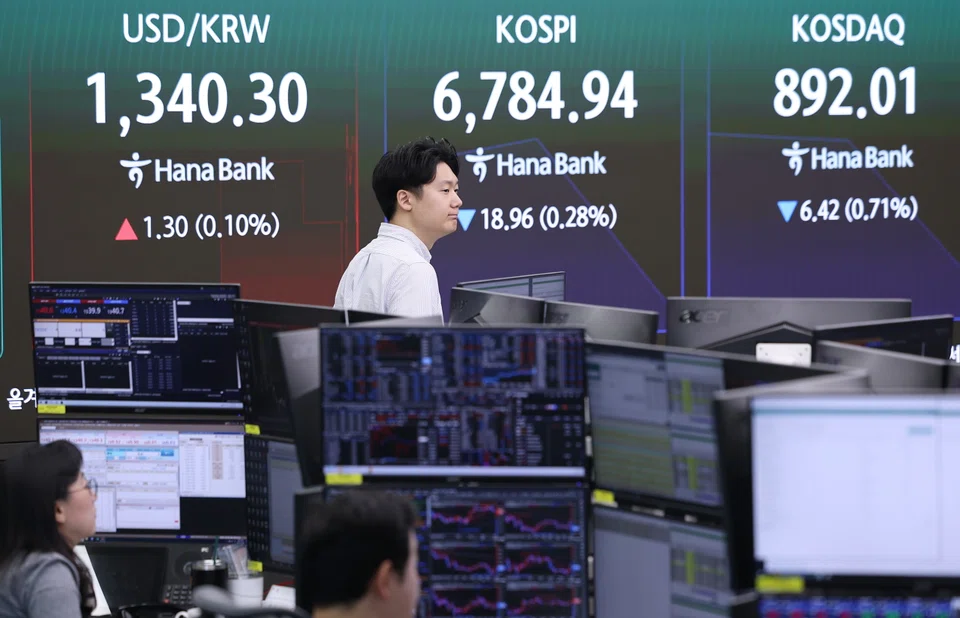
SOUTH Korea spent much of 2026 as a poster child of the scorching global AI trade. Now, by almost every measure, the US$4.3 trillion stock market is rapidly losing relevance with investors.
Turnover has collapsed 70 per cent from its peak in late May, foreigners are retreating at the fastest pace in Asia and local retail investors are also pulling back.
The Kospi, the world’s best-performing major equities benchmark in the first half, has since lost 22 per cent to be the worst in the second half while its AI-heavy Taiwanese and US peers set new highs.
Behind the reversal is a market whose AI fortunes hinge disproportionately on Samsung Electronics and SK Hynix, the two memory-chip giants at the heart of the global AI supply chain.
That concentration is now a liability as investors question the durability of memory chips’ boom cycle, while the brutal leverage-driven sell-off in the summer has made some global funds hesitant to return.
“The biggest challenge I see for most investors – especially those who only recently got into Korea for the memory chip trade – is that the easy money in that theme has been made,” said Phillip Wool, head of portfolio management at Rayliant Global Advisors, adding his fund has been taking profit in South Korean AI stocks and is now underweight SK Hynix and Samsung Electronics.
The two chipmakers together account for over half of Kospi’s weighting and powered its ascent earlier in 2026. Foreign funds pulled US$131 billion from South Korean stocks this year, the most among major Asian markets, according to exchange data compiled by Bloomberg.
Scepticism over memory chip demand was on full display when shares of Samsung, the world’s top producer of such semiconductors, fell on Thursday (Oct 8) despite a nearly nine-fold surge in quarterly operating profit.
South Korea is now struggling to lure buyers, a problem amplified by the nearing completion of combined 55 trillion won (US$41 billion) stock buybacks by Samsung and SK Hynix.
Repurchases by the two chipmakers accounted for the bulk of the US$23 billion worth of buy orders in the market in September, according to JPMorgan Chase.
“We have seen capital increasingly gravitate back toward US equities, contributing to ongoing foreign outflows from the Korean market,” said Richard Tang, head of research Hong Kong at Julius Baer.
Individual investors, a key force behind Kospi’s 100 per cent rally in the first half, remain elusive following the July rout.
Margin loans outstanding have hovered around 33 trillion won over the past month, after peaking at 38.6 trillion won in June, according to data from the Korea Financial Investment Association. Brokerage account balances – or investor deposits awaiting deployment – have also fallen to around 100 trillion won from a record of near 140 trillion won.
“The memory names in particular have become value names, cheap at current earnings,” said Jon Withaar, a portfolio manager at Pictet Asset Management in Singapore. “But retail and fast money hedge funds do not chase value or the concept ‘cheap’. They chase growth.”
To be sure, the declines have opened up buying opportunities for some investors who see AI spending and memory chip profitability still holding up. South Korea’s ongoing initiative to boost corporate value is also another draw. Thanks to earlier gains, Kospi is still among the best performers for 2026 overall.
Yet for those less convinced, the competing Asian semiconductor hub of Taiwan is gaining favour due to its wider and deeper linkages across the AI supply chain and a more upbeat earnings outlook.
Up 70 per cent in 2026, the Taiex Index beat the Kospi by about 23 percentage points last quarter, the widest margin since the turn of the century. Taiwan’s stock gains are also more broad-based, with about 10 per cent of the local gauge’s members having at least doubled in value this year. That compares to 4.7 per cent for the Kospi.
“At this point in time, we prefer to express our tactical AI exposure through Taiwan equities, which offer a more complete technology hardware ecosystem and are supported by robust spending plans from major technology companies,” said Wu Chun-Lai, head of Asia asset allocation at UBS Global Wealth Management Chief Investment Office. BLOOMBERG
Decoding Asia newsletter: your guide to navigating Asia in a new global order. Sign up here to get Decoding Asia newsletter. Delivered to your inbox. Free.
Share with us your feedback on BT's products and services