Seoul: Stocks climb on high foreign demand; won edges down
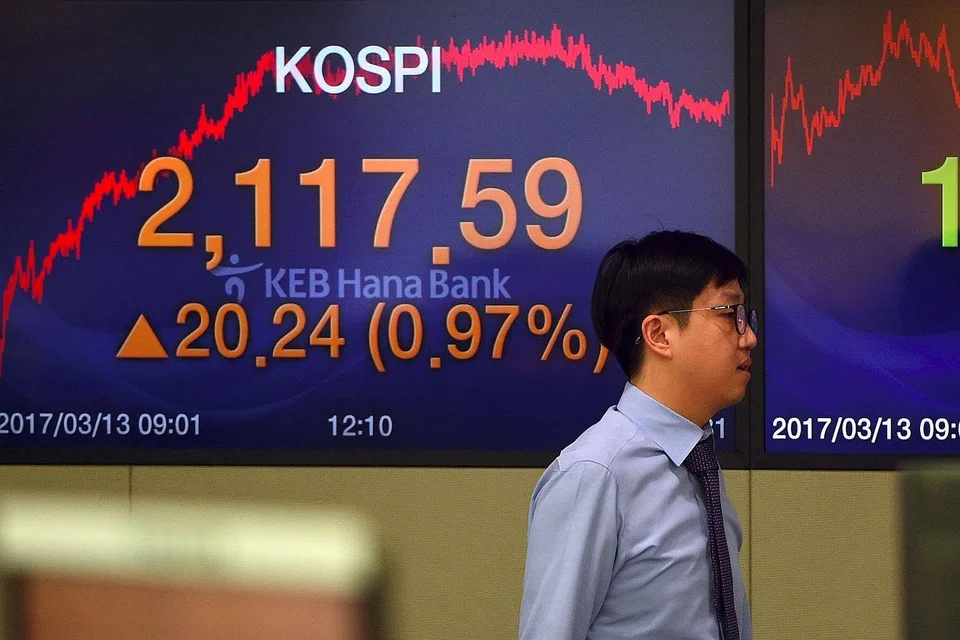
[SEOUL] South Korea's KOSPI stock index rose on Monday. The Korean won fell in the local platform while bond yields rose. At 0630 GMT, the KOSPI was up 26.26 points or 1.06 per cent at 2,501.67. The benchmark index rose sharply in the late session as foreign investors increased their net buying amount, especially of stocks in the tech sector.
The won was quoted at 1,088.7 per dollar on the onshore settlement platform, or 0.21 per cent weaker than its previous close at 1,086.4.
In offshore trading, the won was quoted at 1,087.92 per US dollar, down 0.5 per cent from the previous day, while in one-year non-deliverable forwards it was being transacted at 1,085 per dollar.
MSCI's broadest index of Asia-Pacific shares outside Japan was up 0.41 per cent, after US stocks ended the previous session with mild losses. Japanese stocks weakened 0.49 per cent.
The KOSPI is up around 22.2 per cent so far this year, and down by 0.57 per cent in the previous 30 days.
The current price-to-earnings ratio is 12.10, the dividend yield is 1.28 per cent and the market capitalisation is 1,242.04 trillion won.
The trading volume during the session on the KOSPI index was 320,891,000 shares, and of the total traded issues of 873, the number of advancing shares was 400.
Foreigners were net buyers of 17305 billion won worth of shares.
In money and debt markets, December futures on three-year treasury bonds were unchanged at 108.26.
The Korean three-month Certificate of Deposit benchmark rate was quoted at 1.66 per cent compared with a previous close of 1.66 per cent, while the benchmark 3-year Korean treasury bond yielded 2.088 per cent, higher than the previous day's 2.09 per cent.
REUTERS
Share with us your feedback on BT's products and services