

STI jumps over 1%, Asia stocks soar following US-Iran ceasefire agreement
The benchmark index is buoyed by the three Singapore banks which all traded higher
 Add BT as a preferred source

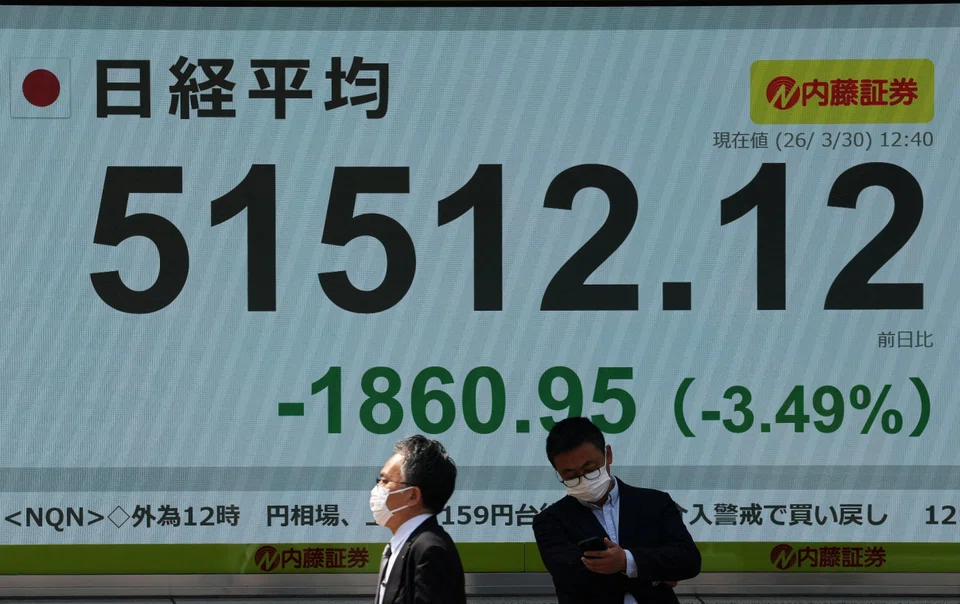
[SINGAPORE] Asian markets advanced on Wednesday (Apr 8) as US President Donald Trump announced a two-week ceasefire with Iran, bringing momentary pause to the conflict.
The Straits Times Index (STI) rose 1.2 per cent to 5,018.19 points at market open, buoyed by the three Singapore banks which all traded higher.
As at 9.01 am, DBS was up 0.1 per cent, UOB rose 1.5 per cent and OCBC increased 2.2 per cent.
Trump said he would halt the bombing of Iran for two weeks as long as Teheran reopens the Strait of Hormuz, less than two hours before his deadline to destroy the country was reached, according to Bloomberg.
Both countries have agreed to a ceasefire, with Iran saying it would grant safe passage through the Strait of Hormuz for two weeks.
Iran’s Supreme National Security Council said that negotiations will take place for two weeks, but may be extended, depending on the mutual agreement of both countries, according to Reuters.
Talks between the US and Iran are set to start on Friday in Islamabad, Pakistan, said Iran.
Across the region, neighbouring markets mirrored the gains.
Malaysia’s KLCI index rose 0.9 per cent as at market open. Hong Kong’s Hang Seng Index climbed 2.5 per cent as at 9.53 am. Thailand’s SET index was 0.7 per cent up at 10.01 am.

Meanwhile, Japan’s Nikkei and South Korea’s Kospi advanced 4.8 per cent and 5.2 per cent, respectively, in early trading.
Australia’s ASX was up 1.8 per cent as at 9.12 am.
Oil dived below US$100 a barrel after Iran conceded to temporarily reopen the Strait of Hormuz, which carries one fifth of the world’s oil and liquefied natural gas.
On Tuesday, West Texas Intermediate dropped as much as 19 per cent to about US$91 a barrel – its steepest intraday decline since 2020, while Brent fell as much as 16 per cent.
Over the past few weeks, the blockade of the strait, which traffics oil and petroleum products from Iraq, Saudi Arabia, Qatar, Kuwait and the United Arab Emirates, has sparked a global oil and gas crisis that International Energy Agency chief Fatih Birol described as being of unprecedented magnitude.
Oil prices to stay elevated in the near term
Nigel Green, CEO of global financial advisory giant deVere Group, said that markets are clearly reacting strongly to the pause now. “Drivers will feel some short-term relief as petrol and diesel prices edge lower.”
Retail, consumer discretionary and aviation sectors will therefore be the immediate winners from cheaper fuel and improved sentiment.
However, a reversal of oil prices back to pre-conflict levels is unlikely, said Ray Sharma-Ong, deputy global head of multi-asset bespoke solutions at Aberdeen Investments.
“Physical and logistical disruptions are not going to disappear overnight,” he said. “Higher shipping costs, war risk insurance, delays, congestion, rerouting inefficiencies, precautionary stockpiling and geopolitical risk premium are going to keep oil above previous levels for some time.”
These circumstances will continue to feed into the entire economy, said the experts, and seep into near-term prices, business costs and investment decisions.
Mixed bag for global equities
A ceasefire at this juncture has mixed implications for different corners of equity markets, though experts noted the stabilisation of major indices since the news.
Green said that above all, financials are likely to participate in the upswing, considering how improved market stability tends to support deal activity and risk-taking, which are both critical for bank earnings.
“Banks perform better in environments where uncertainty declines. A pause in conflict reduces tail risks, which is constructive for credit markets and capital markets activity,” he noted.
The deVere CEO also said tech could lead the rebound, too, as it was hit hardest by rising yields and risk aversion.
“Lower energy prices reduce inflation expectations at the margin, which supports valuations,” he explained.
However, energy equities may see short-term pressure as crude pulls back.
“Supply constraints have not disappeared,” he said. “A two-week pause does not rebuild inventories or solve geopolitical fragmentation.”
Sharma-Ong observed that the strongest rebound in markets will be in those hit hardest by the oil shock and the rise in risk aversion.
“Asia’s more oil-importing equity markets – particularly Korea, Taiwan and Japan – are likely to rebound the fastest,” he said. “These markets are more exposed to swings in energy prices and global risk sentiment.”
Ceasefire duration implications
Whether the two-week ceasefire holds, and if some compromise is found to reopen the Strait of Hormuz, will determine the subsequent economic shocks on global economies, said analysts.
Michael Langham, emerging markets economist at Aberdeen Investments, said the global economic shock from this conflict will prove “manageable”, in the event of a successful de-escalation from here.
“We would view this as a temporary price level shock that may not pass through to consumers or businesses in some economies,” he added.
deVere’s Green added that if progress towards a durable agreement emerges, the rally in global equity markets can extend and broaden.
“Industrial stocks, emerging markets and cyclicals would then have room to catch up,” he said.
However, failure to convert this pause into a longer-term framework would reverse sentiment just as quickly.
“Volatility would return, oil would spike again, and equities would give back gains,” noted Green.
Decoding Asia newsletter: your guide to navigating Asia in a new global order. Sign up here to get Decoding Asia newsletter. Delivered to your inbox. Free.
Copyright SPH Media. All rights reserved.
TRENDING NOW

What makes a good job? Feeling that you matter

Lermit Road bungalow owned by family of Dennis Lee’s son on the market at S$98.8 million

A ‘shadow bank’ hiding in Singapore’s Little India casts light on financial services gap

Keppel DC Reit prepares Singapore data centre for potential redevelopment; H1 DPU up 11.3%

