

Singapore shares edge lower as DFI Retail slides; STI down 0.08%
Hongkong Land leads the gainers on the blue-chip index
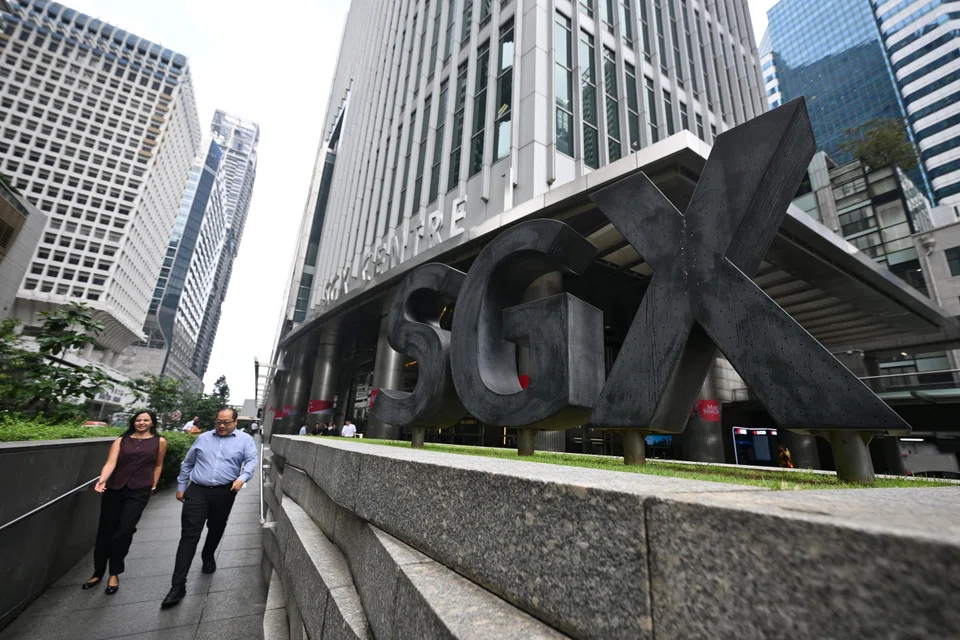
[SINGAPORE] Singapore stocks ended lower on Friday (Sep 18).
The benchmark Straits Times Index (STI) lost 0.08 per cent or 4.41 points to finish at 5,656.11.
Hongkong Land led the gainers on Singapore’s blue-chip index, rising 2.6 per cent or US$0.22 to US$8.64.
The worst performer among STI constituents was DFI Retail Group , which fell 8.5 per cent or US$0.29 to US$3.12.
The three local banks ended mixed on Friday. OCBC rose 0.3 per cent or S$0.10 at S$31.38; DBS finished 0.1 per cent or S$0.08 lower at S$76.86, and UOB finished 0.2 per cent or S$0.10 lower at S$41.78.
The iEdge Singapore Next 50 Index lost 0.03 per cent or 0.43 points to 1,498.02.
On the iEdge Singapore Next 50 Index, Frencken Group was the top gainer, rising 5.8 per cent or S$0.14 to S$2.57. StarHub was the biggest decliner, falling 4.5 per cent or S$0.05 to S$1.06.
Across the broader market, gainers outnumbered losers 303 to 273, after 1.8 billion securities worth S$3.2 billion changed hands.
Addvalue Tech was the most actively traded stock with 134.9 million shares changing hands. OCBC was the most actively traded stock in terms of value, with a volume of 14.5 million shares and a value of S$455.4 million.




Key regional indices were mixed. Hong Kong’s Hang Seng Index gained 0.6 per cent, Japan’s Nikkei 225 rose 1.4 per cent, South Korea’s Kospi was up 2.7 per cent and the FTSE Bursa Malaysia KLCI declined 0.5 per cent.
The Bank of Japan’s latest interest rate hike could also have implications for global markets, as higher rates make Japanese assets more attractive to domestic investors.
Nigel Green, chief executive of deVere Group, said: “Every basis point the Bank of Japan adds makes it more attractive for Japanese money to come home instead of funding US and European markets.
“If that shift accelerates, borrowing costs everywhere get more expensive... This is a global funding story now, and it won’t stay confined to Japan.”
He added: “This is a moment for genuine scrutiny of portfolio exposure rather than panic.”
This article was written with the assistance of AI and reviewed by a reporter
Decoding Asia newsletter: your guide to navigating Asia in a new global order. Sign up here to get Decoding Asia newsletter. Delivered to your inbox. Free.
Share with us your feedback on BT's products and services
TRENDING NOW
Prima to move out of historic Keppel Road flour mill building in 2028

Temasek-related Azalea, SeaTown, Seviora Capital to merge in 2027
Family offices see more tailored products, leverage ‘collective firepower’ for direct deal access

Singapore room rates soar, but hotels seeing mixed demand from F1 race and events

