

Singapore stocks close lower amid mixed regional showing; STI down 0.1%
The worst performer among STI constituents is Sembcorp Industries, which falls 2.8% to S$5.84
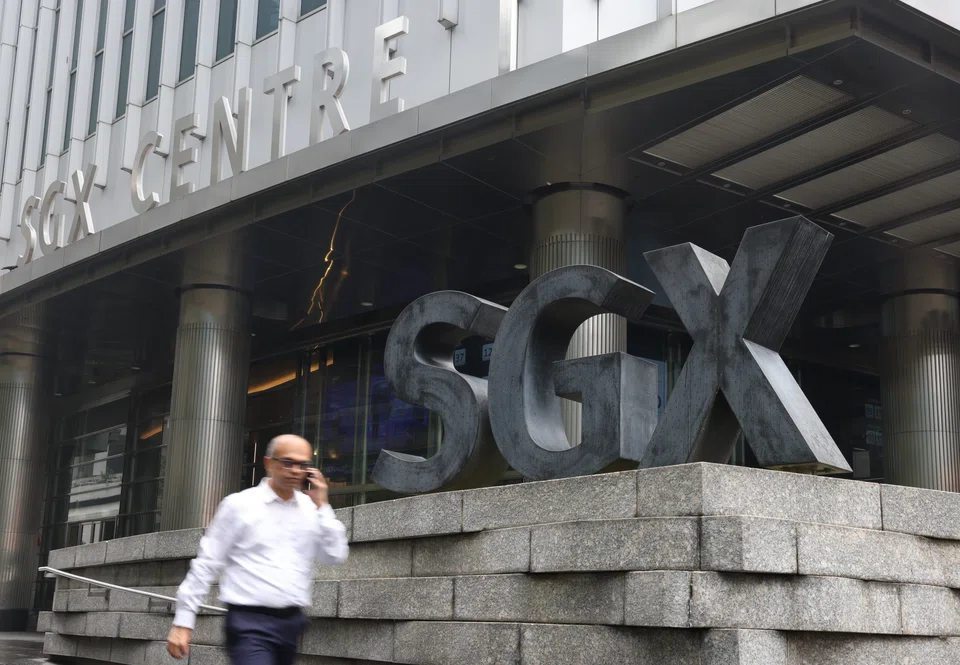
[SINGAPORE] The Singapore market edged into negative territory on Monday (Oct 26).
The benchmark Straits Times Index (STI) lost 0.1 per cent or 6.25 points to finish at 5,415.91.
Hongkong Land led the gainers on Singapore’s blue-chip index, rising 2.2 per cent or US$0.18 to US$8.38.
The worst performer among STI constituents was Sembcorp Industries, which fell 2.8 per cent or S$0.17 to S$5.84.
The local banks all ended lower. DBS lost S$0.23 or 0.3 per cent to S$74.21, OCBC fell S$0.05 or 0.2 per cent to S$28.95, and UOB was down S$0.29 or 0.7 per cent at S$41.30.
Across the broader market, gainers drew level with losers 252 to 252, after 932.6 million securities worth S$1.4 billion changed hands.
CapAllianz was the most actively traded stock, with 91.9 million shares changing hands. DBS was the most actively traded stock in terms of value at S$174.8 million.
Key regional indices were mixed. Hong Kong’s Hang Seng Index gained 0.5 per cent, Japan’s Nikkei 225 fell 0.8 per cent, South Korea’s Kospi was down 1.5 per cent and the FTSE Bursa Malaysia KLCI declined 0.5 per cent.
Nigel Green, CEO of deVere Group, said that Brazil’s election results, where incumbent President Luiz Inacio Lula da Silva gained a surprise win, offers bond markets everywhere a preview.



“Brazil is a live test of how much fiscal looseness bond markets will tolerate in a world weighed down by government debt,” he said.
“Political surprises can reprice an asset class within hours, and currency swings can quietly erase gains made abroad. Spreading exposure across regions and currencies is what cushions those blows.”
This article has been written with the assistance of AI and reviewed by a reporter
Decoding Asia newsletter: your guide to navigating Asia in a new global order. Sign up here to get Decoding Asia newsletter. Delivered to your inbox. Free.
Share with us your feedback on BT's products and services
TRENDING NOW

Government to bring forward raising of retirement age, give employers more financial support to create flexi-load jobs
Former minister Maliki Osman, Revolut chairman join Asia Gulf Holdings advisory board

Is Manila Asia’s new dining hot spot?

Simba at risk of losing operating licence over spectrum misuse

