

Singdollar hits 10-month high against ringgit as investors take refuge in traditional safe haven
The exchange rate has hit RM3.2217, the highest level since end-October 2025

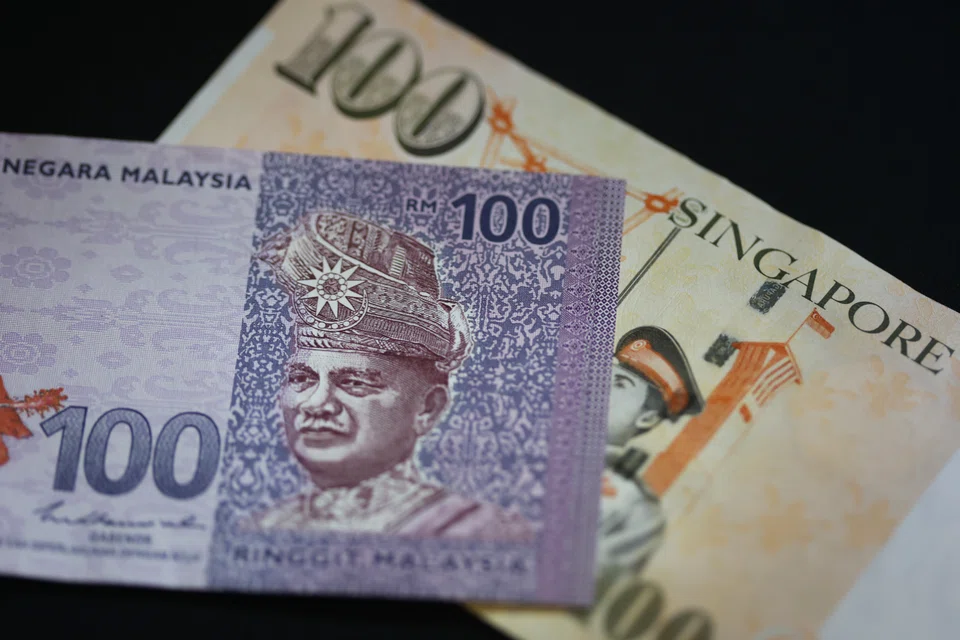
[SINGAPORE] The Singapore dollar rose to a 10-month high against the ringgit on Wednesday (Sep 9), as rising US Treasury yields and risk-off sentiment drove investors towards the city-state’s currency as a regional safe haven.
The exchange rate climbed to RM3.2207, the highest level since Oct 31, 2025, going by Google Finance data. It then rose further to RM3.2217 as at 9.58 am on Thursday.
The divergence underscores contrasting near-term drivers for the neighbouring economies.
Singapore’s exchange-rate framework is buffering its currency against global market stress, while the ringgit faces pressure from a string of foreign capital outflows, even as Malaysia’s underlying economic growth remains stable.
Exceptional Singdollar
The Singdollar’s strength is largely anchored by the Monetary Authority of Singapore’s (MAS) exchange-rate framework, which manages the currency against a basket of its major trading partners, said Saktiandi Supaat, head of FX research and strategy at Maybank.
Strength in major currencies such as the yen, combined with positive sentiment towards Singapore equities, has provided additional support, he added.
The Singdollar is also an exception for Yuxuan Tang, JP Morgan Private Bank’s Asia head of rates and FX strategy, who is “cautious on most Asean currencies” due to the bloc’s capital outflows and external vulnerabilities.
The tightening bias of MAS, prospects for continued capital inflows and the managed nature of the exchange-rate regime should allow the Singdollar to remain relatively resilient and potentially strengthen further, she added.
DBS rates strategists noted that the currency is also drawing support from tightening domestic liquidity and rising short-term rates, which have started edging up alongside elevated global bond yields.


“There is a limit to how low Singdollar rates can trade relative to US dollar rates,” they added, indicating upward pressure on short-term rates as global central banks maintain a tighter monetary stance.
Ringgit weakness short-term
In contrast to the Singdollar, the ringgit is suffering from a broader sell-off in regional foreign exchange markets.
Firming US yields, rising oil prices and weakness in Malaysian government securities have heavily dampened sentiment, said Christopher Wong, FX strategist at OCBC.
That softer sentiment has triggered an exodus from Malaysian equities. Global funds pulled US$122 million from Malaysian stocks in the first week of September, following a US$486 million outflow in August, according to Bloomberg News.
This extends a trend from earlier in the year, which saw foreign stock ownership decline to 18.3 per cent in the second quarter, as noted by Citi in July.
Despite the current sell-off, currency strategists view the ringgit’s slide as temporary.
The weakness is a near-term market adjustment rather than a crack in Malaysia’s fundamentals, OCBC’s Wong said, adding that the country’s economic growth, investment pipeline and external sector are holding up.
Malaysia is also positioned to benefit from artificial intelligence-driven growth and steady electronics exports. The economic boom prompted Bank Negara Malaysia (BNM) to extend its interest rate pause for a seventh consecutive meeting on Sep 3, holding its overnight policy rate at 2.75 per cent.
Following that decision, DBS analysts noted that the central bank subtly dropped its characterisation that the current rate was “appropriate”, a move designed to create policy flexibility while monitoring inflation.
Philip Wee, senior currency economist at DBS, noted that the ringgit had rallied after Malaysia hosted the Asean Summit in late October 2025.
The US Federal Reserve, which cut rates by a cumulative 75 basis points from September to December 2025, also provided a favourable backdrop.
“In Malaysia, the electoral setbacks of the Unity government and voter concerns over living costs tempered the optimism surrounding the Asean Summit,” Wee said.
“The government’s fiscal responses have also raised concerns about the pace of longer-term institutional and fiscal reforms.”
He warned that the ringgit could weaken further against the Singdollar if the Fed raises rates as markets expect, due to the Middle East conflict pushing crude prices back above US$100 a barrel again.
Meanwhile, the US dollar debasement trade will likely benefit the Singdollar more as a haven.
Still, Maybank continues to favour the Malaysian currency in the long run. This is even though near-term pressure on the ringgit could persist if global yields remain elevated.
“We continue to favour selling the dollar on rallies,” Saktiandi said. “We view rebounds in USD/MYR as opportunities to sell the dollar and buy the ringgit.”
Decoding Asia newsletter: your guide to navigating Asia in a new global order. Sign up here to get Decoding Asia newsletter. Delivered to your inbox. Free.
Copyright SPH Media. All rights reserved.
TRENDING NOW

GCash parent Mynt rises in market debut after South-east Asia’s top 2026 IPO

In the age of AI, what is a university education for?

Singapore to use ‘every legal and regulatory lever’ against companies linked to haze: Shanmugam
‘IPOs are not the only vehicle’: KKR heads for record exits even as firms stay private for longer

