Asian shares fall on chip sell-off as Kospi sinks 4.8%; SK Hynix, Samsung shares tumble
Investor attention is on US jobs data due on Thursday
[SYDNEY] Asian shares extended declines on Thursday (Jul 2) as investors rotated out of chipmakers after a stellar quarter, while currency and bond markets braced for US jobs data that could give pointers to the risk of interest rate hikes.
Oil prices hit new four-month lows, with Brent crude down 1 per cent at US$70.88 a barrel, as US President Donald Trump said talks with Iran had gone well in Qatar, and more oil tankers transited through the Strait of Hormuz.
European shares are expected to open steady, with regional stock futures little changed.
Wall Street futures edged up 0.2 per cent after a sell-off in semiconductor shares overnight, though Meta Platforms jumped nearly 9 per cent on reports that it is building a cloud business to sell excess artificial intelligence computing capacity.
MSCI’s broadest index of Asia-Pacific shares outside of Japan fell 1.2 per cent, while Japan’s Nikkei dropped 1.4 per cent. Hong Kong’s Hang Seng index bucked the trend, with a gain of 0.9 per cent.
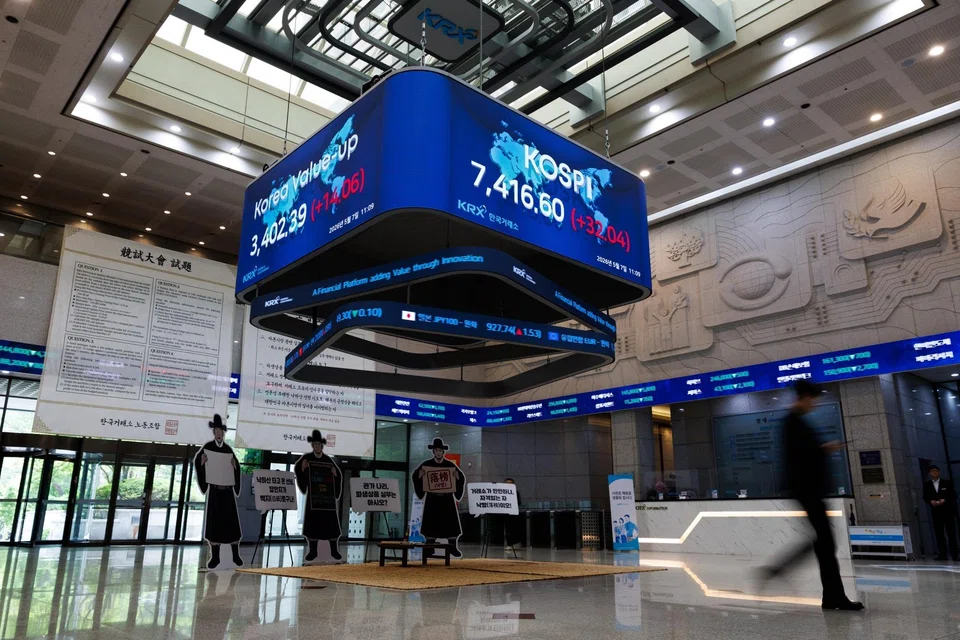
South Korea’s Kospi sank 4.8 per cent, extending Wednesday’s slide of 2 per cent, after an eye-watering second-quarter surge of 68 per cent on soaring AI-related demand for memory chips. SK Hynix plunged 8.5 per cent and Samsung tumbled 7.2 per cent.
“The plunge in Asia semis today is more about a hangover from Wall Street,” said Fabien Yip, a market analyst at IG, adding that profit-taking appeared to be key driver.
“Layered on top is Apple’s reported outreach to restricted Chinese memory makers for China-market devices, which introduces pricing threat to the Korean and Japanese incumbents.”
Investor attention is squarely on US non-farm payrolls data due on Thursday this month due to a holiday on Friday for Independence Day, which falls on a Saturday this year.



Economists polled by Reuters expect a rise of 110,000 jobs for June, but forecasts range widely from gains of 25,000 to 200,000, suggesting high chances of a surprise. The jobless rate is forecast to stay steady at 4.3 per cent.
“Ideally, equity players want a Goldilocks outcome: respectable job creation, a stable unemployment rate,” said Chris Weston, head of research at Pepperstone.
“Anything that avoids a marked increase in the implied probability of near-term rate hikes is likely to be welcomed by equity bulls.”
At the Sintra Forum, Federal Reserve chair Kevin Warsh said inflation risks had eased recently, offering only short-lived relief to Treasuries.
Warsh also said he would stick firmly to the 2 per cent inflation target and “disappoint” anyone who expected loose monetary policy. Markets currently price in about 80 per cent odds of a rate hike in September.
Treasury yields have been climbing as traders braced for a potentially strong jobs number, which could see bets for a near-term rate hike ramp up.
US two-year yields rose 2 basis points (bps) on Thursday to 4.1806 per cent, and were up 9 bps so far this week. 10-year yields also climbed 2 bps to 4.4911 per cent and were up 12 bps this week.
Higher Treasury yields kept the US dollar supported. The euro was steady at US$1.1385, having eased 0.4 per cent overnight after European Central Bank President Christine Lagarde said inflation and growth risks were becoming more broadly balanced.
The dollar slipped 0.1 per cent to 162.39 yen, having hit a fresh 40-year high of 162.84 on Wednesday.
The yen’s slide has drawn the usual warnings of intervention from Tokyo, although the impact of interventions in April and May proved short-lived, despite authorities expenditure of almost 12 trillion yen.
Gold bounced 0.7 per cent to US$4,059 an ounce after a drop of 14 per cent in the second quarter. REUTERS
Decoding Asia newsletter: your guide to navigating Asia in a new global order. Sign up here to get Decoding Asia newsletter. Delivered to your inbox. Free.
Share with us your feedback on BT's products and services