

Apple seeks to buy Chinese-made memory chips with lobbying push
Both CXMT and YMTC are on US Defense Department list of entities believed to support Beijing’s military
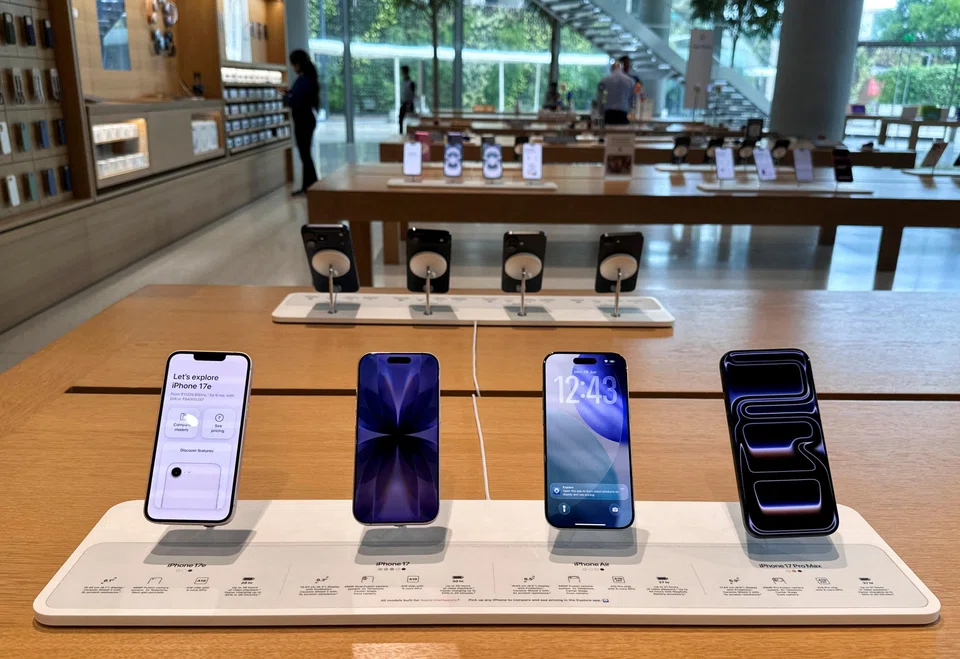
[LOS ANGELES] Apple is in negotiations to purchase chips from two Chinese semiconductor makers on a Pentagon blacklist to help reduce the impact of a global memory shortage that’s forced the company to raise prices across its product line.
The iPhone maker is seeking to buy memory components from ChangXin Memory Technologies (CXMT) and Yangtze Memory Technologies (YMTC) for use in devices sold in China, according to people familiar with the matter. Talks between Apple and the companies are ongoing, and nothing is final yet, said the people, who requested anonymity to describe private discussions.
Apple’s effort has included appeals by chief executive officer Tim Cook to Trump administration officials, including Treasury Secretary Scott Bessent, to help soften the political fallout from any possible deal with the Chinese chipmakers, the people said.
Both CXMT and YMTC, as the two companies are known, are on a recently updated Defense Department list of Chinese entities believed by the US to support Beijing’s military.
While Apple does not need formal US approval to buy chips from CXMT or YMTC, the company would risk significant blowback from national security hawks in Washington at a time of heightened tensions between the US and China, especially over advanced technology.
Some Trump administration officials have expressed objections to giving Apple leeway to add the two Chinese firms to its supply chains.
Spokespeople for the Commerce and Treasury Departments and the White House did not respond to requests for comment. Apple declined to comment.
The effort comes as Apple and other consumer electronics manufacturers grapple with an unprecedented squeeze on the supply of memory chips, touched off by the global artificial intelligence boom.
High-end processors used in data centres require significant amounts of memory, and makers of memory devices have shifted production to serve a fast-growing market where they can demand higher premiums.
SEE ALSO





Buying chips from CXMT and YMTC would expand Apple’s roster of memory suppliers to five. Currently, the company relies on South Korea-based market leaders Samsung Electronics and SK Hynix, along with US-based Micron Technology for memory needs across the range of mobile devices and desktop computing products it sells.
Those memory chipmakers have struggled to keep pace with demand for their components, and each has outlined plans to expand their production lines to meet the needs of AI data centres. Earlier this week, Samsung and SK Hynix vowed to spend more than US$880 billion to build two chipmaking plants apiece to to rapidly expand capacity, and Micron has outlined its own plans to spend billions of US dollars on additional production in the US.
Last week, Apple raised prices of all Macs, iPads, home devices and the Vision Pro, seeking to offset cost increases caused by the shortage of memory chips. A company spokesperson said said that the rapid expansion of AI was to blame and that Apple had “never seen a component price increase this much, this quickly.”
Microsoft took similar steps the same day, announcing that it would raise prices on its Xbox video-game consoles for a third time in 13 months, owing largely to the memory squeeze.
Apple’s campaign risks drawing objections from within the Trump administration, where officials decided earlier this year to keep both CXMT and YMTC on the closely watched 1260H list, a congressionally mandated roster of companies that the Defense Department has concluded support the People’s Liberation Army. YMTC was included on the Pentagon list in January 2024, and CXMT was added in 2025.
YMTC faces other restrictions on its ability to do business with American companies thanks to its inclusion in 2022 on a separate US Commerce Department blacklist. That designation bars companies from buying technology from US suppliers unless they get an export licence.
The Financial Times earlier reported the iPhone maker’s discussions about CXMT.
While the Pentagon’s list carries few immediate legal repercussions, the US is increasingly using it to restrict companies’ abilities to contract with the American military or to receive research funding. A 1260H designation also serves as a warning to US investors, and is widely considered a red flag that can precede more punitive trade restrictions.
Apple had sought in 2022 to source some of its memory supply from YMTC, but that effort was derailed by opposition in Washington following the Chinese company’s inclusion on the Commerce entity list.
By potentially limiting the use of Chinese-made memory chips to devices that would be sold only in China, where Apple already sells dedicated models for the market, the company is hoping to avoid some of the same backlash. BLOOMBERG
Decoding Asia newsletter: your guide to navigating Asia in a new global order. Sign up here to get Decoding Asia newsletter. Delivered to your inbox. Free.
Share with us your feedback on BT's products and services
TRENDING NOW

Malaysian king buys stake in Singapore-listed mining firm expanding into rare earths

Grab CEO’s wife Chloe Tong on life with Anthony Tan and finding her purpose

Once staunchly pro-China, Malaysian Chinese businesses are now distancing themselves from Beijing

Longer wait times expected as S’pore healthcare institutions report system disruptions

