South Korea, Japan stocks slide as Asian shares fall, bonds in focus after rally
MSCI’s Asia Pacific equities gauge slips 0.4% after Wall Street benchmarks eked out a modest gain
ASIAN stocks declined as oil surged on the prospect of renewed US-Iran conflict, reviving inflation concerns. Bonds will be in focus after Treasuries rebounded in the New York session.
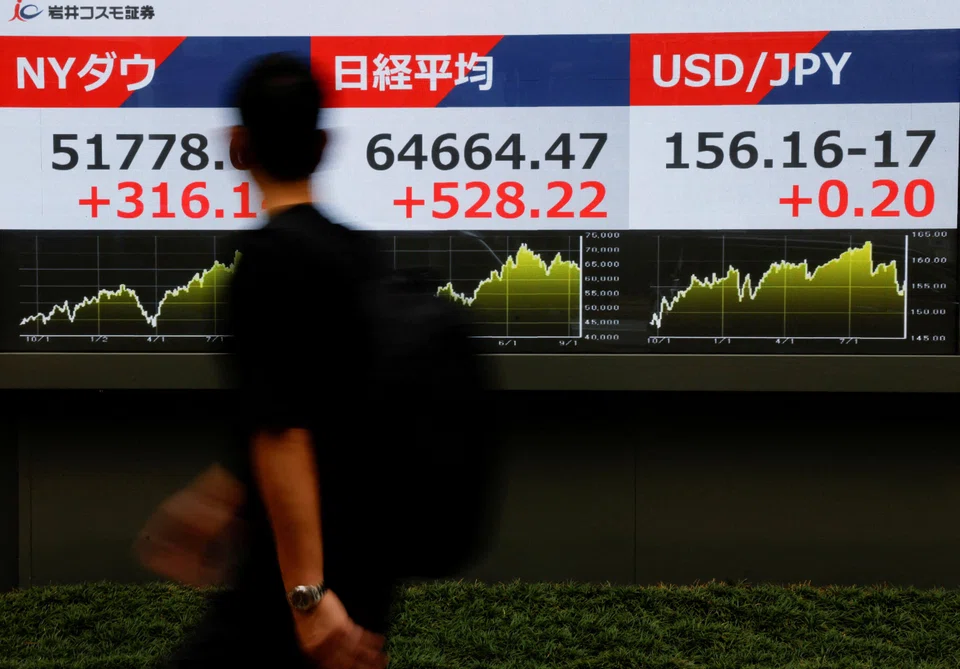
MSCI’s Asia Pacific equities gauge slipped 0.4 per cent with benchmarks in Japan and South Korea declining. Earlier, Wall Street benchmarks eked out a modest gain in a volatile trading session.
Among the main moves in markets, the S&P 500 futures rose 0.1 per cent as at 9.06 am Tokyo time, the Hang Seng futures were unchanged, Japan’s Topix fell 0.9 per cent and Australia’s S&P/ASX 200 rose 0.3 per cent.
Traders remain focused on bonds after Treasuries rebounded from a bruising global bond sell-off despite higher oil prices, as pressure in European markets spurred demand for haven assets.
The 10-year yield retreated from a 24-year high to close at 5.24 per cent on Thursday (Oct 1), with dovish commentary from US Federal Reserve officials also supporting the rally, ahead of Friday’s US jobs data.
Australian, New Zealand and Japanese bonds rose early on Friday.
The prospect of renewed US-Iran hostilities lifted oil, with Brent edging 0.2 per cent higher after a 4 per cent rally on Thursday lifted the commodity past US$100 a barrel.
The prospect of another flare-up in the Middle East leaves investors balancing the inflationary threat from higher oil against signs the Fed may take a more measured approach to further tightening.
The path for energy prices and any escalation between Washington and Teheran may determine whether the rebound in Treasuries can hold and how much pressure spills into equities.



“We continue to think the Fed remains oriented towards a limited two or three hike mini-cycle in the base case,” said Krishna Guha at Evercore.
“It does not currently see demand so strong as to create obvious danger of demand-driven overheating risk.”
In Asia, the yen strengthened to trade around 158 per US dollar after Tokyo’s key inflation gauge rose sharply, backing the Bank of Japan’s stance on continuing to raise the benchmark rate.
Meanwhile, the bounceback in the US bond market gathered pace on Thursday as concern around France’s fiscal and political situation pushed euro-area risk premiums higher.
Long-term UK bond yields also shot past 6 per cent.
In the US, haven appetite helped push the yield on two-year Treasuries lower by 10 basis points to 4.79 per cent.
Also underpinning gains were remarks from Fed vice-chair Philip Jefferson, who said policymakers should take more time before deciding whether additional interest rate increases are needed to slow inflation.
He echoed comments from Federal Reserve Bank of New York president John Williams, who on Tuesday said there was no urgency in considering another hike after the Federal Open Market Committee’s decision to lift rates in September.
However, Federal Reserve Bank of Dallas president Lorie Logan said the central bank must continue raising rates to fully cool inflation.
Meanwhile, traders are also paying close attention to the geopolitical developments in the Middle East and the flow of oil and gas through the Strait of Hormuz.
The Pentagon may soon deploy another aircraft carrier and 10,000 sailors and marines to the Persian Gulf, giving US commanders more options should US President Donald Trump decide to escalate attacks on Iran.
Wall Street analysts and traders said this week that crude flows from the Middle East are closing in on pre-war levels.
Iran, however, appeared to have loaded no crude oil onto tankers in September, the latest indication of a US naval blockade’s effectiveness in severing the Islamic Republic’s access to energy markets.
“The increase in flows remains highly vulnerable to escalation,” said Hamad Hussain, a climate and commodities economist at Capital Economics.
“I’d also describe the market as being structurally tight given the relatively low level of inventories after six months or so of drawdowns. That puts a floor under prices.” BLOOMBERG
Decoding Asia newsletter: your guide to navigating Asia in a new global order. Sign up here to get Decoding Asia newsletter. Delivered to your inbox. Free.
Share with us your feedback on BT's products and services