

South Korea overtakes India as world’s sixth-largest stock market
The Kospi Index has powered past President Lee Jae Myung’s 5,000 goal earlier this year
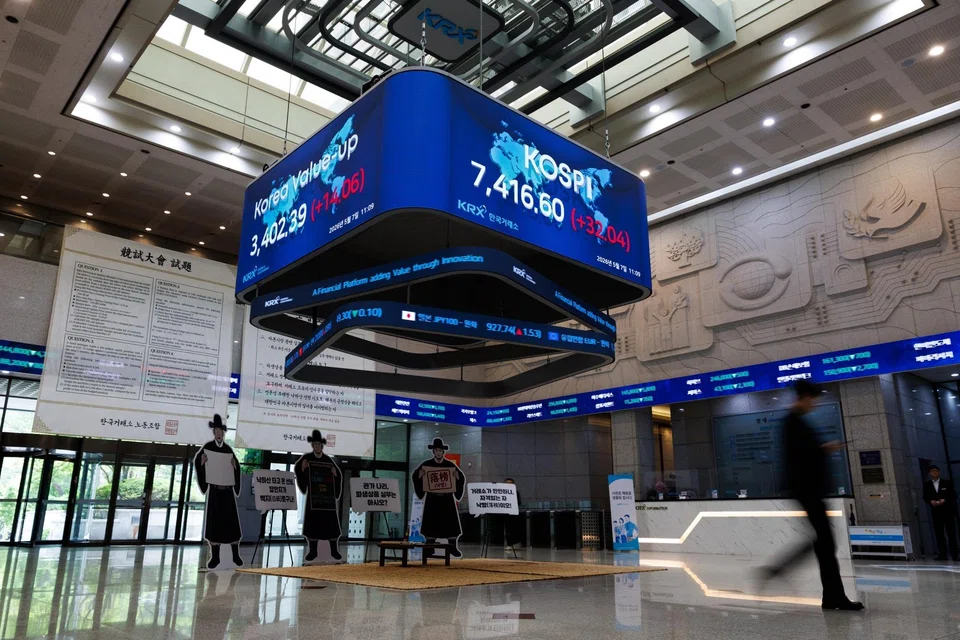
[HONG KONG] South Korea’s equity market has overtaken India’s as the world’s sixth largest, driven by a relentless surge in chip heavyweights powering the global artificial intelligence buildout.
The total market capitalisation of South Korea-listed companies has soared 86 per cent this year to US$5 trillion, while India’s has declined to US$4.8 trillion, data compiled by Bloomberg show. Samsung Electronics and SK Hynix, newly minted members of the US$1 trillion valuation club, have powered Korea’s equity surge.
South Korea’s latest milestone comes after it vaulted past Canada and other European countries this year, underscoring how investors are concentrating their bets on AI and its critical suppliers. Together with Taiwan, the two Asian chipmaking hubs are rewriting global equity rankings in a way that captures investor fascination over their outsized influence in the AI economy, yet also stirs concern about the risks of an overheated market.
The rally “highlights the continued relevance of South Korean technology companies in the next wave of technological innovation”, said Gerald Gan, chief investment officer at Reed Capital Partners. “It also reflects a broader shift in global capital flows towards major Asian economies, which were once overshadowed by Western markets but are now playing an increasingly prominent role in shaping the future of technology and growth.”
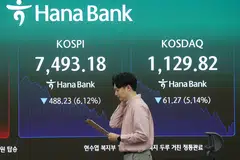
The South Korean stock market has benefited from a dual tailwind, as President Lee Jae Myung’s push for corporate reform coincided with the emergence of AI as a dominant investment theme. The Kospi Index has powered past Lee’s 5,000 goal earlier this year and Wall Street analysts are now calling for 10,000.
But given the heavy concentration of gains in a handful of stocks, Ross McGarry, senior investment analyst at Asset Value Investors, cautioned that Korea must follow through.
“This year’s rally has been heavily carried by the memory cycle – Samsung and SK Hynix have done the heavy lifting,” he said, calling the closing in on India “a remarkable milestone”. The real test, he added, is whether Korea can sustain this re-rating through genuine corporate governance reform.
India, meanwhile, has been dragged lower by a weakening rupee, record foreign outflows and a dearth of companies directly linked to the AI infrastructure.
Higher energy costs have also stoked inflation concerns and clouded growth prospects, prompting global funds to sell about US$26 billion of local equities this year. India’s stock benchmark is down about 11 per cent this year, heading for its first annual drop after a decade of gains.


“The India growth story has increasingly lost momentum in investors’ minds as the country contends with mounting domestic and external political challenges,” Gan said. “At the same time, longstanding infrastructure deficiencies continue to undermine its ambitions in advanced manufacturing.”
While South Korea has overtaken in market value, India’s US$4.15 trillion economy, among the fastest growing in the world, still trumps Korea’s US$1.93 trillion gross domestic product, according to International Monetary Fund estimates.
One of the theses for investing in the Indian stock market was that the GDP per capita could see a “J-curve in rising domestic consumption at US$4,000 or above”, said Stanley Tang, senior portfolio manager at Sumitomo Mitsui DS Asset Management. India’s GDP per capita reached US$2,810 this year, according to IMF data.
“Long-term thesis still holds, but inflation is creating a near-term headwind,” Tang said. BLOOMBERG
Decoding Asia newsletter: your guide to navigating Asia in a new global order. Sign up here to get Decoding Asia newsletter. Delivered to your inbox. Free.
Share with us your feedback on BT's products and services
TRENDING NOW

DBS, OCBC, UOB rout lops billions off STI as inflation, rate concerns spook investors

Grab CEO’s wife Chloe Tong on life with Anthony Tan and finding her purpose

OCBC sheds S$8 billion in value as shares close nearly 6% down; analysts cautious on banks

Deal between tycoon friends sparks scrutiny of Philippine power sector

