

South Korean stocks slide as cracks emerge in world-beating rally
Retail investors, once key drivers, are showing less willingness to commit fresh cash
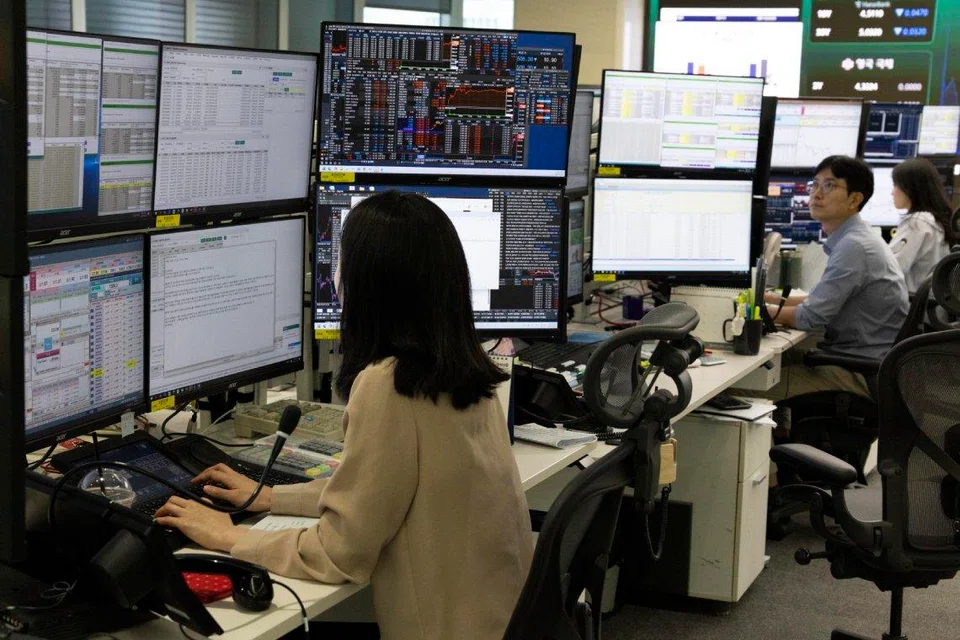
[SEOUL] South Korea’s US$4.9 trillion stock market is starting to flash signs of strain after a world-beating rally.
The Kospi tumbled as much as 6.4 per cent early Friday (Jun 5) as Samsung Electronics and SK Hynix sank more than 7 per cent, outsized moves that show how volatile the index has become. The exchange briefly halted the Kospi programme selling as futures sold off.
The Kospi surged more than 100 per cent this year to Thursday but gains have been concentrated in the two chip heavyweights, making the market vulnerable to a sudden waning of momentum in the artificial intelligence trade.
Retail participation is also losing some steam, while surging margin loans face the risk of a Bank of Korea rate hike. The rise of leveraged exchange-traded funds, designed to magnify daily moves, may further intensify any reversal, analysts say.
“For now, I am more concerned about signs of overheating in market positioning than a deterioration in fundamentals,” said Ha SeokKeun, chief investment officer at Eugene Asset Management in Seoul. “I expect a period of increased volatility and consolidation over the next one to two months.”
Market breadth is the central worry. Samsung Electronics and SK Hynix, enjoying AI-driven chip demand, account for 54 per cent of the Kospi’s market weight and roughly half of the gauge’s average daily turnover in May, according to Korea Exchange data. Nearly three-quarters of its gains this year have come from the two firms.
Single-stock leveraged ETFs tied to Samsung and SK Hynix are adding to concerns. The four most popular single-stock ETFs accounted for 21 per cent of the total ETF turnover in South Korea in their first five sessions after launching May 27, exchange data show.
“The current market structure is vulnerable to a downturn as it’s dominated by the short gamma in the leveraged ETFs,” said Kenny Kim, CEO at Meridian One Asset Management. “The setup requires investors to chase rallies with heavy buying when the market rises, but forces them to dump shares when the market falls.”
Fading interest
Retail investors, once key drivers, are showing less willingness to commit fresh cash. Brokerage deposits fell to 121 trillion won (S$101 billion) by May 22 from 137 trillion won on May 12, according to the Korea Financial Investment Association ( KFIA ).



Meanwhile, margin balance hit a record 38 trillion won on May 29, up from 27.3 trillion won at the end of 2025, KFIA data show.
Rising margin loans alone may indicate heightened interest. But the increase, while investor deposits fall, may point to more leverage stress without fresh appetite to take on risk, according to Shawn Oh, an equity sales trader at NH Investment & Securities. “The signal is clear: the cash buffer eroding while active leverage refuses to unwind,” he added.
Still, optimism dominates in South Korea. Appetite for AI-related stocks remains strong, and Wall Street banks remain upbeat on chip earnings. Just this week, Goldman Sachs raised its Kospi target to 12,000 from 9,000.
“The market breadth is indeed narrow, but that will not necessarily stop the benchmark from hitting 10,000,” said Jonathan Pines, head of Asia ex-Japan equities at Federated Hermes.
Another test looms next month, when the central bank is widely expected to raise interest rates. That could dampen liquidity, said Seo Sang-Young, a strategist at Mirae Asset Securities.
“The market is sensitive to bond yields because investments are driven by borrowed money,” Seo said. BLOOMBERG
Decoding Asia newsletter: your guide to navigating Asia in a new global order. Sign up here to get Decoding Asia newsletter. Delivered to your inbox. Free.
Share with us your feedback on BT's products and services
TRENDING NOW

DBS, OCBC, UOB rout lops billions off STI as inflation, rate concerns spook investors

Grab CEO’s wife Chloe Tong on life with Anthony Tan and finding her purpose

OCBC sheds S$8 billion in value as shares close nearly 6% down; analysts cautious on banks

Deal between tycoon friends sparks scrutiny of Philippine power sector

