Stocks in Asia drop again as local regulators rush to stem rout
The declines continued from Friday
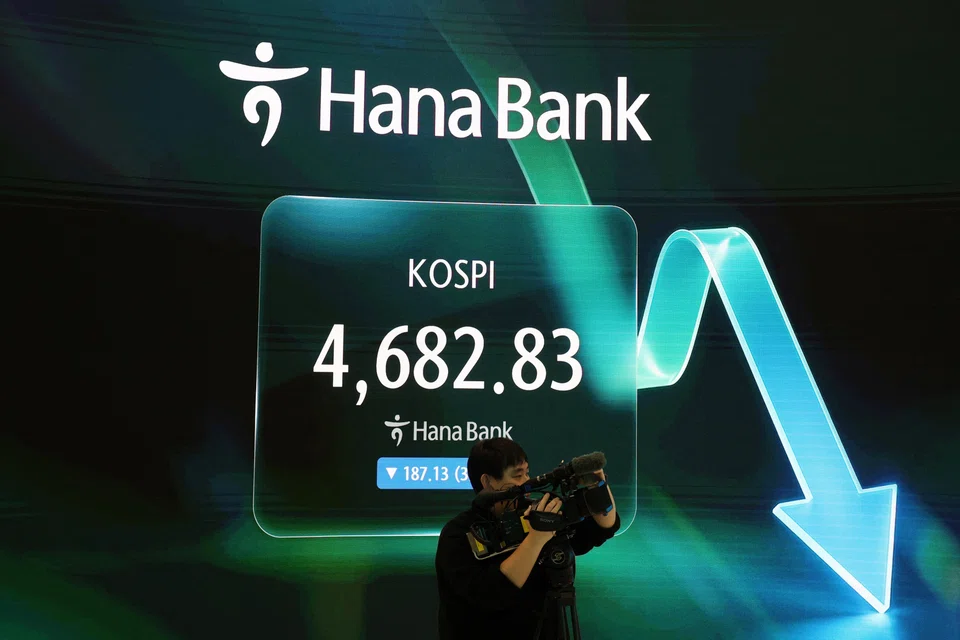
SOUTH Korean and Chinese shares fell as a global technology stock rout intensified, testing Asian authorities’ efforts to restore investor confidence as the AI trade unravelled.
The benchmark Kospi Index dropped as much as 4.4 per cent, following Friday’s losses on Wall Street that sent the S&P 500 into a technical correction and the Nasdaq 100 posting its worst week since March 2020. Korea has trimmed the year’s rally, which at one point reached more than 110 per cent, to just 10 per cent.
Shares in mainland China and Hong Kong also fell over 1 per cent after Monday’s opening bell. Taiwanese stocks fluctuated.
The declines extended Friday’s rout in Asia that later spread to other regions. That prompted regulators in Korea, Taiwan and China to announce measures — from buying equities to widening short-selling curbs — over the weekend to stabilise markets as the profitability of AI trades from chipmakers to hyperscalers gets drastically repriced.
Anthropic PBC’s slide after its much-anticipated debut is emblematic of the turn in sentiment, with investors piling into US Treasuries and other haven assets.
“These interventions are circuit breakers rather than a turning point,” said Dilin Wu, a strategist at broker Pepperstone Group. “These steps may help stabilise prices in the near term, but they can’t reverse a broader reassessment of AI valuations or bring foreign investors back on their own.”

Korean authorities said on Sunday they will ease daily limits on company share buybacks for three months and begin preparations to activate a stock-market stabilisation fund if needed. The rescue fund was last used during the global financial crisis in 2008, according to local media.
Taiwan expanded curbs on short sales of local stocks on Saturday and said it has been buying shares, stepping up efforts to revive confidence after the island’s benchmark index had its worst weekly fall in 35 years.
The local Financial Supervisory Commission imposed a blanket ban on short selling below the previous trading day’s closing price, covering both margin short sales and borrowed shares.


Separately, the island’s NT$500 billion (US$15 billion) National Financial Stabilisation Fund said it has entered the market to support Taiwanese stocks and urged investors to remain confident.
In China, the minimum margin requirement for investors buying securities with borrowed funds will fall to 80 per cent from 100 per cent on Nov 30, according to notices issued on Sunday by the Shanghai, Shenzhen and Beijing stock exchanges with approval from the China Securities Regulatory Commission. The exchanges had raised the ratio to 100 per cent from 80 per cent in January to curb leverage risks.
Regulators said the latest adjustment is related to a marked decline in margin-financing activity and relatively low overall leverage. Brokerages can apply the revised rules to outstanding financing contracts when calculating available margin balances, while investors engaged in abnormal trading may face stricter requirements and other risk controls.
The change could unleash nearly 400 billion yuan (US$60 billion) in additional funds, the Xinhua News Agency reported on Sunday, citing the regulator.
Meanwhile, the Shenzhen Stock Exchange is proposing introducing market makers on the ChiNext board, according to draft rules released for public comment. The system is intended to broaden the pool of market participants, improve liquidity and pricing efficiency, and strengthen the market.
“The support measures appear more sentiment- and liquidity-oriented than fundamentally market-changing,” said Fu Zhifeng, chief investment officer at Shanghai Chengzhou Investment Management.
“The market-making measure may provide only marginal liquidity support, while lowering the minimum margin requirement for securities financing from 100 per cent to 80 per cent mainly eases near-term forced-selling pressure and provides investors more time to meet margin calls, rather than bringing meaningful new capital into the market.”
The moves add to a series of efforts by Beijing to restore confidence after a months-long rout pushed the benchmark CSI 300 Index into a bear market.
The gauge tumbled over 8 per cent in October, its worst monthly performance in more than a decade, as weakness in the economy and a sharp reversal in tech shares weighed on sentiment. BLOOMBERG
Decoding Asia newsletter: your guide to navigating Asia in a new global order. Sign up here to get Decoding Asia newsletter. Delivered to your inbox. Free.
Share with us your feedback on BT's products and services