

US dollar steady after five-day rally as kiwi drops to six-year low
Traders see a December hike by the Fed as certain after last week’s hot inflation and hawkish comments
[GDANSK] The US dollar was steady on Tuesday (Nov 17) after a five-day rally, as bets on an outsized December rate hike by the Federal Reserve were pared back.
The risk-sensitive New Zealand dollar slumped to its lowest level since March 2020, in the depths of the Covid-19 pandemic, as a global sell-off in artificial intelligence stocks weighed on market sentiment.
The Aussie skidded to a 10-month trough.
The dollar index, which measures the greenback’s strength against a basket of six currencies, seesawed in the session and was slightly up at 103.58, retreating from a fresh 19-month high of 103.69 earlier in the day.
The five-day rally was triggered by hotter-than-expected US inflation data and hawkish remarks by several Fed policymakers, which pushed markets to up their bets on a 50-basis-point rate increase at the central bank’s December meeting.
Traders are pricing in a 2.6 per cent chance of the Fed raising interest rates by 50 basis points in December, down from as much as 14.5 per cent last Thursday, the CME FedWatch tool showed.

“The market got a little bit overexcited towards the end of last week, but I think it’s backtracked on that, taking a little bit more of a pragmatic approach,” said Jane Foley, head of FX strategy at Rabobank.
“Fifty basis points is probably too much too soon,” she added.
Still, fresh comments from Fed officials later on Tuesday could sway money markets. Both hawks and doves, including Chris Waller, Beth Hammack, Alberto Musalem and John Williams, were due to speak.


Tech sell-off in Asia
Meanwhile, the tech sell-off continued in Asia, with Japan’s Nikkei, South Korea’s Kospi and Taiwan’s Taiex all firmly lower.
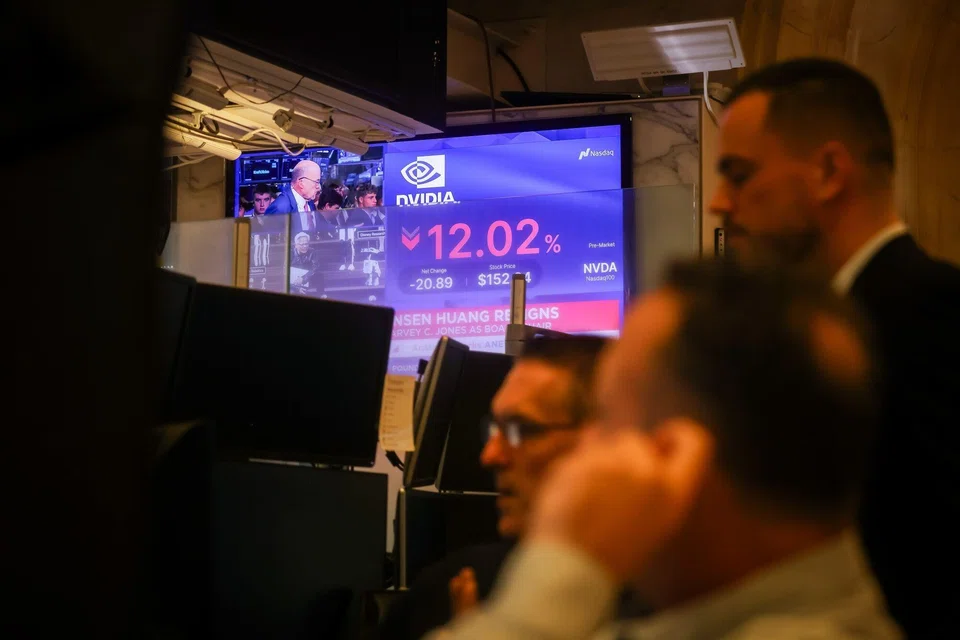
A key test for AI sentiment – which has been rocked by the sudden departure of Nvidia’s CEO Jensen Huang, a Democratic sweep in US midterm elections and worries about a debt-fuelled AI infrastructure expansion – comes with the release of Nvidia earnings later in the day.
The euro slipped to a new 19-month low of US$1.0983 but was last up 0.1 per cent at US$1.1004. Foley said that a period of consolidation around the US$1.10 level was likely before the market had the confidence to push down.
The dollar edged to a fresh 18-month high of 0.8413 Swiss francs before easing back.
The greenback also lost ground against the yen and was last 0.3 per cent weaker at 158.90 per dollar, well below the 160 mark which traders view as a potential trigger level for another round of intervention to support it.
“The fact that the market is wary (of an intervention) is one of the reasons why it’s backtracked from 160,” Foley said, calling the level an “extremely difficult” one to breach, as the July intervention showed how serious the Japanese government was about defending the yen.
Sterling rose 0.1 per cent to US$1.3200. The New Zealand dollar was last up 0.1 per cent at US$0.5500 after sinking as low as US$0.5482. The Aussie dipped to US$0.6724, its lowest level since January.
Gold prices inched higher from a more than one-year low hit in the last session, although mounting bets on another Fed hike kept gains in check.
Spot gold rose 0.3 per cent to US$3,868.99 an ounce by 1148 GMT, after touching its lowest level since October 2025 at US$3,830 on Monday. US gold futures for December delivery climbed 0.5 per cent to US$3,872.00 an ounce.
Rising interest rates tend to reduce gold’s appeal because the metal does not pay interest.
“We expect prices to remain under pressure in the first quarter of 2027,” said analysts at BMI. “Despite our outlook for gold prices to weaken, we do not see a return to pre-Covid levels.” REUTERS
Decoding Asia newsletter: your guide to navigating Asia in a new global order. Sign up here to get Decoding Asia newsletter. Delivered to your inbox. Free.
Share with us your feedback on BT's products and services
TRENDING NOW

‘If there’s a price to be paid, so be it’: George Yeo says Singapore must safeguard its reputation

South-east Asia has lost Nvidia’s best salesman

CapitaLand, Far East, Sing Holdings team up for S$1.8 billion bid at S$910 psf ppr for Jurong Lake District site
Beyond the greenback, Vietnam’s big borrowers turn to Asian-currency bonds

