

US-Iran peace deal: S-Reits, aviation stocks, developers on investors’ radar as potential winners
The Straits Times Index is up 1% or 51.49 points, closing at 5,077.29


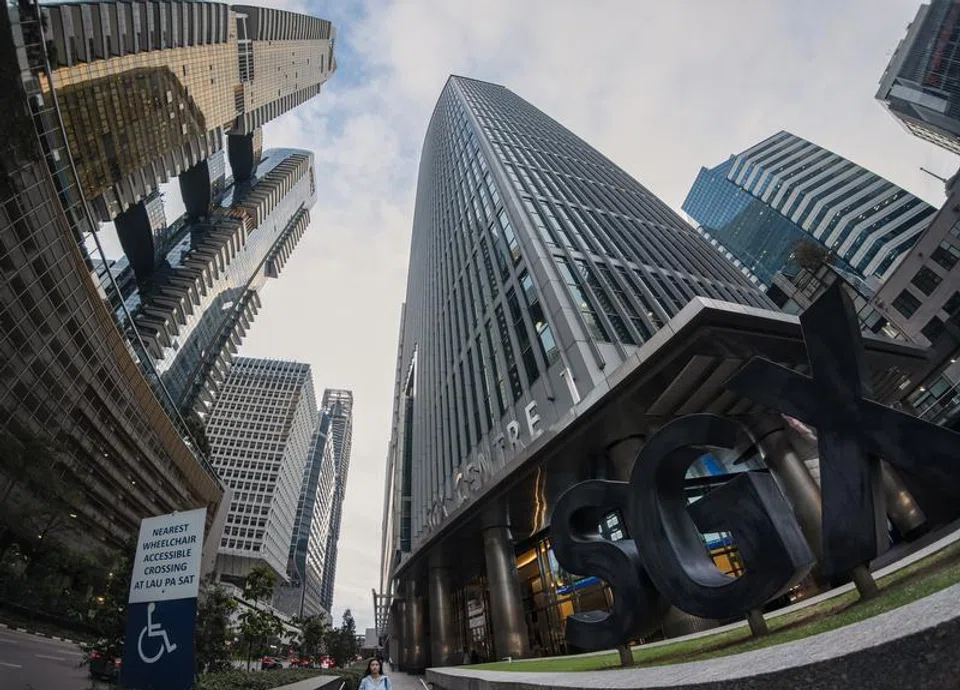
[SINGAPORE] Singapore real estate investment trusts (S-Reits), aviation counters and property developers are set to lead gainers on the local bourse on Monday (Jun 15) after a US-Iran peace deal was announced – though analysts note that much of the geopolitical relief has already been priced in.
The Straits Times Index (STI) rose 1 per cent or 51.49 points, closing at 5,077.29 after easing from an intraday high of 5,095.12.
The top three gainers on the STI were Jardine Matheson , with a 4.3 per cent or US$2.75 gain to US$66 ahead of its investor day; Yangzijiang Shipbuilding , which was up 4.3 per cent or S$0.15 at S$3.60; and Singapore Exchange (SGX), which climbed 3 per cent or S$0.67 to S$23.25.
The worst performer among STI constituents was Keppel DC Reit , which fell 1.3 per cent or S$0.03 to close at S$2.26.
Across the broader market, gainers edged out losers 435 to 196, after 1.5 billion securities worth S$2.1 billion changed hands.
The local market’s upward trajectory comes on the back of confirmation that a formal peace treaty between the US and Iran will be signed on Friday in Switzerland, effectively ending military operations and reopening the blockaded Strait of Hormuz.
The positive sentiment reverberated across the region.
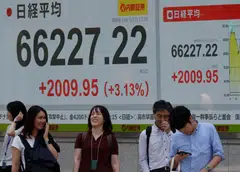
Japan’s Nikkei 225 surged 5 per cent, South Korea’s Kospi rallied 5.2 per cent, Australia’s ASX 200 closed 1.3 per cent higher, and the FTSE Bursa Malaysia KLCI ticked up 0.5 per cent.
Analysts believe the initial oil supply shock has already been discounted by investors, including in the Singapore market.
“The ceasefire is a net positive for the (Singapore) market but largely priced in,” said Glenn Thum, research manager at Phillip Securities Research, pointing to a roughly 20 per cent decline in oil prices from their peak and earlier record highs on the STI.
As oil prices and shipping disruptions begin to correct, analysts are mapping out how different Singapore sectors will fare under the de-escalation.
Aviation to fly high
Plunging fuel costs are set to hand immediate relief to aviation counters.
By 5.30 pm on Monday, Brent crude futures had tumbled 5 per cent to US$82.94 a barrel, and US West Texas Intermediate had fallen 5.3 per cent to US$80.36.
Thum named Singapore Airlines (SIA) the “clear winner” of the peace deal, while RHB Singapore head of equity research Shekhar Jaiswal said that related names in the aviation sector, such as Sats , will benefit from airspace reopening as well.
SIA ended the day 2.4 per cent or S$0.17 higher at S$7.17, and Sats was 2.3 per cent or S$0.09 up at S$4.03.
S-Reits, property
Yield-sensitive S-Reits also stand out as beneficiaries of the geopolitical resolution.
They could be secondary beneficiaries of the ceasefire, “as lower forward inflation could temper expectations of rate hikes”, Jayden Vantarakis, head of Asean equity research at Macquarie Capital, told The Business Times.
Property developers are also expected to see positive impacts from lower rate expectations and sticky safe-haven flows.
Jaiswal noted that Singapore’s structural appeal as a financial centre has been reinforced by the crisis rather than merely benefiting temporarily, meaning those safe-haven capital flows are likely to be sustained.
Offshore and marine, defence gains to moderate
Conversely, sectors that rode on the war’s “urgency premiums” are expected to see their momentum ease. Urgency premium refers to the pressure on exploration and production companies to rapidly deploy capital to secure new supply.
According to RHB, offshore and marine names face a softer outlook as “the urgency premium on exploration and production spending fades at lower oil prices”.
Likewise, Thum said “oil-leveraged names like Seatrium give back the war-driven premium”.
“This should lead to a more disciplined, cost-conscious and restricted capital expenditure,” Jaiswal noted.
Shares of Seatrium ended the day at S$2.00, up 3.1 per cent or S$0.06.
Other shipping counters were also trading higher. Nam Cheong gained 10.3 per cent, Samudera Shipping was up 3.1 per cent and Marco Polo Marine added 2.1 per cent.
Similarly, while defence procurement will remain elevated, the urgency to do so could moderate, RHB said.
Shares of ST Engineering rose 1.6 per cent or S$0.17 to close at S$10.74.
Jaiswal gave a “reduce” rating for both sectors.
Neutral outlook for lenders
After opening higher, Singapore’s banking trio turned in a more moderate performance. DBS edged up 0.4 per cent or S$0.25 to S$63.49; UOB rose 0.8 per cent or S$0.29 to S$38.45 and OCBC gained 0.9 per cent or S$0.21 to S$23.71.
Jaiswal said that banks may see a modestly less favourable net interest margin trajectory.
However, he noted that the wealth management tailwind is structural, not cyclical. This means that lenders with sizeable wealth management exposure such as OCBC and DBS will likely continue to see strong support.
He rated the sector as “maintain”.
Regional optimism, but caution warranted
Despite the market optimism, analysts warned that the period leading up to the Friday ceasefire signing remains critical, with several practical hurdles that need to be addressed before energy markets can fully normalise.
Jaiswal said that even if a deal is reached, significant work remains to restore oil flows.
This includes clearing mines from the Strait of Hormuz, restarting idled production fields and repairing energy facilities damaged during the conflict.
“Until the signing... a degree of caution is warranted,” he said.
Decoding Asia newsletter: your guide to navigating Asia in a new global order. Sign up here to get Decoding Asia newsletter. Delivered to your inbox. Free.
Copyright SPH Media. All rights reserved.
TRENDING NOW

Once staunchly pro-China, Malaysian Chinese businesses are now distancing themselves from Beijing

Looking beyond looming CEO succession, should UOB potentially pursue a transformative merger?

Could stablecoins be the future of money?

Grab CEO’s wife Chloe Tong on life with Anthony Tan and finding her purpose

