

US stocks: S&P 500 ends marginally lower as investors focus on US-Iran war
The three major indices closed mixed for the day
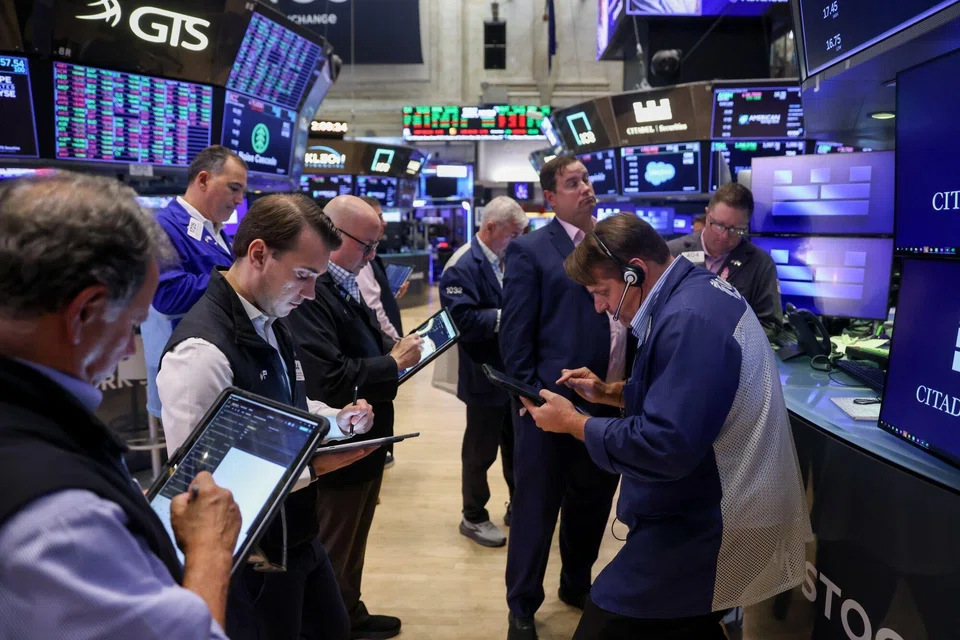
THE S&P 500 ended marginally down on Thursday (Sep 24), with Microsoft dipping and Meta Platforms rising, as uncertainty about the Middle East lifted oil prices and Treasury yields.
The S&P 500 and Nasdaq rebounded from session lows after Reuters reported US and Iranian negotiators were exploring a phased path out of war that would involve Teheran reopening the Strait of Hormuz and Washington lifting its economic blockade of Iran.
US and Iranian leaders exchanged barbs this week at the UN General Assembly. Brent crude prices rose over 3 per cent to nearly US$107 per barrel after a Houthi missile attack on Saudi Arabia revived fears of supply disruptions.
“This just reinforces the view that we’re dealing with one major market catalyst right now,” said Bill Northey, senior investment director at US Bank Wealth Management. “It’s really all about oil and inflation and the effect on interest rates, and then the interest rate cascading across the capital markets.”
AI heavyweights were mixed, with Microsoft dipping 0.5 per cent and Broadcom losing 1.3 per cent, while Advanced Micro Devices rose 2.4 per cent.
Meta Platforms climbed 4.5 per cent, a day after the social media company unveiled a small handheld gadget for use with its recently launched AI assistant.
Oracle fell 3.5 per cent after a report said the company sent a “force majeure” notice to a New Mexico data centre. Shares of Blue Owl, the project’s developer, also fell sharply.
Treasury yields rose, with the 30-year Treasury bond yield reaching its highest since 2004. Higher yields make safe-haven Treasuries relatively more attractive to investors than stocks with uncertain returns.
The S&P 500 declined 0.02 per cent to end the session at 7,704.13 points.

The Nasdaq edged up 0.01 per cent to 26,939.37 points, while the Dow Jones Industrial Average declined 0.31 per cent to 51,349.98 points.
Eight of the 11 S&P 500 sector indexes fell, led lower by materials, down 1.18 per cent, followed by a 0.96 per cent loss in consumer staples.
The S&P 500 this week has traded just under 19 times expected earnings, its lowest valuation since 2023, according to LSEG data. AI-related heavyweights are responsible for much of the recent increase in earnings expectations.
US President Donald Trump welcomed Chinese President Xi Jinping to the White House for a summit expected to be heavy on symbolism but light on substance related to issues including AI, trade, Taiwan and the war in the Middle East.
Data on Wednesday suggesting strong business activity has led to increased expectations the Federal Reserve will raise interest rates again following its 25-basis-point hike last week. Traders are now pricing in a nearly 70 per cent chance of a hike next month, according to the CME FedWatch Tool.
New York Fed President John Williams, who has a vote on the Federal Open Market Committee, on Thursday said it was reasonable to think that the US central bank might need to raise interest rates again before the end of the year.
MGM Resorts slumped 11 per cent after media mogul Barry Diller’s People withdrew its proposal to purchase the casino operator.
Declining stocks outnumbered rising ones within the S&P 500 by a 1.9-to-one ratio.
The S&P 500 posted 14 new highs and 41 new lows; the Nasdaq recorded 53 new highs and 238 new lows.
Volume on US exchanges was 16.8 billion shares traded, compared to an average of 16.7 billion shares over the previous 20 sessions. REUTERS
Decoding Asia newsletter: your guide to navigating Asia in a new global order. Sign up here to get Decoding Asia newsletter. Delivered to your inbox. Free.
Share with us your feedback on BT's products and services
TRENDING NOW

Once staunchly pro-China, Malaysian Chinese businesses are now distancing themselves from Beijing

Looking beyond looming CEO succession, should UOB potentially pursue a transformative merger?

Could stablecoins be the future of money?

Grab CEO’s wife Chloe Tong on life with Anthony Tan and finding her purpose

