

What’s behind the Singdollar’s strength amid the Iran war – and how long will it last?
The currency has emerged as a beacon of regional stability, shielding against geopolitical volatility

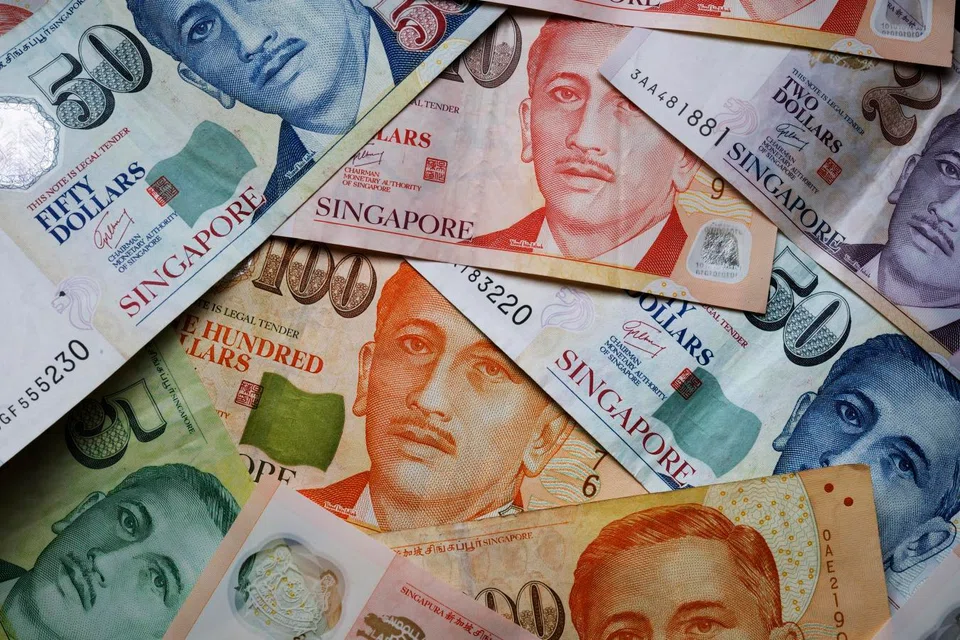
[SINGAPORE] While the ongoing conflict in the Middle East has broadly battered Asean currencies against the US dollar, the Singapore dollar has emerged as a beacon of regional stability, acting as a shield against geopolitical volatility.
Rather than falling back on a simple narrative of Asean weakness, analysts pointed to a split in how regional currencies are weathering the storm, with the Singdollar benefiting heavily from its low-volatility, safe-haven characteristics.
Christopher Wong, forex strategist at OCBC, noted that the Singdollar has behaved like a “regional defensive currency” since the Iran war began.
During the initial “shock phase” of the fighting – defined by Wong as the period from Mar 1 up to the first ceasefire announcement on Apr 8 – the Singdollar held its ground better than most Asian peers.
It recorded its most significant Asean gains against the Philippine peso, rising about 3.4 per cent, followed closely by a 2.7 per cent appreciation against the Thai baht. Gains against the Indonesian rupiah clocked in at 1.6 per cent, while it appreciated 1.2 per cent against the Malaysian ringgit and 0.6 per cent against the Vietnamese dong.
Saktiandi Supaat, head of forex research at Maybank, echoed this sentiment, framing the Singdollar’s performance as “differentiated resilience” across the region.
“The SGD has been one of the more stable currencies, supported by Singapore’s policy credibility, its exchange-rate-centred framework, and some safe-haven characteristics amid geopolitical and oil-related uncertainty,” he said.
Both analysts agreed that the Monetary Authority of Singapore’s (MAS) recent move to slightly steepen the Singapore dollar nominal effective exchange rate, or S$NEER, appreciation path has also anchored this relative strength.
Iran war ceasefire shift
The Iran war ceasefire announcement on Apr 8 triggered a distinct shift in currency dynamics, noted the analysts.
SEE ALSO


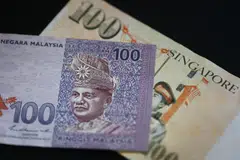
Wong observed that early underperformers, such as the Malaysian ringgit, Thai baht and South Korean won, have already started to recover against the Singapore dollar. Meanwhile, currencies like the Indonesian rupiah and Philippine peso continue to trade under pressure.
“That pattern reflects a shift from risk aversion and oil anxiety towards a more selective relief rally,” Wong explained.
The Malaysian ringgit’s trajectory highlights a notable pivot in the bilateral exchange rate. In March, Minister of State for Trade and Industry Alvin Tan noted that the Singdollar appreciated against the ringgit at an average annual rate of 1.3 per cent between 2020 and 2025.
However, prior to the recent geopolitical shock, the Malaysian ringgit had surged. While the Iran war pushed the Singdollar back above 3.11 against the ringgit, higher energy prices and robust domestic demand position the ringgit to continue strengthening.
Saktiandi maintained his bullish view on the Malaysian currency, noting that market watchers should expect it to be resilient and “in fact at times be stronger than SGD”.
Uneven business impact
For Singapore, a firmer currency presents a double-edged sword. On the domestic front, it is a clear boon for blunting imported inflation.
Both analysts highlighted that a strong Singdollar helps ease cost pressures for fuel, food and raw materials, and supports consumer purchasing power for imported goods and overseas travel.
For businesses, however, the impact is uneven. While import-heavy sectors benefit, the sustained strength of the local dollar threatens to squeeze margins and erode the competitiveness of Singapore’s exporters.
Wong also pointed out that for Singapore firms with overseas operations in the region, “SGD strength may not be as helpful when profits are translated back”.
This uneven impact is already playing out in Indonesia. On Apr 15, the rupiah hit a fresh low of about 13,500 against the Singdollar, weighed down by rising oil prices linked to the Iran war and global capital outflows.
While this curtails imported inflation from Singapore’s massive neighbour, it directly threatens the local medical tourism sector as elective procedures and travel to the city-state become significantly more expensive for Indonesian patients.
Looking ahead, Wong noted that the Singdollar’s relative resilience can last as long as two conditions hold.
“First, effects of tighter MAS policy should further help anchor relative SGD strength; second, the geopolitical backdrop remains uncertain enough to keep demand for lower-beta Asian currencies intact,” he said.
However, once the immediate geopolitical stress fades, investors are expected to rotate back into pro-cyclical, trade-sensitive currencies linked to tech and global growth, he added.
“Then, SGD strength may fade and could even underperform some of the higher-beta currencies on a relative basis once markets move from ‘defence’ to ‘rebound’,” Wong noted.
Saktiandi, too, cautions that the Singdollar’s dominance will not last forever.
“I wouldn’t see this as a one-way move,” he said. “Over time, as external conditions stabilise and the USD cycle evolves, regional currencies should also find support.”
Decoding Asia newsletter: your guide to navigating Asia in a new global order. Sign up here to get Decoding Asia newsletter. Delivered to your inbox. Free.
Copyright SPH Media. All rights reserved.
TRENDING NOW

DBS, OCBC, UOB rout lops billions off STI as inflation, rate concerns spook investors

Grab CEO’s wife Chloe Tong on life with Anthony Tan and finding her purpose

OCBC sheds S$8 billion in value as shares close nearly 6% down; analysts cautious on banks

Deal between tycoon friends sparks scrutiny of Philippine power sector

