

Why US$100 oil, 5% US yields affect Singdollar, ringgit differently vs other Asean currencies
High energy prices, elevated borrowing costs are causing a divide in regional currencies, say analysts

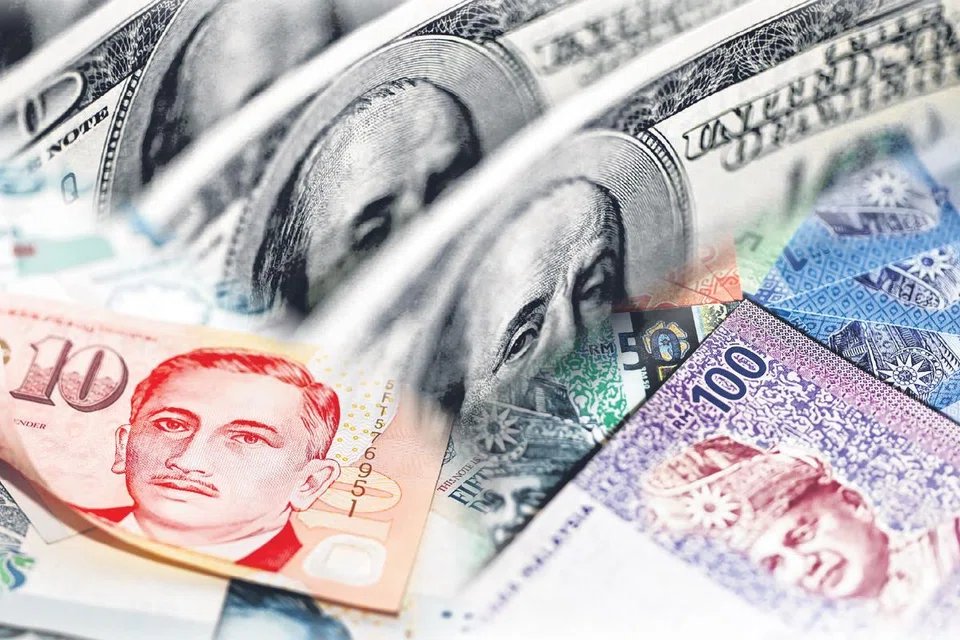
[SINGAPORE] Global financial markets are confronting a dual shock: crude oil prices soaring past US$100 a barrel and the US 10-year Treasury yield crossing 5 per cent for the first time in three years.
While an expected easing of the US dollar was anticipated to provide a softer backdrop for Asean markets, persistent energy costs and surging global yields are instead driving a sharp divergence across regional currencies.
Oil prices surged more than 6 per cent after drone attacks on Monday (Sep 14) by the Iran-backed Houthis knocked out a key Saudi Arabia pipeline bypassing the closed Strait of Hormuz, while planned talks between Gulf Arab states and Iran were postponed.
Brent futures traded above US$105 a barrel, while the West Texas Intermediate hovered near US$101.
Compounding the energy shock, the US 10-year Treasury yield crossed 5 per cent on Tuesday, driven by stubborn inflation concerns and heavy borrowing demand from the public and private sectors. Traders are bracing themselves for the US Federal Reserve to hike interest rates on Wednesday in response to inflation fears.
Analysts also noted that elevated long-term US yields reflect growing investor concerns over US fiscal sustainability – a dynamic that complicates foreign-exchange movements across emerging markets.
As demand for US bonds falls and yields rise, capital is typically drawn into the US dollar, causing capital outflows from emerging market currencies.
“The tougher episodes are when several shocks hit together,” said Christopher Wong, FX strategist at OCBC. “A weaker US dollar can help regional currencies, but that support can quickly be offset if oil and US yields are rising at the same time.”
Why are Asean currencies diverging?
The growing split across Asean comes down to underlying balance-of-payments (BOP) dynamics, trade accounts and capital flows, say analysts.



Even with US$100 oil, the outperformers – the Singapore dollar, ringgit and dong – have held up relatively well against the greenback.
DBS analysts on Sep 10 noted that Singapore has benefited from durable BOP surpluses, strong foreign direct investment (FDI) inflows and artificial intelligence-driven export tailwinds, alongside proactive monetary tightening by the Monetary Authority of Singapore.
Malaysia, as a net oil and gas exporter, has seen its trade surplus cushioned by higher energy prices. Meanwhile, Vietnam’s dong is anchored by persistent FDI and passive fund inflows ahead of its FTSE Russell secondary emerging market reclassification on Sep 21.
The underperformers amid soaring oil prices – the Philippines, Thailand and Indonesia – are heavy oil importers whose currencies face strong headwinds.
The Philippines and Thailand have seen current account positions deteriorate under rising import bills. The Philippines has also grappled with weak portfolio investor appetite amid domestic governance challenges, while Thailand’s acute current account pressures are only partially offset by post-election FDI interest.
Indonesia’s rupiah, while weighed down by a wider second-quarter current account deficit, has shown signs of stabilising due to capital inflows into debt instruments and Bank Indonesia Rupiah Securities, noted DBS.
What lies ahead?
Market watchers emphasise that the critical variable for Asean economies is not whether oil has breached US$100, but how long energy prices remain elevated.
“A short-lived spike is manageable,” said OCBC’s Wong. “A prolonged period of high oil, especially if it comes together with higher US yields and renewed US dollar strength, would be more challenging and would likely result in greater differentiation across Asean currencies.”
Despite currency pressures, regional central banks may have limited appetite for aggressive interest rate hikes.
DBS analysts expect reduced scope for currency-driven monetary tightening, noting that domestic inflation will become the primary focus for policymakers in the coming months.
Beyond global commodity prices, supply-side factors could keep inflation sticky. Saktiandi Supaat, head of FX research and strategy at Maybank, warned that weather-related El Nino disruptions to agriculture, water supplies and electricity generation warrant close monitoring.
To navigate these headwinds, he said that sustained investment, credible policy responses and sound fiscal management will remain vital buffers for Asean economies.
Decoding Asia newsletter: your guide to navigating Asia in a new global order. Sign up here to get Decoding Asia newsletter. Delivered to your inbox. Free.
Copyright SPH Media. All rights reserved.
TRENDING NOW

Government to bring forward raising of retirement age, give employers more financial support to create flexi-load jobs

If Europe goes to war, the fallout will be felt in East Asia

Indonesia stocks suffer worst plunge in nearly 30 years as MSCI proposes standalone status

Vietnam’s northern provinces, not Hanoi or Ho Chi Minh City, are powering near 10% GDP growth

