

Liquidated Robinsons owner's priority claims paid in full; unsecured claims get 3.295% on the dollar

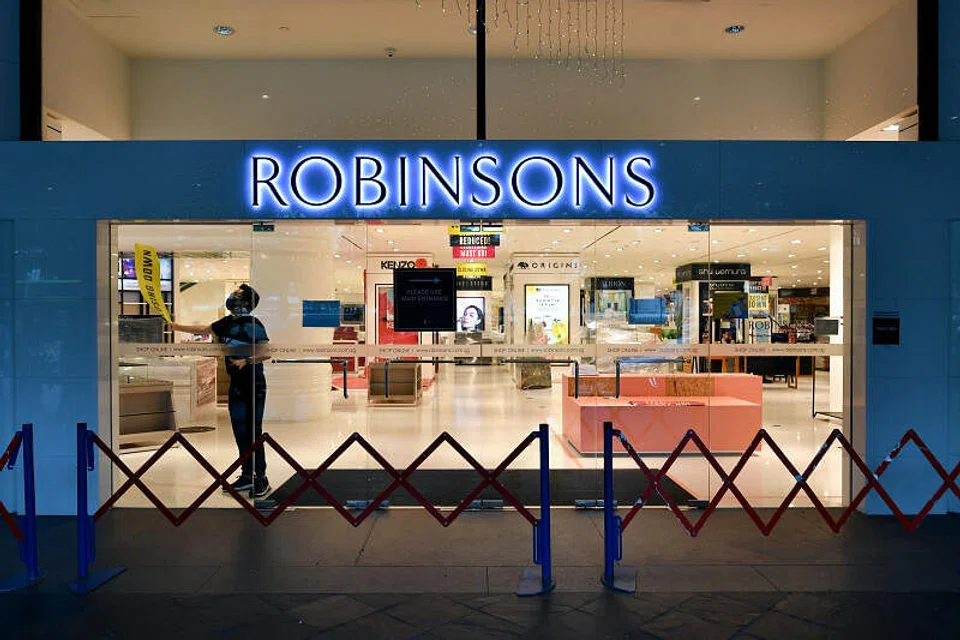
ALL the seven priority claims totalling S$2.65 million filed in the liquidation of the owner of Robinsons department stores were settled in full. In contrast, only S$152.94 million of the S$243.3 million unsecured creditor claims filed were successful, and these only got back 3.295 per cent.
A total of 594 creditor claims were filed in the liquidation, with priority claims and unsecured creditor claims numbering seven and 587 respectively, said Cameron Duncan, a partner at KordaMentha, the liquidator for Robinson & Company (Singapore).
Robinson & Co had owned and operated Robinsons department stores till the century-old firm went into liquidation last October.
All the priority claims were 100 per cent paid, the first and final notice of dividends (the proceeds from the realisation of the assets) published in the government gazette showed.
Examples of priority claims are the expenses and costs of winding-up - including liquidator's fees - employees' wages and remuneration up to the statutory imposed S$13,000 priority cap, and taxes.
The unsecured creditor claims included those from employees for the balance of their claims exceeding the S$13,000 priority cap, landlords, trade creditors and parties who provided unsecured funding to Robinson & Co.
The valid unsecured creditor claims got 3.295 cents on the dollar recovered.
No creditors have appealed against the adjudication decisions, Mr Duncan told The Business Times.
After completing its investigations as part of the liquidation process, KordaMentha concluded that Robinsons had remained solvent since 2015 due to access to funds from either related parties or bank facilities.
But the loss of the ability to access the bank facilities in October 2020, and the unwillingness of related parties to continue funding the trading losses caused Robinsons' failure.
Felicia Tan, a partner at boutique law firm TSMP Law who is not involved in the Robinsons liquidation, said: "These days, you'll be lucky to get anything between twenty and thirty cents on a dollar, it is that bad. A lot of the actual cases average from eight cents to 15 cents to 20 cents. In a liquidation process, the company has almost no funds."
A creditor can begin winding-up proceedings, if owed at least S$15,000. However, directors of a company would need to file a statutory declaration if the company applies for liquidation to vouch that it is unable to continue its business due to its liabilities, without hitting the S$15,000 threshold. This is known as creditors' voluntary liquidation.
Robinsons was a creditors' voluntary liquidation. The finalisation of the Robinsons liquidation occurs without the need for a court process.
In a creditors' voluntary liquidation, the company directors make an assessment that the company is insolvent or likely to become insolvent and pass resolutions to put the company into provisional liquidation.
The liquidation is then confirmed by a subsequent meeting of shareholders, followed by a meeting of the creditors. At the meeting, the creditors have an opportunity to decide if they want to keep the liquidator nominated by the company or if they wish to change the liquidator.
After the final meeting of creditors is held, a Notice of Dissolution of Company is lodged with the Accounting and Corporate Regulatory Authority and the official receiver (a regulator in compulsory and voluntary winding-up who monitors the liquidator's conduct to ensure that he performs his duties and complies with the law). After three months, the company is dissolved.
Read More:
Robinsons owes S$31.7m to 442 creditors
Robinsons Singapore says goodbye after 162 years
- Robinsons owes S$31.7m to 442 creditors
- Robinsons Singapore says goodbye after 162 years
TRENDING NOW
Prima to move out of historic Keppel Road flour mill building in 2028

Temasek-related Azalea, SeaTown, Seviora Capital to merge in 2027
Family offices see more tailored products, leverage ‘collective firepower’ for direct deal access

Singapore room rates soar, but hotels seeing mixed demand from F1 race and events

