‘The customer wishes to be recognised’: Cold Storage, Giant in Singapore to focus on ‘superior’ customer service, says buyer Macrovalue
As the acquirer reaps economies of scale from larger import volumes, consumers can expect lower prices and a wider range of products in turn

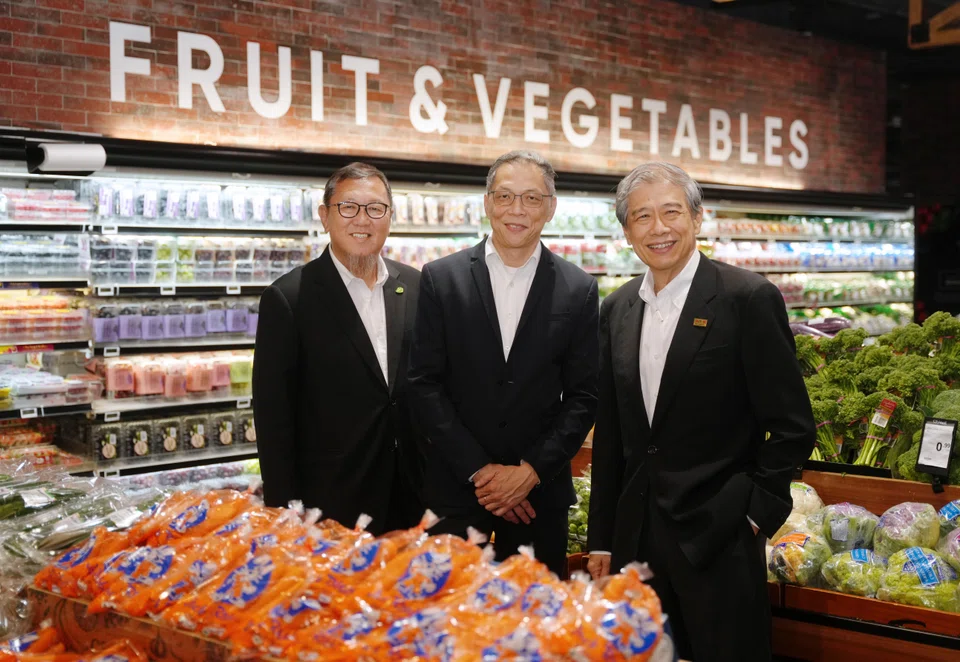
[SINGAPORE] Cold Storage and Giant in Singapore will set themselves apart from their competitors by providing “superior” customer service and elevated offerings, said one of the two co-owners of Malaysian retail group Macrovalue, which is buying over the supermarket chains from DFI Retail Group.
“When you walk into a Cold Storage, you must feel like you’re (boarding) Singapore Airlines,” Andrew Lim said in a press interview on Tuesday (Mar 25), a day after the deal was announced.
Such stellar service standards will therefore be the unique selling proposition of Cold Storage and Giant, he said, adding that this can be achieved by investing in staff training. This means building better relationships with customers and “humanising” the grocery shopping experience for them.
“The customer wishes to be recognised… You don’t want to go somewhere in a hypermarket and be treated like a unit of consumption.”
On Monday, Singapore Exchange-listed DFI Retail Group said it will sell all its Cold Storage and Giant stores in Singapore, as well as two distribution centres, to Macrovalue for S$125 million.
The stores comprise 48 Cold Storage outlets – including the CS Fresh, CS Fresh Gold and Jasons Deli brands – and 41 Giant stores. There will be no retrenchments or changes in management following the acquisition.
As Lim sees it, Macrovalue has now come full circle with its purchase of DFI’s Singapore food business, given that the group already owns Cold Storage’s and Giant’s operations in Malaysia.
Macrovalue was set up in 2022 by Lim and entrepreneur Gary Yap. In 2023, it bought Malaysia-based GCH Retail Group – the operator of the Giant, Cold Storage and Mercato chains in the country – from DFI for an undisclosed sum.
“So now, what we’re doing is that we are merging back again with Singapore – we’re coming home,” Lim said.
The businessman is also the group deputy chairman of department store Sogo Kuala Lumpur and the executive chairman of Gama Group, which operates Gama Supermarket & Departmental Store in Penang.
Cheaper products, wider range
As Macrovalue reaps economies of scale from larger import volumes, Singapore consumers can expect lower prices and a wider range of products at Cold Storage and Giant outlets in turn, said Lim Boon Cheong, managing director of Cold Storage.
“If we combine our volumes, we will be able to source for more products because Singapore in itself is a very small market for many big exporters,” he said. The group also intends to tap Malaysia’s logistics and supply chain capabilities.
In addition, Singaporeans today desire better products and services, noted Macrovalue’s Lim.
Cold Storage is therefore well-placed to capture this demand through its slate of more premium offerings, he said. Likewise, the group intends to offer higher-quality products in the more mass-market Giant within its price bands.
Still, what both supermarket chains need to work on is fostering a stronger human connection between staff and customers.
“If you come into our stores and our staffers recognise you… you’d be happy. You can get delivery any day, but you want to have a human connection.”
Such a goal, while understandably challenging, is within reach for the group, Andrew Lim added, noting that his retail employees in department store Gama recognise regular customers as “old friends”.
Given Singapore’s multi-religious and multicultural landscape, retailers also need to tailor their merchandising and promotion plans to cultural norms – and Andrew Lim believes Macrovalue can do this better than its competitors, given his extensive retail-management experience in Malaysia.
For instance, his Sogo department store in Kuala Lumpur leaves mats at strategic spots around its outlet during Ramadan to invite Muslims to break fast there.
Since taking over DFI’s Malaysia supermarket business, which was loss-making at that time, Andrew Lim has made key changes to the Giant hypermarkets in the country.
One involved Macrovalue restructuring the space of certain Giant hypermarkets to hold lifestyle activities such as pickleball to draw more customers. The group also decided not to renew the leases of some Giant Minis – a smaller-format store under the brand – in Malaysia as they were not as profitable, he said.
Managing profitability
DFI’s latest divestment to Macrovalue comes even as the group’s supermarket operations in Singapore returned to profitability in the fourth quarter of 2024.
In a results update on Mar 10, DFI’s group chief executive Scott Price attributed the segment’s “significant” recovery in FY2024 to an improved sales mix, effective cost-control measures, and store portfolio optimisation.
For the full year ended December, DFI posted an underlying profit of US$200.6 million, up from US$154.7 million the year before. This was despite full-year revenue slipping to US$8.9 billion, from US$9.2 billion.
However, it posted an overall net loss of US$244.5 million against a net profit of US$32.2 million in FY2023.
With the sale of its Singapore food business, DFI said on Monday that it will pivot its focus and resources in the Republic towards its Guardian and 7-Eleven businesses.
On a group level, operating profit for its health and beauty segment stood at US$210.8 million for FY2024, while its convenience store segment brought in US$102.3 million. This is compared with US$57.8 million for its food business, which comprises all its supermarket brands.
When asked how Macrovalue will manage profit margins for its supermarkets in Singapore, Lim Boon Cheong of Cold Storage said that the group’s focus rests squarely on its customers.
“If we do our work well and serve our customers well… the numbers will look after (themselves),” he said.
The group is not fazed by competition in the grocery space, either. Manpower shortage and rising business costs persist for supermarket players across the board, he added, saying that Macrovalue will manage these challenges “to the best of its ability”.
Macrovalue’s Lim said the acquisition of DFI’s Singapore food business was not funded by debt. To support future expansion in the Republic, the group may turn to Singapore and Malaysia banks for financing. There are plans to open more Cold Storage and Giant outlets across the island, with the group now actively scouting for locations.
Andrew Lim expects to recoup his investment by the third quarter of this year, though this is not his priority.
“When you focus on money, you lose the proposition. The proposition is to create value-add, to create better customer service; we’ll recoup the money when we recoup the money.”