DBS Q3 profit falls 5% to S$2.81 billion on weaker trading income, misses forecasts
The bank will pay S$0.81 per share in dividends for the period

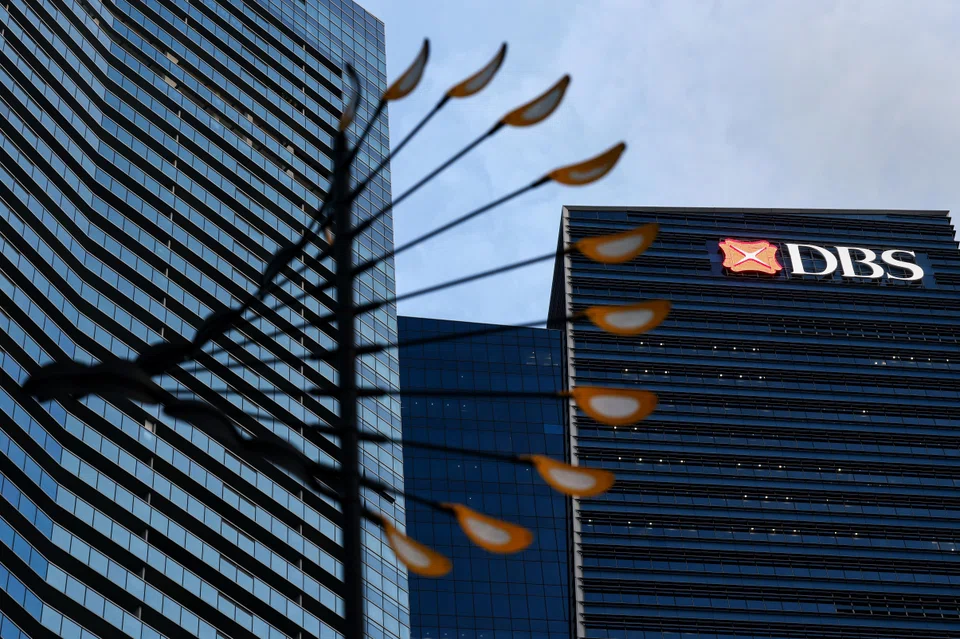
[SINGAPORE] DBS’ net profit for its third quarter fell by 5 per cent as growth was offset by lower markets trading income amid unfavourable equity market conditions, it said on Thursday (Nov 5).
Net profit for the three months ended Sep 30, 2026, stood at S$2.81 billion, compared with S$2.95 billion in the year-ago period.
The earnings missed the S$2.95 billion consensus forecast in a Bloomberg survey of eight analysts.
The lender declared a dividend of S$0.81 per share for the period, comprising an ordinary dividend of S$0.66 and a capital return dividend of S$0.15.
This is up from the S$0.75 per share paid out in the year-ago period, comprising an ordinary dividend of S$0.60 and a capital return dividend of S$0.15.
Group net interest income in Q3 2026 rose 4 per cent to S$3.71 billion, as hedging and strong balance-sheet growth more than offset the impact of the Singapore Overnight Rate Average (Sora) being lower.

Group net interest margin (NIM) was down nine basis points (bps) at 1.87 per cent for the quarter, from 1.96 per cent in the previous corresponding period.
DBS CEO Tan Su Shan noted that the bank’s net interest income had passed its trough, with its exit NIM reaching 1.9 per cent at the end of Q3 2026.
For the commercial book, net fee and commission income was up 6 per cent at S$1.43 billion, while treasury customer sales and other income rose 19 per cent to S$685 million.
SEE ALSO




Meanwhile, markets trading income declined 65 per cent to S$152 million due to unfavourable market conditions, noted DBS.
The bank’s non-performing loans ratio was 0.9 per cent, down from 1 per cent in the same period a year ago.
The Common Equity Tier-1 ratio was 15.9 per cent based on transitional arrangements, while the pro-forma ratio on a fully phased-in basis was 14 per cent.
On Wednesday, the Monetary Authority of Singapore reduced the operational risk multiplier imposed in relation to past digital disruptions to 1.5 times from 1.8 times, following “significant progress” by DBS to strengthen its technology and operational risk controls and improve service reliability and disruption response.
Adjusting for this, the ratios at Sep 30 would have been 16.1 per cent under transitional arrangements and 14.1 per cent on a fully phased-in basis.
Outlook
Looking ahead, DBS expects total income growth to be in the mid-single-digit range in 2027.
The bank assumes that there will be two more rate hikes in the US from now till end-2027, with Sora averaging at around 1.6 per cent and the Singapore dollar further strengthening.
The lender expects loan and deposit growth to support net interest income, alongside continued expansion in wealth management.
It also expects prudent growth in its coverage of companies in the financial institutions group, and technology, media and telecommunications sectors.
Meanwhile, 2027 cost-income ratio is targeted to be in the in low-40 per cent range with mid-single-digit expense growth, and specific provisions to be within 17 to 20 bps.
Tan noted that the outlook has become more uncertain amid elevated energy prices, tighter financial conditions and geopolitical risks, even as the global economy has remained resilient.
“As we enter 2027, we will stay nimble to capture opportunities while prudently managing risks,” she said.
In a separate filing on the Singapore Exchange, the bank also announced that Peter Seah will retire from his role as chairman of DBS’ board after 16 years in the role. He will be succeeded by current board member Anthony Lim on Jan 1, 2027.
Shares of DBS closed 0.1 per cent or S$0.10 lower at S$70.78 on Wednesday.
Decoding Asia newsletter: your guide to navigating Asia in a new global order. Sign up here to get Decoding Asia newsletter. Delivered to your inbox. Free.
Copyright SPH Media. All rights reserved.