

Dividends or growth? EQDP fund managers say capital allocation is key to valuations
SID Chairperson Guild Forum panellists weigh in on how listed firms should use their cash
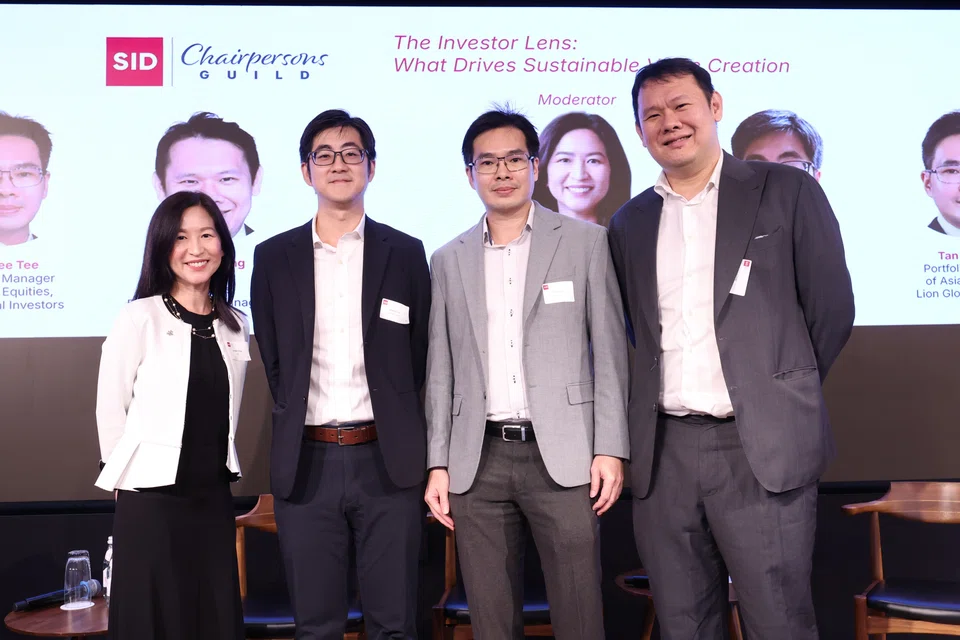
[SINGAPORE] Listed companies should either reinvest cash where returns beat the cost of capital or return it to shareholders instead of letting it sit idle, said fund managers under the Monetary Authority of Singapore’s (MAS) Equity Market Development Programme (EQDP) at a panel.
This comes as investors are ultimately still looking for growth.
“Typically, you would be able to find some avenues to invest in for future growth and when your earnings start to improve, your cash flow improves, (which) allows you to pay higher dividends over time,” said Shawn Ang, director of equities at Fullerton Fund Management. “That creates a more virtuous cycle which market participants would prefer.”
He was speaking as part of a panel at the SID Chairperson Guild Forum on Thursday (Oct 1), moderated by Lee Wen Ching, executive director and equity strategist at UBS.
Lee noted that many Singapore-listed companies sit on substantial cash and asked panellists whether they should pay a special dividend, raise ordinary dividends, buy back shares or do none of these and instead reinvest for stronger growth.
The SID forum gathered chairs of SGX-listed companies alongside fund managers participating in the Monetary Authority of Singapore’s EQDP.
Participants looked at how boards and management can unlock enterprise value, and at what investors want to see in lasting value creation.
The SID Chairpersons Guild is a community of practice for chairs of listed companies. It brings chairs together to learn, share and exchange perspectives with one another and with subject experts. It now counts 180 chairs as members.
Ang said at the panel that a cash pile is a “blessing”, because it gives a company options. A special dividend, he added, is “one and done” because it depletes the cash pile while investors prefer payouts that are sustainable.

“The question is: Which of these options leads to the best outcome?” he noted.
He framed the decision as one of capital allocation, whether buying back shares or investing for growth is the better use of the money, and if neither is, whether to pay a special dividend.
Speaking for himself, Ang said that he would also like to see a higher valuation multiple. “Ultimately it goes back to capital allocation and what is the base use of capital,” he noted. “If you can use it to reinvest into higher growth because it will drive your earnings, return on equity and potentially multiple.”
Fellow panellist and EQDP manager Tan Lee Tee, portfolio manager of Asian equities at Lion Global Investors (LGI), agreed with Ang on growth. “We want the companies here to grow,” he said.
But growth spending needs discipline, he added. Companies should have a robust capital allocation framework and invest only when a project can earn a return on invested capital above the cost of capital. With the cost of capital having risen, he noted, that hurdle is now higher.
“Pay out the dividend first”
Tan also called for more share buybacks, which are common in the US. But in Singapore, they are concentrated among large-cap stocks. He described them as “a very powerful signalling tool”.
If a company believes its shares are undervalued, he said, buying them back is like investing in a very good business at a very cheap valuation. When shares trade below book value, Tan said, a buyback can be a better outcome than investing in the existing business at book value.
Ang added that buyback tells investors that the best use of the company’s capital is its own shares because management believes the business can generate enough earnings to meet the hurdles associated with return on invested capital and return on investment.
Another panellist was Sherman Lim, portfolio manager for Singapore equities strategy at Avanda Investment Management. He noted that he had no strong preference between dividends and buybacks as it depends on each company’s circumstances.
Where liquidity or free float is already low, he understands the hesitance to buy back shares.
What matters more to him, Lim said, is the sustainability that Ang raised earlier – not leaving all the economic profits as cash on the balance sheet.
“It is about equitably sharing the profits of the company with minority shareholders like us, and consistently doing that will afford you a higher valuation over time,” he added.
However, LGI’s Tan indicated that many companies and their chairs are concerned about what would happen if new opportunities arise. They want to preserve cash for opportunities that could emerge in the future, even if there are none immediately in sight.
But circumstances have changed, he noted. With the EQDP, a significant amount of capital is now sitting with fund managers looking to deploy it into growth projects.
Companies therefore should not be overly concerned about preserving cash for potential opportunities, he pointed out.
“Pay out the dividend first,” Tan said. “The market at this point in time is more than ready to hand out crude capital.”
Decoding Asia newsletter: your guide to navigating Asia in a new global order. Sign up here to get Decoding Asia newsletter. Delivered to your inbox. Free.
Copyright SPH Media. All rights reserved.

