

Former Hyflux legal officer unaware of power plant in bid for Tuaspring project
Prosecution and defence also trade allegations over disclosure of e-mails

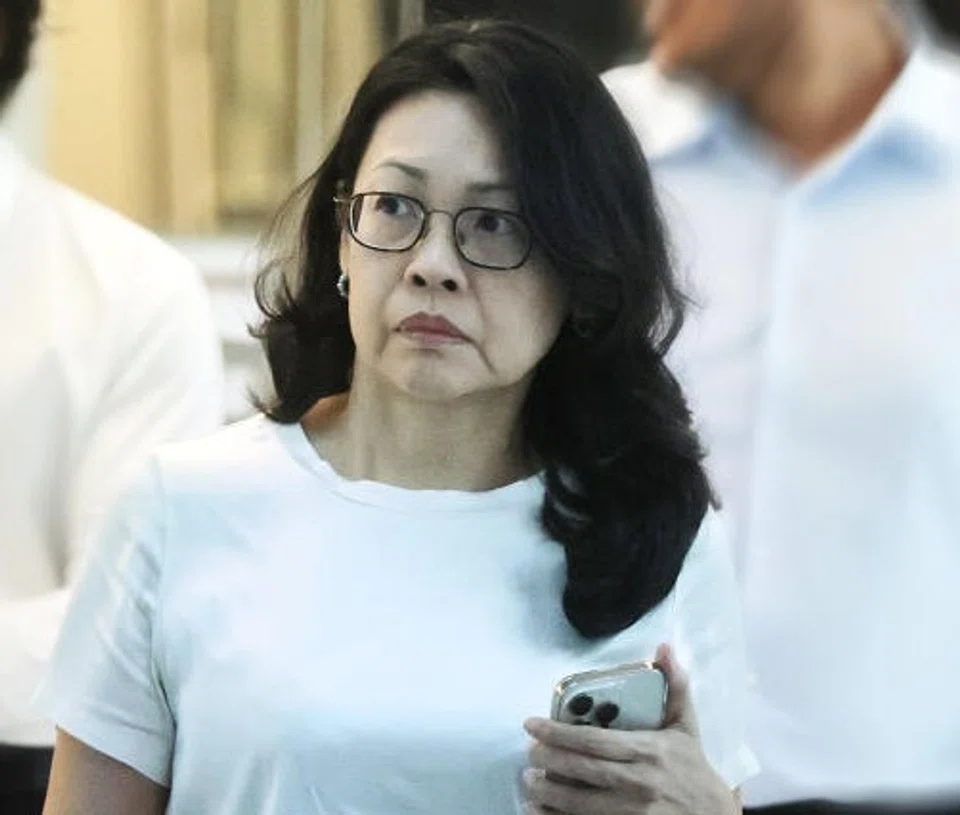
[SINGAPORE] The former legal officer of Hyflux tasked with reviewing the water-purchase agreement for the company’s tender for the Tuaspring integrated water and power project did not know beforehand that the bid had included a power plant.
Yang Ai Chian told the district court on Wednesday (Sep 17), during the trial of her former boss and Hyflux founder Olivia Lum and five others, that she – then as senior vice-president for legal (business) – was asked to review the water-purchase agreement that formed part of the tender documents.
Hyflux had in 2010 tendered for the project to design, build, own and operate Singapore’s second and largest seawater reverse-osmosis desalination plant in Tuas for a concession period of 25 years.
It won the tender with its proposal to provide the desalination plant with power generated from a co-located power plant, and to sell the excess capacity to the national grid – for revenue to subsidise the desalination plant.
Now, Lum, former chief financial officer Cho Wee Peng and four board members are standing trial for allegedly failing to disclose to the Singapore Exchange that Hyflux was entering the electricity business in its filing about bagging the Tuaspring project.
Yang, who is now employed in a legal role with Nanyang Technological University, told the court: “I was not aware that there was a power plant involved before we submitted (the bid). After the submission… when the bid was announced, there was an air of jubilation. Our bid was the lowest.”
She added that she had heard through the grapevine that there was a power plant. But she knew nothing about the power plant – whether it was about the facility being planned as a supplier of electricity to the desalination plant, or that Hyflux would sell the remaining capacity, with the revenue split between the two plants, or the profitability of the project.
She said that, in her legal role with Hyflux, she would typically review the terms of the water-purchase agreement, as well as highlight the risks, obligations and performance required of the company, so that the management could consider whether it was prepared to accept these obligations.
She also testified that she had only a short stint as the company secretary during her employment with Hyflux between 2004 and 2013.
During the cross-examination by Senior Counsel Davinder Singh, who represents Lum, Yang agreed with him that compliance with the listing rules was the responsibility of Hyflux’s then-head of compliance Peggy and corporate secretary Lim Poh Fong.
Yang could not recall Peggy’s surname.
Singh pointed out to her that Lum would expect everyone to do their work, given that Hyflux had improved its compliance bench strength, and that Peggy and Lim were the subject-matter experts, and the management was open about sharing information on the Tuaspring project with those involved.
He then went on to ask the prosecution witness: “You considered Lim Poh Fong did her job, she knew her job was compliance… having your experience working with them, Peggy and Lim Poh Fong knew what their job was?”
“I would think so,” replied Yang.
Before the prosecution witness started her testimony in the morning, the prosecution and Lum’s defence counsel spent about an hour trading allegations.
Singh accused the prosecution of not fulfilling its disclosure obligations, while Deputy Public Prosecutor (DPP) Kevin Yong called this a serious allegation.
Singh complained to District Judge Toh Han Li that the prosecution had on Tuesday flooded the defence team with nearly 4,500 e-mails.
This came after the judge had earlier ordered the prosecution to hand over to the defence the correspondences it had sought for between the banks and Hyflux over the Tuaspring project.
Singh was dissatisfied that the documents were released to his team only now, and that e-mails that were “irrelevant” to what he had requested were also included.
He claimed that it was part of the prosecution’s obligations to disclose these e-mails, whether they were requested or not.
He said that this put the defence in a prejudiced position, and that his client reserved her right in relation to the prosecution’s disclosure obligations. He also stated that his team would need time to consider whether any witnesses needed to be recalled after reviewing the e-mails.
DPP Yong maintained that the documents were provided voluntarily, and that the prosecution was not under obligation to disclose them.
He also said it was “very troubling” that Singh only raised this matter months after having receiving exhibits from the prosecution.
He explained that some e-mails that Singh had cited as irrelevant were included in Tuesday’s bundle because the prosecution was unclear about the defence’s case, and was therefore not privy to what would be relevant to it.
He added that his team was not obliged to go through all the e-mails, and that keywords were used to sieve out the potentially relevant ones from the “large mass”.
This led to a situation where there were “false positives”.
The district judge noted that the e-mails were provided by the prosecution after he had limited the range of the dates of the e-mails, as the defence’s request was “too wide”.
He also ordered that the defence would have time to review the e-mails and recall witnesses to the stand.
The trial continues.
TRENDING NOW

LTA proposes combining car COE categories, adding rebate-surcharge system

StarHub to acquire MyRepublic’s mobile business amid ongoing telco consolidation

DBS, OCBC, UOB rout lops billions off STI as inflation, rate concerns spook investors

Grab CEO’s wife Chloe Tong on life with Anthony Tan and finding her purpose

