

New Zealand dairy farmers pocket billions from huge capital payout
The Reserve Bank of New Zealand has long held the view that the capital return would be used to repay debt
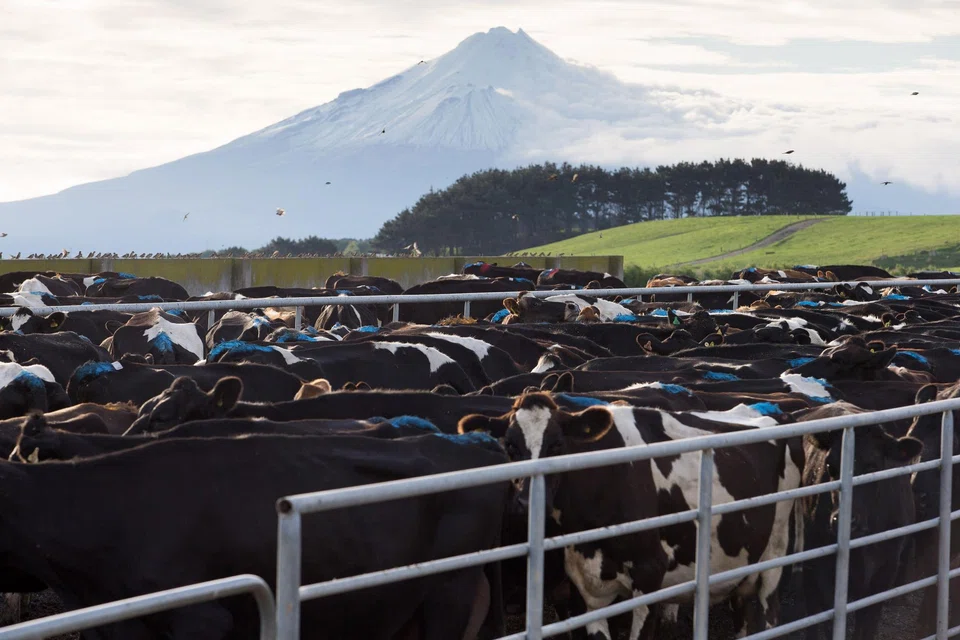
[WELLINGTON] New Zealand dairy farmers are about to get a record multibillion-dollar, tax-free payout. They may need every cent of it.
Around NZ$3.9 billion (S$2.9 billion) will hit the bank accounts on Tuesday (Apr 14) of those who supply Fonterra Cooperative Group as the world’s biggest dairy exporter makes dividend payments and returns some of the proceeds from the sale of its Mainland Group consumer unit. But the cash injection comes just as the war in Iran drives up fuel and fertiliser costs and threatens to squeeze margins across the country’s crucial dairy sector.
For farmers such as Tom Groundwater, the windfall is prompting careful choices rather than a spending spree.
Groundwater, who farms about 1,400 cows on two properties on the Mid Canterbury plains south of Christchurch, holds 620,000 Fonterra shares and is set to receive more than NZ$1.3 million. He plans to put the lump sum towards an equitable succession plan for his family, balancing the interests of two sons who will take over the farms in the coming years and two city-based daughters.
“We are aiming to put that capital payment towards a business for those girls to sort of try and even things up a wee bit,” he said. “The boys have got a good business running and although the girls have got good jobs and got their own houses, they need a good business as well. So what we are aiming to do is to invest off farm.”
Groundwater considered repaying debt, but with the farms passing to his sons, he considered that would not be fair to his daughters. It is also difficult to find suitable land in his area that merits expansion or the investment, he said.
“They say a million dollars is a lot of money, but when you come to buying land it actually is not, it does not get you very far,” he said.
French windfall
The cooperative sold Mainland to French dairy giant Groupe Lactalis for NZ$4.2 billion, and is returning NZ$3.2 billion to shareholders, equivalent to NZ$2 a share. Holders will also receive a 16 cents a share special dividend from Mainland’s earnings prior to the sale, and a 24 cents a share first-half dividend from the cooperative’s continuing business.
Fonterra has nearly 8,100 farms, the average herd size is about 450 cows, supplying its plants. Between them, the farmers own more than 1.3 billion shares. There are another 300 million shares on issue to other classes of shareholders, including the listed Fonterra Shareholders’ Fund.
SEE ALSO




Most of the money being paid out to farmers on Tuesday will be used to reduce farm debt and strengthen balance sheets, taking advantage of a windfall gain to protect against the inevitable slowdown in income when dairy prices retreat. Some owners may catch up on overdue expansion, such as new cowsheds or equipment, while others are tipped to search for extra land either to increase their herds or to ensure access to winter pasture for their cows.
The distribution comes as farmers benefit from strong global dairy prices in recent seasons with Fonterra paying a record price of NZ$10.16 per kilogram of milk solids for milk supplied in the year ended July 2025. It is forecasting a payment of NZ$9.70 a kilogram for the current season.
“Dairy farmers are currently in a period of relatively strong financial performance, with milk prices supporting positive cash flow across much of the sector, however, the outlook is not without risk,” said Mark Storey, head of economics at industry body DairyNZ. “Ongoing conflict in the Middle East and disruption to shipping are contributing to volatility in fuel and fertiliser markets. These are key farm inputs, and sustained increases will put pressure on margins.”
Against that background, he expects many farmers are likely to take a long-term approach and will focus on strengthening their financial position and building resilience. Still, there may be scope for some to reinvest in their farm businesses or to use it to build resilience ahead of upcoming regulatory and environmental requirements, he said.
Caution reigns
With an expected emphasis on debt repayment, any significant boost to rural spending from the capital payment may be contained.
The Treasury Department this week said that talks with businesses last month revealed balance sheet repair and deferred farm maintenance remain the priorities for farmers. However, it said that it had heard more anecdotes relating to consumer spending and succession planning than in prior rounds of business engagement.
The Reserve Bank of New Zealand has long held the view that the capital return would be used to repay debt, although in February the Monetary Policy Committee noted the risk that it may spur more investment and consumer spending by farmers.
Still, that was before the Middle East conflict erupted.
“The significant injection of cash is likely to generate more spending and investment,” said Doug Steel, senior economist at the Bank of New Zealand in Wellington. “However, the current international situation around the Middle East and a substantial lift in some cost items may well see a bit more caution regards general spending than might have otherwise have been the case.” BLOOMBERG
Decoding Asia newsletter: your guide to navigating Asia in a new global order. Sign up here to get Decoding Asia newsletter. Delivered to your inbox. Free.
Share with us your feedback on BT's products and services
TRENDING NOW

Malaysian king buys stake in Singapore-listed mining firm expanding into rare earths

Family offices ‘kept captive’ by relationship managers turn to independent advisers, direct deals

Once staunchly pro-China, Malaysian Chinese businesses are now distancing themselves from Beijing

Could stablecoins be the future of money?

