Singapore’s record-high electricity tariff drives retailers to roll out discounts, but price war unlikely
Firms are expected to be prudent amid ongoing volatility, with lessons learnt from business failures in the 2021 crisis

[SINGAPORE] Singapore’s electricity retailers are out to attract new customers with promotions on fixed-price plans – as consumers seek cost certainty following the 17 per cent surge in the electricity tariff for July to September, marking a record high for the Republic.
However, retailers are still cautious about managing their exposure to energy prices, with the uncertainty of the Middle East conflict. This makes a price war unlikely, analysts told The Business Times. Greater safeguards also lower the chances of retailers exiting the market, as seen during the 2021 global gas crisis.
Players have been quick to roll out promotions in recent weeks – offering prices as much as 20 per cent lower than the latest regulated tariff of S$0.3478 per kilowatt-hour (kWh), including goods and services tax. (All rates mentioned in the story are inclusive of GST.)
Geneco, for instance, revised its 24-month fixed-price plan from S$0.283 per kWh to S$0.275 per kWh from Jun 30. It also introduced a S$200 bill rebate for customers switching over from the regulated tariff under SP Group, and a S$100 rebate for those switching from other retailers.
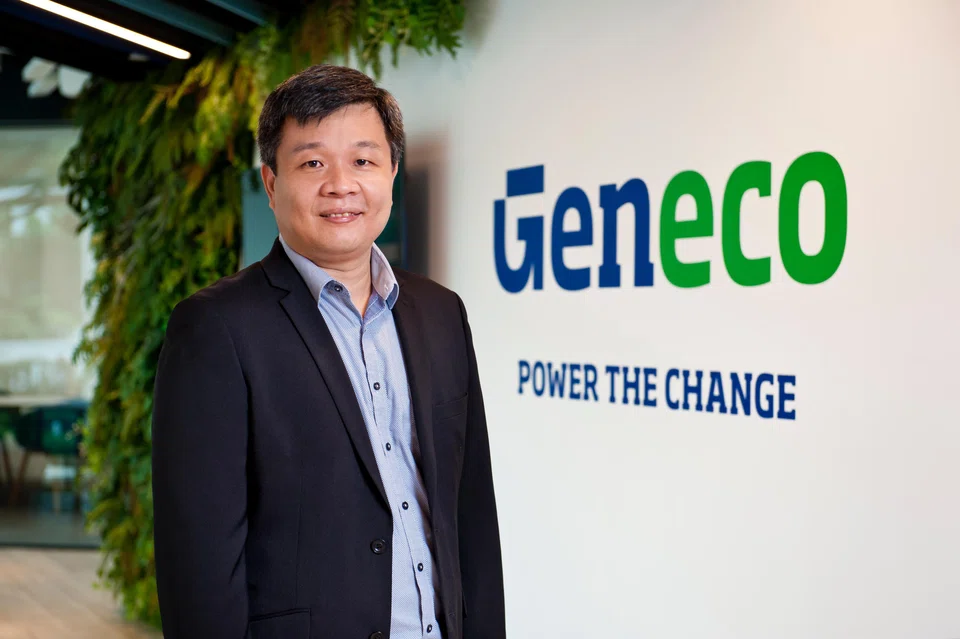
This provides customers “more savings and assurance over their electricity costs amid ongoing market uncertainty”, said Geneco chief executive Lim Han Kwang.
The company is also absorbing the cost of an advanced electricity meter – worth S$43.60 – for customers that sign up for its two-year “Get It 7 to 7” plan during the promotional period. The plan offers a cheaper electricity rate between 7 am and 7 pm, but requires installation of the meter.
Lim sees both households as well as small and medium-sized enterprises seeking greater certainty over their electricity costs.
Data from the Energy Market Authority (EMA) also shows more gravitating towards fixed-price retail plans.
Between Feb 1 and Jun 1, the proportion of households on such plans increased from about 36.6 per cent to 37.1 per cent; those purchasing electricity from SP Group under the regulated tariff fell from 63.4 per cent to 62.8 per cent.
Customers “increasingly value cost certainty and protection from fluctuations in electricity prices”, said Lim Sam San, senior vice-president for the retail business at Tuas Power. The company is offering promotional prices up till Jul 12, such as a three-year plan with a fixed rate of S$0.2728 per kWh and a S$160 bill rebate.
Other promotions include Keppel Electric’s limited-time offer of a two-year fixed-rate plan at S$0.275 per kWh with up to S$120 in bill rebates, and PacificLight Energy’s three-year fixed-rate plan of S$0.272 per kWh for households.
PacificLight’s general manager Geraldine Tan observed that while many households are still on the regulated tariff, there is “steady interest” in fixed-price plans due to their simplicity and cost certainty.
Retailers are also targeting businesses. For instance, Flo Energy is offering a fixed-rate three-year plan at S$0.2943 per kWh for businesses, urging them to “beat the July SP tariff hike”.
Sharad Somani, head of infrastructure for Asia-Pacific at KPMG, said that retailers are set to continue competing actively for market share through promotions.
However, he does not foresee a price war, as retailers are “likely to focus on balancing customer acquisition with sustainable pricing and prudent cost management in a volatile energy market”.
Their promotions have been “tactical” and time-limited, noted Chong Zhi Xin, head of Asia gas research at S&P Global Energy.
“What we are witnessing is selective customer acquisition by better-capitalised retailers who hedged (their exposure) early and can offer temporary discounts.
“Price wars typically require sustained margin compression that could lead to retailers exiting the industry, but that level has not yet been reached,” he said.
More resilient market
Singapore’s electricity market is also more resilient than during the previous energy crisis in 2021 and 2022, noted Somani.
The sharp swings in wholesale electricity prices in those years led to the exit of several retailers. As BT reported in 2023, this drove many consumers away from retail contracts back to SP Group.
That said, many of the surviving players today are “gentailers” – involved in both electricity generation and retail – and thus “better equipped to manage wholesale electricity price volatility through integrated operations and risk management”, added Somani.
Lim of Tuas Power, which is a gentailer, said that the company’s generation business allows it to provide customers with “greater price stability and greater peace of mind, even during periods of market volatility”.
Retailers are less likely to go bankrupt than during the previous crisis, noted Cao Yanqi, senior analyst for Asia-Pacific power research at Wood Mackenzie.
He pointed out that Singapore’s temporary price cap on wholesale electricity – introduced as a safeguard in 2023 – has not yet been triggered. “However, specific risk exposure will depend on each retailer’s financials and risk preferences,” he added.
Chong of S&P Global Energy noted that retailers with insufficient hedging or higher procurement costs may need to raise prices, particularly for new contracts.
Flo Energy is confident about navigating the current market conditions with hedging and monitoring strategies, said its CEO Matthijs Guichelaar.
“We monitor a broad range of market indicators that can influence electricity prices, including fuel price indices, gas supply constraints, generation plant availability and broader wholesale market conditions,” he addded. “These factors help us assess potential market movements and inform our procurement and risk-management decisions.”
Geneco is likewise working closely with EMA and industry partners to navigate market conditions.
Uncertainty ahead
Singapore’s latest electricity tariff surpasses the peaks during the Russia-Ukraine war, noted David Chew, a senior consultant at Rystad Energy.
The Middle East conflict “has caused lasting disruption to critical supply infrastructure, increasing risk premiums across global energy markets”, he said. “Unlike previous market shocks, restoring physical infrastructure takes time.”
Fuel costs represent 75 to 80 per cent of the total electricity tariff, and thus “a sharp increase in power prices was unavoidable”, said Chong of S&P Global Energy.
“For Singapore, the worst of the supply disruption appears to be behind us, but consumers will continue to feel the effects with a lag,” he added.
It typically takes about three months for an increase in Brent crude prices – to which the majority of Singapore’s liquefied natural gas (LNG) contracts are indexed – to pass through to electricity prices, noted Hu Maoping, principal analyst for gas and LNG at Wood Mackenzie.
While progress in Iran-US negotiations could mean more favourable electricity tariffs in the fourth quarter, Hu remains cautious, given the “fragility” of the current ceasefire.
LNG carrier exits from the Strait of Hormuz – estimated at about 15 since the war started in late-February – appear to be on a case-by-case basis and “may not signal a sustained restart in LNG exports from the Middle East”, noted Lee Rou Urn, Asia editor for LNG at Argus Media.
Singapore electricity consumers are especially likely to see prices remaining high in the lead-up to November, when gas demand rises for heating during the winter months.