Falling AI token costs could fuel next leg of Singapore semiconductor rally: analysts
Shares of AEM, UMS and Frencken have soared between 65% and 400% this year with bets on AI-driven chip demand

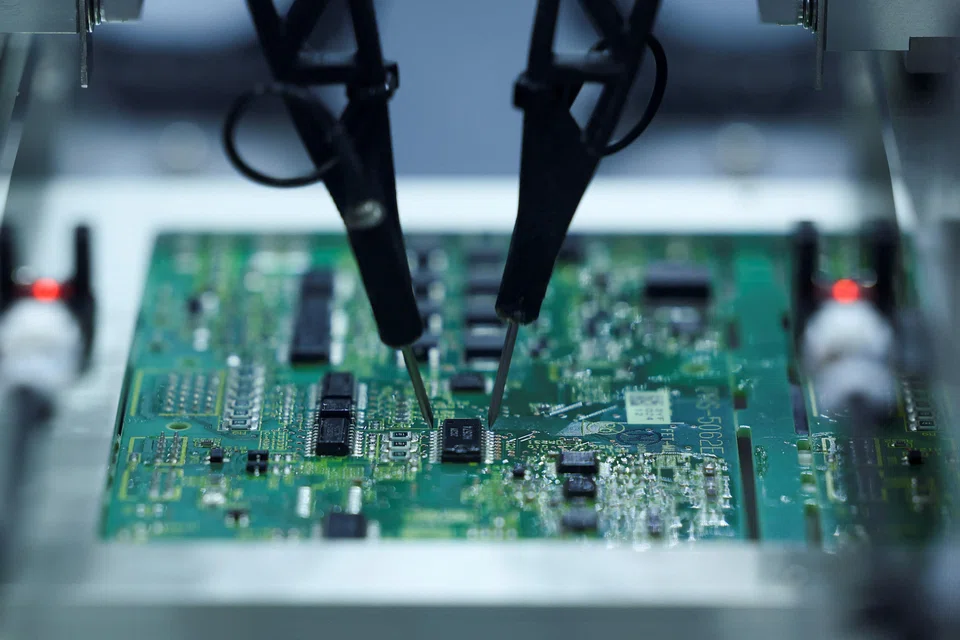
[SINGAPORE] Singapore-listed semiconductor equipment suppliers are set to be the beneficiaries of a possible fresh wave of spending on artificial intelligence infrastructure, with falling token costs spurring wider use of AI models, analysts said.
Silicon Data’s Large Language Model Token Expenditure index – an expenditure-weighted benchmark for the cost of a million tokens – stood at US$0.9665 on Aug 31, less than half of its May peak of US$$2.0651.
The decline could trigger increased usage of AI in the form of AI applications and agentic AI, which would generate more computing demand and improve the economics of the infrastructure underpinning them, DBS Group Research said.
These trends could in turn improve hyperscalers’ returns on their infrastructure investments and sustain higher capital expenditure in the long run, feeding through to demand for semiconductor equipment and testing.
“Open-weight adoption should broaden semiconductor beneficiaries across the value chain,” DBS Group Research said in its report.
Analysts identified AEM , UMS Integration and Frencken as three Singapore-listed companies positioned to capture profits, even though they do not manufacture semiconductor chips themselves.
Frencken and UMS are upstream suppliers, providing high-precision components and equipment manufacturing services to semiconductor companies, and AEM provides advanced testing and handling systems.
In the year to date, the share prices of AEM, UMS and Frencken have already experienced a boost.
As at Sep 2, AEM’s share price is up 403.5 per cent at S$8.66; shares of UMS have jumped 123.6 per cent to S$2.54, and Frencken’s shares are 64.5 per cent higher at S$2.27.
Uneven earnings conversion
Even as all three companies are expected to continue riding the AI boom, the extent and pace of earnings growth among them are likely to vary.
AEM has so far recorded the strongest earnings growth; its first-half net profit stood at S$30.8 million, from just S$3.1 million the year before.
The company raised its 2026 revenue guidance to between S$630 million and S$680 million, from its previous range of S$550 million to S$600 million. It also issued an earnings per share guidance of S$0.245 to S$0.275.
Analysts remain positive on it. UBS noted in an August report that rising semiconductor complexity and the scaling chip performance for data-intensive AI workloads should increase testing intensity.
“AEM is well positioned for the AI-driven test upcycle,” said Amanda Tan, analyst from DBS Group Research.
UMS achieved a strong set of H1 results, reporting a 66 per cent increase in net profit to S$33.4 million.
RHB Group analyst Alfie Yeo said: “We still see UMS as a long-term beneficiary of the semiconductor sector’s AI-led growth. It may even hit its new key customer’s annual order target of S$300 million quicker if advanced packaging order volume goes up.”
UMS has not publicly announced the “new key customer”, but analysts understand this customer to be US semiconductor equipment firm Lam Research.
Facing increased demand, UMS already has plans to expand on its production capacity with a third plant in Penang, which is targeted to start mass production by end-2027.
Ling Lee Keng, analyst at DBS Research Group, said: “With core operations in Malaysia, Singapore and Vietnam, the group is well positioned to benefit from ongoing supply-chain diversification amid US-China trade tensions.”
Frencken, on the other hand, was the only one of the three companies to report a dip in H1 net profit; its earnings shrank by 3.4 per cent to S$19.3 million, but its second-quarter profit rose 13.7 per cent. Nonetheless, analysts remain positive on the group’s long-term prospects.
“Frencken’s outlook is turning increasingly positive,” said Ling.
She noted that the group’s management expects a stronger H2 on improving customer demands and better order visibility driven by the semiconductor upcycle.
She expects the semiconductor momentum to extend into FY2027.
“Growth should be led by robust semiconductor demand in Asia and a recovery in Mechatronics Europe, while higher volumes support utilisation and margins,” she added.
Mechatronics, which includes of the group semiconductor business, is one of the company’s two core pillars.
Frencken is also raising funds to support its expansion. Under its recently proposed 44.1 million new share placement, 90 per cent of the estimated S$97.1 million net proceeds will be used for business development plans.
Capacity and valuations pose risks
Despite the positive demand outlook, analysts noted that risks still hang over the three companies.
One constraint flagged by analysts was capacity, which they noted could limit how quickly companies translate stronger demand into earnings.
“The key near-term bottleneck remains skilled manpower in Penang, particularly for component production,” said Ling from DBS, noting that UMS’ current utilisation rate is around 50 per cent, against a target of 80 per cent.
AEM is also experiencing a more than S$400 million order backlog from its asynchronous modular parallel smart testing platform.
While demand for the services of the equipment testing company remains high, William Tng from CGS International (CGSI) is concerned about AEM’s ability to meet customers’ orders if demand is stronger than expected.
“We understand AEM is actively managing its production capacity,” he said.
Confirmation of stronger second-half orders remains key for Frencken’s recovery, said CGSI analyst Billy Toh.
With share price valuation already reflecting much of the AI optimism, he noted that the next leg of growth will be increasingly sensitive to order delivery and customer concentration.
“The common risk is that share prices, especially those of AEM and UMS, have moved faster than the earnings base, increasing sensitivity to order timing and customer concentration.”