

Fee income, recovery in loan growth are key drivers for Singapore banks in 2026
But analysts expect overall results to be flattish or lower, weighed down by net interest income

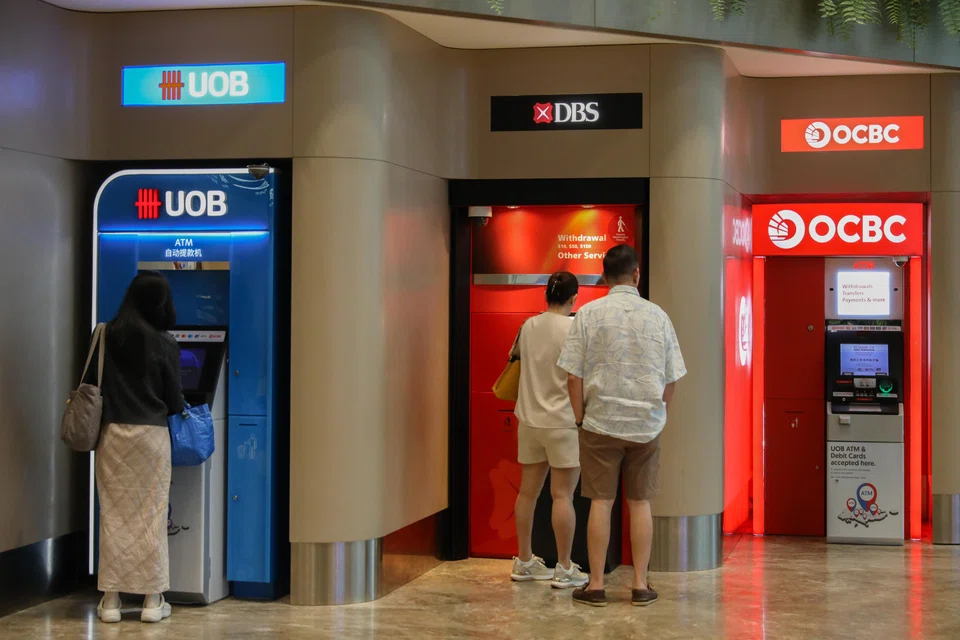
[SINGAPORE] Fee income and a recovery in loan growth will likely be the key earnings drivers for the three local banks – DBS, OCBC and UOB – in 2026 as net interest income continues to fall, analysts said.
Meanwhile, wealth management will probably remain the biggest contributor to non-interest income growth. But analysts also believe other non-interest income segments can become bigger contributors in the year ahead as interest rates decline.
“This year, non-interest income was largely just the wealth segment picking up steam, while the other contributors weren’t really there yet,” said Thilan Wickramasinghe, Maybank Securities’ head of research and regional financials.
“As you go into 2026, the loan-related fees will also pick up steam, and there’s a lot more optimism about capital markets deal momentum.”
Glenn Thum, research manager at Phillip Securities Research, said wealth management fee income would show the greatest improvement as funds get shifted into investment products amid low interest rates.
DBS Group Research analyst Lim Rui Wen also pointed out that net new money inflow remains robust amid safe-haven liquidity flows, given Singapore’s reputation as a regional wealth centre.
Loan growth – which was already better than expected during the third-quarter results season in November 2025 – should also pick up, said Wickramasinghe.
Domestically, lower rates should support the construction and housing boom in 2026. He also noted that Singapore’s export segment has not really slowed down despite trade volatility as a result of US tariff policy.
In the region, Maybank is bullish on China’s growth trajectory in the new year, while many South-east Asian countries will experience fiscal policy deployments, he said.
Furthermore, Singapore’s plans to boost local equities will benefit the entire market, even though the measures are targeted at small and mid-cap companies, he added.
He said that average trading volumes have increased across the board, and the market broadening and liquidity depth improvement will boost the brokerage, investment banking and fee businesses of all the banks.
“In the last couple of years, non-interest income took a back seat to net interest income, given the ‘once-in-a-decade’ interest rate environment that we had, but now you’re seeing that reversal happening.”
Lower overall results
Nevertheless, analysts said overall results will likely be flattish or lower, weighed down by net interest income – which makes up more than 60 per cent of the three banks’ total revenue, noted CGS International analysts Tay Wee Kuang and Lim Siew Khee.
In particular, OCBC and UOB should experience a greater impact as less of their net interest income is hedged, DBS’ Lim added.
But Wickramasinghe said the banks should be able to manage a few more rate cuts ahead, given that net interest margins (NIMs) have stabilised.
“Now, the focus has shifted away from margins towards net interest income as a whole, and I think that’s possible because there’s quite a bit of liquidity that is still coming to Singapore,” he said.
Phillip’s Thum also expects the influx of deposits and higher current and savings account ratio to offset a decline in NIMs.
Considering the impact of rate cuts on net interest income and earnings, the CGS analysts believe the banks’ strong capital position will remain the sector’s bright spot.
They noted that all three lenders will continue to explore ways to return excess capital to shareholders, such as through dividends and share buybacks.
Thum is looking out for a more definitive capital return plan from OCBC and UOB, as only DBS has given guidance until 2027.
Lim also noted that OCBC “softened (its) tone on dividends” at a recent analyst briefing, and anticipates more progressive dividends or a change to the dividend payout ratio in the bank’s next three-year corporate plan.
Asset-quality risks
Analysts are also keeping an eye out for asset-quality risks, especially for UOB.
Generally, the three banks have not noted systemic risks, and loan provision buffers have improved quarter on quarter. Guidance from DBS and UOB also suggest stable or normalised credit costs for 2026, a research analyst from RHB said.
Furthermore, key problem areas in North Asia are supposed to be recovering, Wickramasinghe said, adding that the US economy is still holding up, and South-east Asia will likely witness fiscal spending across the region.
But he said that it is unclear whether UOB’s undertaking of S$1.4 billion in provisions in Q3 2025 is a one-off occurrence.
Lim added that the lender’s credit cost guidance for 2026 remains high, at 25 to 30 basis points, even after taking on the “huge” provisions due to its commercial real estate exposure.
TRENDING NOW

OCBC Q3 profit rises 3% to S$2.04 billion, slightly above expectations

Stocks to watch: OCBC, IHH Healthcare, FLCT, SingPost, Koh Brothers Eco Engineering

From legacy to launch: Francis Yeoh and Yeoh Pei Xien on family unity and YTL’s next‑gen ventures

Wealthy Indonesians snap up government bonds as yields near 8%: OCBC

