

Five decades on, Raffles Medical eyes further regional growth and insurance push
It will focus on expanding its business in Asia as it sees plenty of opportunities in the region

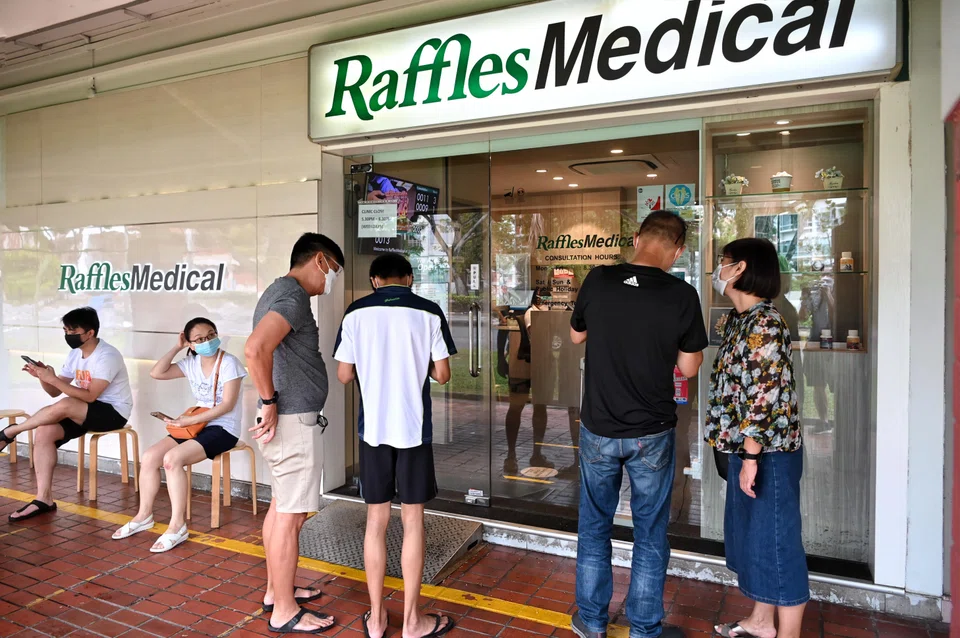
[SINGAPORE] Raffles Medical is looking to deepen its footprint in Asia and grow its insurance business as it marks 50 years since its founding. It has cash on hand for acquisitions and aims to launch a new regional scholarship scheme to build a pipeline of healthcare managers.
Executive chairman Loo Choon Yong told The Business Times in a recent interview that the group, which now operates in five countries and 12 cities, will continue to focus on Asia. It has no plans to enter further markets such as the US or Europe.
Asia is preferred as it is in the same time zone, is easier to travel to and because of the superior economic growth in the region, said Dr Loo.
“There are plenty of opportunities in Asia. Asia is still growing,” he said, pointing to growth of 4 to 5 per cent in China, 6 per cent in India and 5 to 6 per cent across much of South-east Asia, against 1 to 2 per cent in Europe.
In 2023, the group announced that it had entered into a strategic partnership with My My Trading Services Company to acquire a majority interest in American International Hospital, a 120-bed tertiary hospital in Ho Chi Minh City, subject to conditions precedent and regulatory approvals.
The hospital asset was valued at US$45.6 million, and the group also agreed to take on a management services contract for the hospital’s operations.
Dr Loo said the group does not always need to build from scratch and can use its financial resources to buy existing hospitals or clinics, including practices in Singapore whose owners wish to sell.
“We do have cash. We can deploy this when the right opportunities come,” he said.
Asked if the group is targeting other markets in Asia, Dr Loo did not elaborate.

Indonesia has amended its laws to allow foreign doctors to practise, but Dr Loo said expansion will have to depend on the local conditions.
Markets such as Japan, South Korea and Taiwan, where hospitals must be not-for-profit, present another hurdle.
The ability to bring in the group’s own doctors is an important consideration, because it audits the clinical work of all its doctors through a medical board and independent reviewers.
It has replicated this governance model in its China hospitals in Beijing, Shanghai and Chongqing. Those China hospitals are increasingly being positioned as a lower-cost option under the Raffles brand for patients from Central Asia and Mongolia, since these locations have more direct flights to Beijing and Shanghai than to Singapore.
Dr Loo said a strong Singapore dollar and higher post-pandemic costs for accommodation, food and transport have made Singapore more expensive for medical tourists, and the group can now offer “different price points” for the same treatment depending on a patient’s budget.
Insurance as adjacency
Aside from international expansion, the group has set its sights on the insurance sector as its main adjacency for growth over the coming decades.
Raffles Medical’s insurance business, which underwrites individual plans such as Raffles Shield and group policies for corporate clients including DBS, is currently run by a general manager but will be elevated to a full division with a managing director as it grows.
“You may hear more about us expanding our insurance business,” Dr Loo said.
This segment also shows more promise in aiding the group’s international ambitions, as it would be more straightforward to expand its insurance arm overseas, subject to capital and regulatory requirements in each market.
The next 50 years
Raffles Medical Group was founded in 1976 when Dr Loo, then 27, and fellow doctor Alfred Loh bought a clinic with eight staff. It now employs about 2,900 people.
Dr Loo said the group had no grand plan at the outset beyond a simple idea: to look after patients properly and charge cost plus a margin so that the practice would be sustainable.
He singled out the opening of Raffles Hospital in 2001, 25 years after the group’s founding, as the defining milestone.
The group’s initial public offering in 1997 was undertaken specifically to raise funds for the hospital, he said. Building it required the group to integrate specialists, general practitioners, nurses, allied health staff and a professional back office for the first time.
Having celebrated its 50th anniversary, the group is now “talking about our 100th”, Dr Loo said. “We are a very strange animal. We don’t think like a usual corporation. We are thinking 50 years ahead.”
Part of that horizon is talent. Raffles Medical has committed to awarding 50 scholarships over the next five years, up from about seven a year previously, and will for the first time extend them to candidates from countries where it operates, including China and Vietnam.
Rather than sending recipients to Singapore, the group will sponsor study at universities in those markets to build a cadre of healthcare managers who can run its regional operations.
Succession
On the issue of succession, Dr Loo, who has said publicly that he hopes to step back, said he is delegating on a regular basis.
The group has a managing director overseeing its three hospitals in China, two managing directors for the Singapore business and a full C-suite.
He said the picture will become clearer “in the next couple of years”, and that the group has identified several people with the potential to take on more of his responsibilities.
Raffles Medical reported a net profit of S$29 million for the six months to Jun 30, down 9.6 per cent from S$32.1 million in the year-ago period, on revenue of S$353.2 million, a 6.7 per cent decline from S$378.4 million.
Earnings per share fell to S$0.0157 from S$0.0173. Its stock ended at S$0.84 on Friday (Sep 11).
The group attributed the profit drop mainly to lower occupancy at its transitional care facilities, after the government reduced the number of step-down beds it contracts from Raffes Medical following the opening of new public hospital capacity.
The impact fell on the healthcare services segment, run by its general practitioners, where profit fell to S$15.6 million from S$24.9 million.
The hospital services division, by contrast, grew profit 11 per cent to S$19.7 million on stable revenue of S$170.2 million. Revenue at Raffles China Healthcare rose 13 per cent to 184.8 million yuan (US$27.5 million). Dr Loo said transitional-care volumes have since stabilised, and that patient numbers rose in July from June.
Asked about the government’s plans to lower private healthcare costs, including the possibility of a lower-cost private hospital, Dr Loo said Raffles Medical had participated in a year-long industry consultation and is awaiting clarity on the ministry’s specifications. “Currently, it’s highly speculative,” he said.
Decoding Asia newsletter: your guide to navigating Asia in a new global order. Sign up here to get Decoding Asia newsletter. Delivered to your inbox. Free.
Copyright SPH Media. All rights reserved.
TRENDING NOW
8 public officers referred to police over property buys near unannounced MRT stations: Chan Chun Sing

Grab CEO’s wife Chloe Tong on life with Anthony Tan and finding her purpose

Retrenched PMETs who return on lower pay see median 25% wage cut

Hao Mart owner resisting OG’s mortgage foreclosure on his Tanglin GCB

