

Happy times over for container lines
 Add BT as a preferred source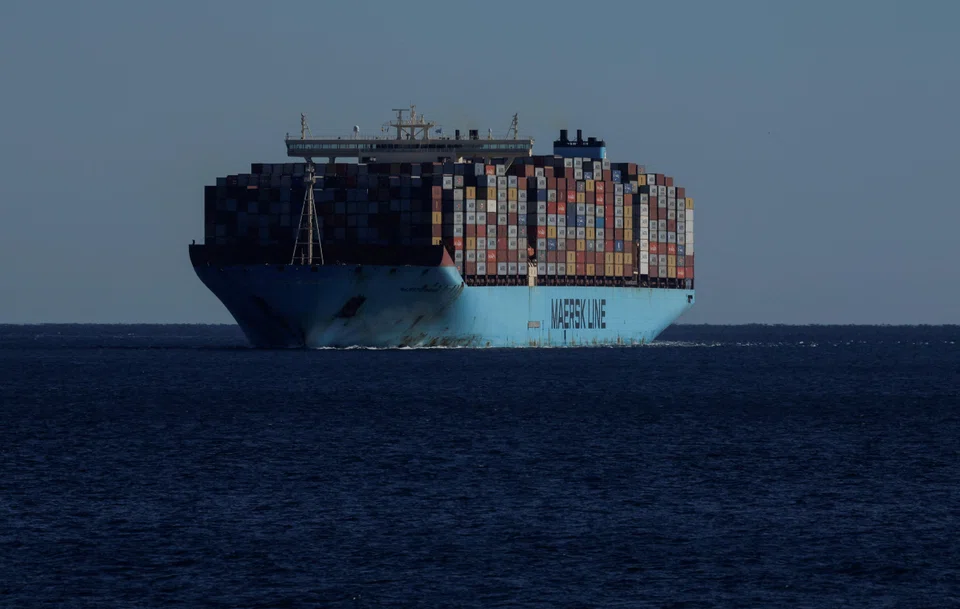
DeeperDive is a beta AI feature. Refer to full articles for the facts.
REGULAR readers of this column will know I have always wondered why anybody would work at a transocean liner shipping company.
For a while during the pandemic, the answer suddenly seemed to become obvious, as rates rocketed and shippers screamed “profiteering” at the container carriers.
That happy time for the container shipping lines did not last long, and many more familiar stories are now emanating from the boxship sector.
The second-largest container shipping operation, Maersk’s Ocean division, reported a 9 per cent increase in volume from the previous quarter. It said that a “strong cost focus supported an 11 per cent decrease in unit cost at fixed bunker (prices) compared to the third quarter of 2022”.
However, its statement noted that “earnings before interest and taxes (Ebit) was negative at US$27 millon, down from US$8.7 billion in Q3 2022, driven by significant pressure on rates, in particular on Asia to Europe, North America and Latin America trades”.
These are certainly not happy times for Maersk’s staff. The statement further read: “Maersk has imposed rigorous cost containment measures during the year to effectively cushion the impact of the challenging market conditions, including a headcount reduction from 110,000 in early 2023 to around 103,500 today.”
Navigate Asia in
a new global order
Get the insights delivered to your inbox.
The company added that it was intensifying those measures, given the worsening price outlook in the Ocean division. It has also introduced plans to “decrease the workforce by 3,500 positions, with up to 2,500 to be carried out in the coming months and the remaining to extend into 2024. This will reduce the global workforce to below 100,000 positions”.
Maersk further said that it now regards global container volume “growth” in the range of minus 2 per cent to minus 0.5 per cent, compared to minus 4 per cent to minus 1 per cent previously. It expects “to grow in line with the market” – make of that what you will.
Oslo-based freight-rate analytics platform Xeneta said it has carried out in-depth analysis of the latest ocean freight rates, and has branded the current market as “unsustainable”.
The group’s CEO, Patrik Berglund, said: “The cost of moving goods by sea has plummeted in 2023 by almost 60 per cent for long-term contracts on a global level, and some corridors – such as the Transatlantic to the US East Coast and the Far East to Europe – are down by around 80 per cent on both short- and long-term rates.”
In fact, he said, “freight rates are so low that shipping liner companies are effectively subsidising businesses to transport their goods around the world”. It is not the first time that has happened since containerisation, and particularly since the effective banning of the rate-setting liner conferences.
Berglund commented: “The big shipping liner companies won’t allow this to continue, and will jack up prices – it could be in 2024 or later, but it’s inevitable, and the carriers will want it sooner rather than later.”
As it happens, the largest container line, MSC, last Sunday (Nov 12) issued a general rate increase for dry containers for US-to-Far-East destinations. The increases are US$80 per 20-foot container and US$100 per 40-foot containers.
Whether the lines will be successful in pushing up rates is another matter.
While Xeneta has been warning businesses that are locked into long-term contracts with shipping liner companies at the lower end of 2023 prices that they could be the first to suffer if the market turns, the chances of significant upturn in freight rates do not look high.
The group pointed out that the current global economic downturn has resulted in declining consumer spending and demand for goods, which generally spells bad news for the shipping industry. It pointed out that “containers transported between the Far East and the US West Coast alone have fallen by 16.2 per cent during 2023”.
In September, the Xeneta Shipping Index revealed that global long-term contracted rates had increased for the first time in 12 months. This turned out to be a false dawn, as subsequent data from Xeneta showed October reverting to a downward trend, with its Global XSI index dropping by 2.6 per cent to 165.3 points.
Emily Stausboll, Xeneta market analyst, said: “Carriers have had some success in capacity management, limiting the impact of the 3.3 per cent decrease in global shipping volumes in the year to date. However, this hasn’t been enough to support sustained rate increases on a global basis.”
Vespucci Maritime is similarly downbeat, from shipping line perspective. It noted: “The end of September traditionally marks the end of the peak season, as China moves into its one-week Golden Week holiday. It is by now very clear that the peak season was a dud from the container lines’ perspective.”
Lars Jensen, CEO of Vespucci Maritime, pointed out: “The Asia-to-Europe trade was essentially in free fall in terms of the spot market throughout the month, and ended up at levels below what was seen pre-pandemic.
He added: “The equally important transpacific trade was also under pressure, although in this case, it would be more correct to state that the rate levels kept seeping to the US West Coast, whereas the East Coast saw a stronger declining trend. The Atlantic trade, which suffered a complete collapse earlier in the summer, essentially languished at the extremely low level it had bottomed out at.”
Xeneta’s Berglund warned: “However, even though looking straight at the spot-rate developments paints a bleak picture for the carriers, the reality is worse.”
He explains that cost inflation meant that, “very broadly speaking... trades where spot rates are not at least 30 per cent higher than pre-pandemic times are in a poorer state than in 2019”. He added that this applied to a vast number of trades.
Jensen noted that the container shipping market is at a crossroads. He said: “It is clear that the demand does not support the carriers’ deployment of capacity in their current networks. It is also clear that the continuing delivery of more new vessels will only make this worse. Unless the carriers change behaviour, we could be facing a much more severe downturn in rates in the coming months.”
We have been here many times before. Currently it looks as if the lines are pulling back capacity in a bid to keep freight rates up. That can only happen to a certain extent in a marketplace populated by competing alliances and competing companies within those alliances.
So, as has been the case for most of the past 30 years, I still struggle to see why anybody would put their money into a liner shipping company.
Decoding Asia newsletter: your guide to navigating Asia in a new global order. Sign up here to get Decoding Asia newsletter. Delivered to your inbox. Free.
Copyright SPH Media. All rights reserved.
TRENDING NOW

Shelving S$5 billion office redevelopment plan proved ‘wise’ as geopolitical risks mount: OCBC chairman

Eurokars Group introduces rental car franchises Enterprise Rent-A-Car, National Car Rental, and Alamo to Singapore

20 photos that show how dramatically Singapore has changed in two decades
Singapore’s key exports up 15.3% in March from electronics surge, exceeding forecasts

