iFast unveils ‘Truly Global Business Model’, rebrands FSMOne to FSM Global
The group is repositioning itself to view its customers as international – not just from the markets in which it operates

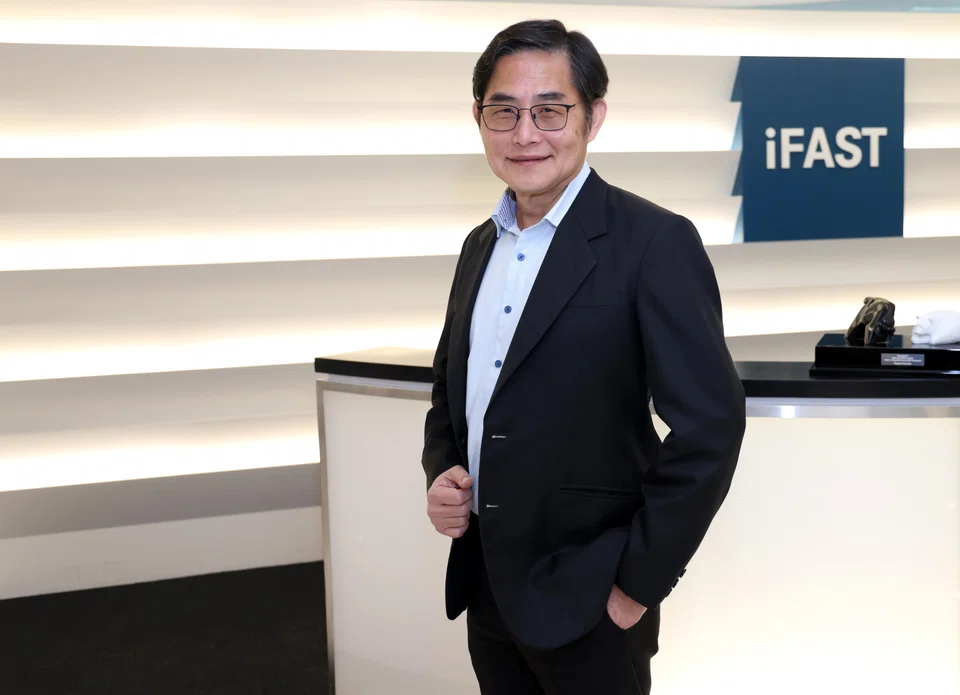
[SINGAPORE] Digital bank and wealth management platform iFast has unveiled its “Truly Global Business Model”, which realises its vision of serving customers across the globe from Singapore and Hong Kong to London.
In a briefing on Friday (Feb 13), iFast chairman and chief executive officer Lim Chung Chun likened it to the Netflix or Spotify model. Noting that such services “essentially... don’t require fiscal movement of goods”, he said that there was “no reason why (banking and wealth management) cannot be the basis of a truly global business”.
There is still more work ahead to make the Truly Global Business Model a bigger part of the enterprise. For this, the company’s three financial centres of London – where iFast Global Bank (iGB) operates – Singapore and Hong Kong are key. The Asian cities are iFast’s wealth management bases.
From these hubs, the group is repositioning itself to view its customers as global – not just from the markets in which the platform operates.
“I think we can accelerate this Truly Global Business Model, and that is a very important aim for the next year,” said Lim.
As part of this, iFast will rebrand FSMOne in Singapore and Hong Kong to FSM Global to signal its intent to customers, he added.
“We’re repositioning that for Hong Kong and Singapore, because these are two top financial centres and it is very suitable for us to use (them) to target global customers.”
FSMOne Malaysia, however, will not be renamed, as the focus for that business unit is local clients.
In alignment with the vision, iGB will roll out new services aimed at its international customers. Already, the majority of its clients are not UK residents.
In January, iGB joined the Bankers’ Automated Clearing Services payment system – the UK equivalent of Singapore’s General Interbank Recurring Order – to enable its customers to directly credit salaries and pay bills. The bank plans to launch more global payment services.
“The important part of the vision we have for (iGB) is that with one bank account, you can actually spend your money around the world,” said Lim.
These additional services will be a driver for the overall banking business.
Staying local
Lim said that iFast’s proposed acquisition of a 30 per cent stake in Financial Alliance Corporation for S$19.6 million is not linked to the Truly Global Business Model. The potential deal was announced in January.
Historically, iFast has taken minority stakes in other financial advisory firms in Singapore, but its focus has shifted to acquiring a minority stake in a financial advisory company that will become a bigger entity.
A thriving financial advisory industry is what iFast prefers, and Lim believes that consolidation in the market is under way, with private equity giants such as KKR buying Finexis.
“We basically want to be playing our part to help companies like Financial Alliance achieve their dream of becoming a much bigger business, becoming a listed (financial advisory) firm that has a much bigger long-term potential,” said Lim.
He noted that iFast’s stake in Financial Alliance may change or even grow, depending on the firm’s plans, which could prompt it to seek more funding from iFast for acquisitions or other needs. But the intention is to keep a minority stake in the company, he said.
The group has no plans for now for a secondary listing in Hong Kong or London, where iFast is planning to serve global customers.
But if there are such aims, iFast will look into whether currently listed companies can participate in the recently announced dual-listing bridge between the Singapore Exchange and Nasdaq.
Lim said: “If we do want a secondary listing, I feel that we should go for the biggest and most liquid (option). Otherwise, it may not really make sense.”
Shares of iFast ended Friday at S$9.39, 4 per cent or S$0.39 lower.