

Iran uncertainty, credit costs in focus for UOB as analysts stay cautious with ‘hold’ ratings
This comes even after the lender’s Q1 profit beat consensus estimates by around 3%

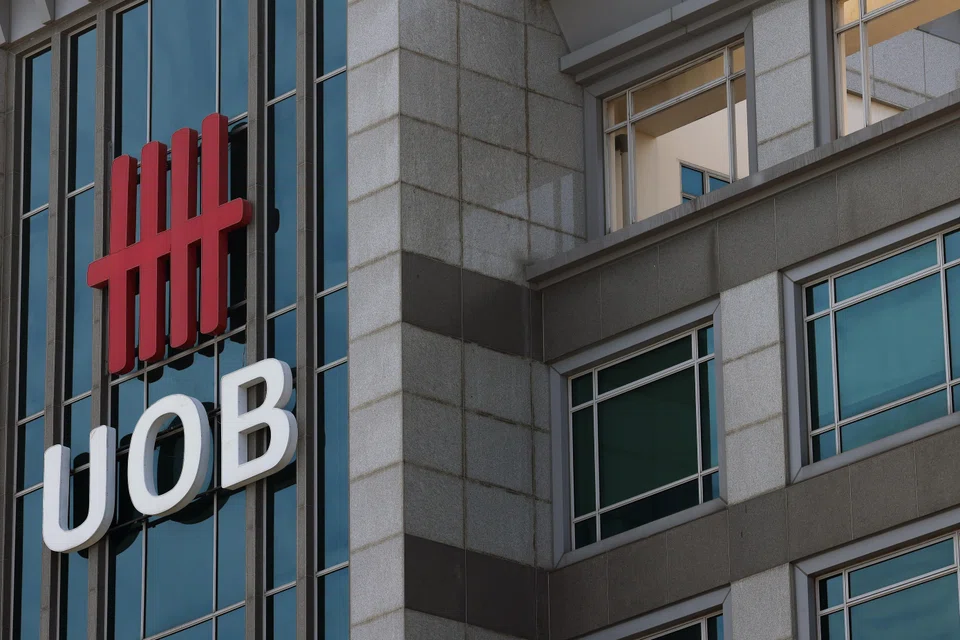
[SINGAPORE] Analysts have kept their “hold” ratings on UOB, citing concerns over costs and asset-quality risks as the conflict in the Middle East continues.
This comes even after the lender’s first-quarter results exceeded expectations. DBS Group Research analyst Lim Rui Wen noted that while UOB’s Q1 net profit beat consensus estimates by around 3 per cent, revenue came in 3 per cent below consensus.
Her target price on the counter is S$35.70, she said in a note on Thursday (May 7).
“We remain watchful of asset-quality risks in an environment of slower global growth amid concerns of impact from Iran war, on top of UOB’s commercial real estate exposures,” said Lim.
“Higher-than-expected non-performing loans (NPLs) and recessionary risks could unwind expectations of credit cost and NPL declines, thus posing risks to earnings.”
UOB recorded a 4 per cent year-on-year dip in net profit to S$1.44 billion for the three months ended Mar 31.
Net interest margin (NIM) declined to 1.82 per cent from 2 per cent a year earlier on the back of lower benchmark interest rates. Morningstar equity analyst Kathy Chan noted, however, that this was “partly offset by funding cost management”.
UOB has kept its FY2026 forward outlook unchanged and has guided for a full-year NIM of 1.75 to 1.8 per cent, on top of high-single-digit fee growth and low-single-digit operating cost growth.
Chan said she expects NIM pressure through 2027, though she raised her mid-cycle NIM forecast to 1.79 per cent from 1.76 per cent as the rate gap between the Singdollar and greenback normalises.
SEE ALSO

She also lifted her target price for UOB to S$38 from S$36.
Credit costs
CGS International analysts Tay Wee Kuang and Lim Siew Khee noted that UOB cut its IT-related expenses 15.9 per cent quarter on quarter, even as operating expenses were “relatively stable”.
Staff costs, meanwhile, rose 15.4 per cent quarter on quarter. Tay and Lim said that this came “likely on the back of bonus accruals”, adding that this suggests IT-related expenses “will pick up for total operating expenses to come within management’s guidance”.
The analysts kept their target price for UOB unchanged at S$38.70.
UOB reported credit costs of 26 basis points (bps) for Q1, up from 25 bps a year earlier. Credit costs refer to expenses and losses incurred by a bank when it lends to customers.
Tay and Lim noted that “specific provisions of 29 bps were still in the higher range of management’s guidance of 25 to 30 bps, offset by a minimal 3 bps (S$18 million) write-back in general provisions”.
Citi analyst Tan Yong Hong said that credit costs “will remain within guidance”, though risks include changes to asset-quality outlook and, in turn, the credit-cost cycle down the line.
“While our concerns on asset quality have subsided… muted revenue growth is likely a new focus, and we maintain a neutral rating,” he said.
Citi’s target price for the counter is S$37.40.
Morningstar’s Chan pointed out that UOB has factored in its credit-impairment charge of S$231 million “some uncertainties from the conflict in the Middle East”, further noting that the lender’s management “remains comfortable with the current general allowance coverage of 1 per cent”.
She added that UOB’s “above-peer regional and small and mid-sized enterprise exposure may see more impact from any supply chain disruptions”.
Therefore, “we assume 2026 credit costs to be at the conservative end of guidance”.
Better momentum in H2 2026
RHB Group Research kept a “neutral” rating and S$39.50 target price on UOB, as it believes the lender’s valuation is “decent and fairly reflects asset-quality risks”.
It noted that UOB’s Common Equity Tier 1 (CET1) – a measure of a bank’s core regulatory capital – is at 15.2 per cent.
Also pointing to the CET1 figure, Citi’s Tan said that UOB’s “capital position remains strong”. “The internal target is 14 to 14.5 per cent. Excess should be used to sustain business related growth, over which capital management plans will be reviewed.”
Post-final dividend per share, UOB’s CET1 would be 14.8 per cent, or 14.4 per cent, assuming its entire S$2 billion share buyback programme – announced in February 2025 – is completed.
The Citi analyst also noted the lender’s addition of more relationship managers, and its consideration of a booking centre in Hong Kong to tap North Asia wealth flows.
The lender’s assets under management have about 58 per cent overseas contribution, primarily in Asean, he added.
Tan flagged that despite a “soft start” to its AUM, UOB’s management expects “better momentum” in the second half of 2026 on the back of new products and a roll-out of tools.
The lender has set a target to double its wealth income by 2030 from 2025, when it contributed about 9 per cent of total income.
Decoding Asia newsletter: your guide to navigating Asia in a new global order. Sign up here to get Decoding Asia newsletter. Delivered to your inbox. Free.
Copyright SPH Media. All rights reserved.
TRENDING NOW

Grab CEO’s wife Chloe Tong on life with Anthony Tan and finding her purpose

Hwa Seng Builder, two China companies win S$1.2 billion Tuas Road Viaduct phase two contracts

Deal between tycoon friends sparks scrutiny of Philippine power sector

Canada is upping oil flows to Asia, but South-east Asia’s refineries aren’t ready to handle them yet

