Vistara-Air India merger won’t yield instant profits but could benefit SIA in the long haul: analysts

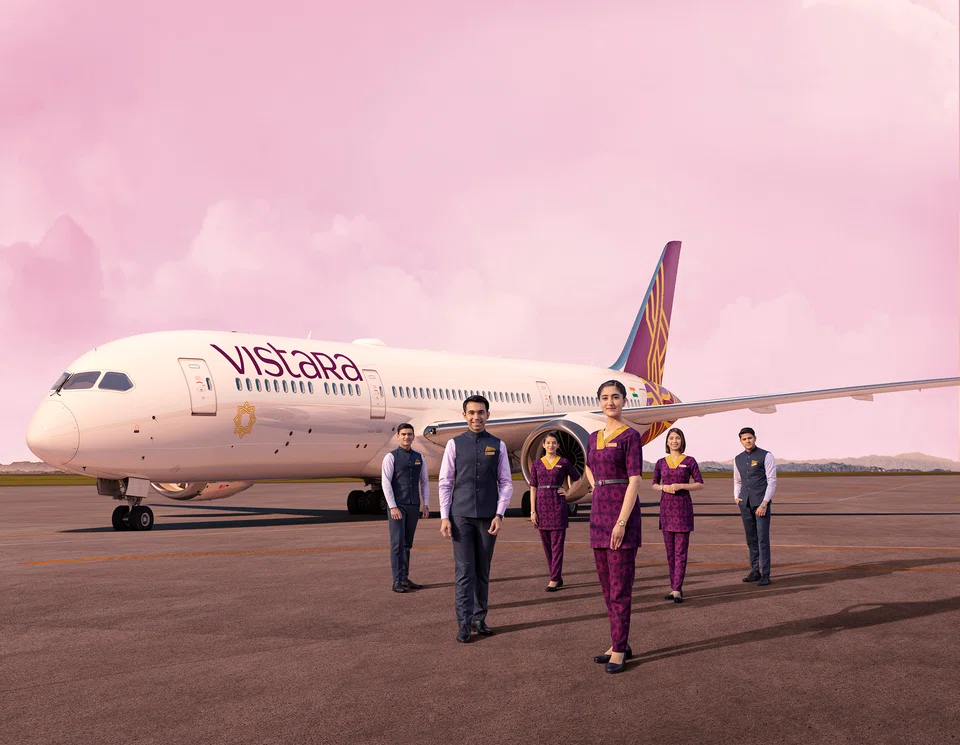
AS S INGAPORE Airlines (SIA) engages Tata Group over the potential merger of their joint venture – Indian carrier Vistara with Tata-controlled Air India – analysts are mixed about the prospects for any expansion in India.
A larger presence in India would give SIA a presence in a growing market with greater domestic revenue opportunity, but India has a highly competitive aviation scene that historically has not been very profitable.
The pandemic has taught SIA the significance of a domestic market, said DBS equity analyst Jason Sum.
Unlike peers in the United States and China, which could carry domestic passengers when international travel was restricted, SIA’s passenger traffic was less than 5 per cent of pre-pandemic levels for a protracted period.
Vistara, on the other hand, operates in a country with a fast-expanding middle class and relatively low air travel penetration, Sum said.
Boeing expects India to be one of its fastest-growing aviation markets, and has projected its air traffic to grow at 7 per cent annually through 2040.
According to Goh Choon Phong, SIA’s chief executive, Vistara has managed to take the second-largest share of India’s domestic market in less than 10 years since its inception in 2013.
“It is operating to 11 international points from India. Singapore Airlines will never be able to operate from India to domestic India, nor to so many international points from India,” Goh said at the company’s recent financial results briefing.
SIA owns 49 per cent of Vistara, while Tata owns the other 51 per cent. Goh said the Vistara stake is in line with SIA’s multi-hub strategy to directly participate in a market, and that Vistara can complement the Singapore hub.
Last month, SIA said it was in confidential discussions with Tata to deepen the partnership between their two companies.
The combined Vistara and Air India – should a merger take place – would be in a better position to wrest more share from the domestic market leader, budget airline IndiGo.
Sum of DBS said a merger would also broaden the combined entity’s international network and enable it to better compete against Middle Eastern carriers in the long-haul travel market.
Shukor Yusof of aviation consultancy Endau Analytics said SIA’s “management is very comfortable dealing with the Tata Group, and this in many ways will help them in their eventual decision”.
Added Yusof: “India is a huge market, particularly with China remaining shut. I get the sense (that) SIA is leaning on injecting more to get a seat on board. It’s a unique opportunity – even if the risks involved can be quite substantial.”
Competition in India is keen, however, and consumers are very price-sensitive, making profitability difficult for carriers.
DBS’ Sum said regulatory limits on domestic air fares and high taxes on jet fuel would be a drag on profitability: “The combined entity may remain loss-making for some time and require additional capital injections from both SIA and Tata in the future.”
Citi equity analyst Kaseedit Choonnawat said any incremental investment by SIA into the combined entity would be a “near-term negative” for the flag carrier, because of the loss-making records of both Indian airlines, Air India’s negative equity, and the latter’s plans to treble its fleet size.
Air India was loss-making for over a decade, even before the pandemic floored some carriers globally.
Vistara posted a net loss of S$363.7 million for FY2022 versus a net loss of S$305.7 million in FY2021, according to SIA’s annual report. SIA has depleted all its cost of investment in the Indian carrier, according to SIA’s latest half-year financial statements.
A back-of-the-envelope calculation based on disclosures indicates SIA has pumped in over S$900 million in the joint venture.
Choonnawat estimates SIA might need to spend another S$1.7 billion to maintain its 49 per cent stake in the combined entity, and S$2 billion a year over a decade as its contribution towards capital expenditure of the combined Indian entity – excluding any restructuring cost.
He nevertheless expects a combination to be favourable for SIA in the long haul, as the combined entity should have a higher capacity and certain levels of frequency or destination dominance – especially on international routes.