More dissenters could signal increased resistance to future Fed rate cuts
Investors should be positioned for the Fed to continue easing at least once more in 2026, say analysts
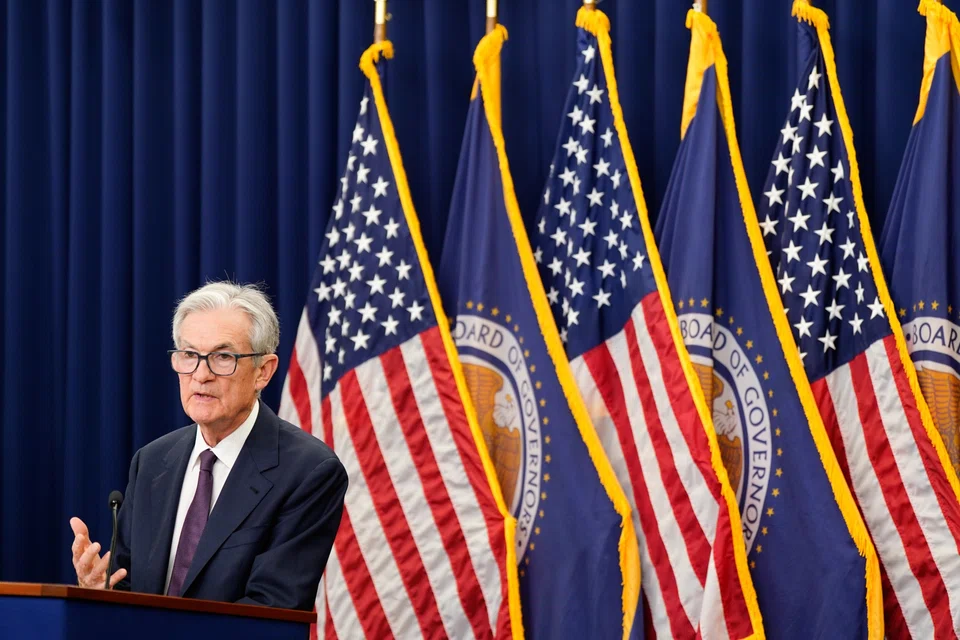
THE US Federal Reserve’s expected interest rate cut and its surprisingly rosy view of the US economy caused stock gains on Wednesday (Dec 10), although those gains were somewhat limited as the fog of the recent 43-day government shutdown has not fully cleared.
The central bank cut rates to a range of between 3.5 and 3.75 per cent, in line with the vast majority of projections.
There was an unusually high number of dissenters, however, with the vote coming out as 9-3. One dissenter, Stephen Miran – the chairman of the Council of Economic Advisers in US President Donald Trump’s second Administration – had advocated a 50 basis point cut, while two others argued that a cut was reckless in the face of inflation risks.
“The Fed was dovish in October, hawkish in November, and is dovish again now,” said Scott Helfstein, the head of investment strategy at money manager Global X, in a note to clients.
“Investors should be positioned for the Fed to continue easing, but perhaps the pace of easing might slow down.”
Stocks were volatile in the wake of the Fed’s statement, mostly due to new language that said the central bank would adjust interest rates further only “if risks emerge”. Investors initially interpreted that condition as a sign the Fed was hitting the pause button once again.
Fed chairman Jerome Powell, who will step down in May next year after overseeing three more meetings, confirmed that the Fed was leaning towards a pause in 2026.
He said rates were now likely neutral and no longer “restrictive”, which meant they would not impede economic growth nor stimulate inflation, and were thus no longer in need of adjustment. The so-called “dot plot” – or chart of Fed officials’ rate predictions – suggested there would likely be at least one more rate cut in 2026.
“I feel like we are well positioned to wait and see how the economy evolves from here,” said Powell.

He also reiterated the tricky position that the central bank found itself in, contending with both rising inflation and rising unemployment. This was the first time in his career that the US economy was dealing with both phenomena at the same time, he said.
The positive surprises in the aftermath of Powell’s press conference came in the economic analysis. While citing the risks on both sides of the Fed’s dual mandate, Powell also noted that things were not as bad as the 1970s.
During that era, inflation and unemployment remained stubbornly high for years. Powell noted that after spiking to 10 per cent in 2022, inflation has moderated to roughly 3 per cent of late.
Asked by journalists on what his legacy would be, Powell expressed hope that it would be an economy with a healthy labour market and tame inflation that he could hand over to the next Fed chair in May. Trump is widely expected to name his adviser Kevin Hassett as Powell’s successor in the coming weeks.
Economic optimism
Powell’s economic optimism was the “cherry on top” of the rate cut for stock-market bulls, said Ryan Detrick, chief market strategist at financial consultancy The Carson Group, in a commentary.
Powell’s optimism was grounded in data. The combination of “solid” consumer spending and an artificial intelligence (AI) boom would likely push up gross domestic product growth to about 2.3 per cent in 2026, he said.
While acknowledging that the American lower and middle classes were struggling due to the cumulative effects of four years of price increases, Powell also claimed that lower-income earners experienced the biggest wage increases at the end of the last expansion; and that there was reason to hope for similar progress if the current expansion lasts long enough.
“We are going to get a great deal of data between now and (the) January meeting,” said Powell. “The data we get is going to factor into our thinking.”
The stock market reaction was muted, with the Dow Jones Industrial Average finishing about 1 per cent higher.
There could be bigger moves next week, when the economic data that Powell has waited for since the “fog” of the government shutdown descended two months ago finally arrives – both the consumer price index and November jobs data are expected to be announced.
Powell was also sanguine about the ongoing AI boom. There were no signs, as yet, he said, of mass layoffs caused by AI replacing human workers, though he did allow that this was a long-term risk.
He said the boost to GDP growth from capital expenditure on data centres and other AI technology look set to continue into 2026.
What investors and analysts will be watching out for in 2026 is whether there will continue to be a relatively high amount of dissent among the Fed when it comes to how it decides on rates.
Powell noted that the state of the current US economy – with inflation still above the Fed’s 2 per cent target and the labour market showing signs of weakening – is one where disagreements should be expected.
“A very large number of participants agree that risks are to the upside for unemployment and to the upside for inflation, so what do you do?” Powell said. “You’ve got one tool, you can’t do two things at once. It’s a very challenging situation.”
The combination of muted inflation and strong US jobs data to be released next week could well justify Powell’s continued optimism for the time being.
Decoding Asia newsletter: your guide to navigating Asia in a new global order. Sign up here to get Decoding Asia newsletter. Delivered to your inbox. Free.
Share with us your feedback on BT's products and services