

OCBC raises 2026 loan growth forecast after Q2 profit jumps 22%, lifts dividend
Higher guidance comes as wealth, trading and insurance offset pressure from lower interest rates

[SINGAPORE] OCBC has raised its full-year loan growth guidance after a stronger-than-expected first half, as continued momentum in wealth management and corporate lending helped offset lower interest rates.
The bank now expects loan growth of high-single digits to low-double digits, up from its previous forecast of mid-single-digit growth. It also expects total income to grow year on year despite a slight decline in net interest income.
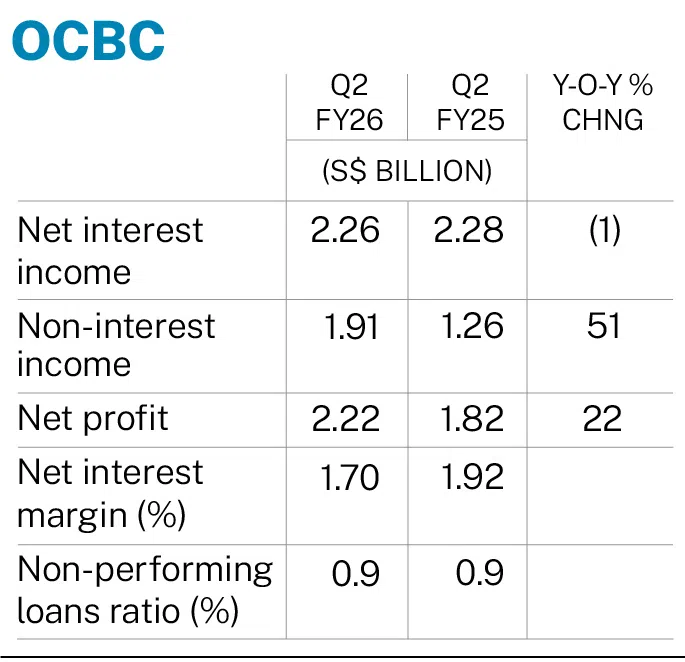
The upgraded outlook came as OCBC on Friday (Aug 7) reported a record second-quarter net profit of S$2.22 billion, up 22 per cent from a year earlier and above the S$1.91 billion consensus forecast in a Bloomberg survey of five analysts.
Profit before tax rose 20 per cent to S$2.76 billion as total income climbed 18 per cent to a record S$4.17 billion.
The stronger performance was driven by non-interest income, which jumped 51 per cent to a record S$1.91 billion.
Fee income rose 28 per cent on the back of record wealth management fees, while trading income surged 85 per cent as customer activity picked up and Great Eastern benefited from a rebound in equity markets. Insurance income, meanwhile, increased 68 per cent.
Net interest income, however, slipped 1 per cent to S$2.26 billion as lower interest rates compressed margins.
The board declared an interim dividend of S$0.47 per share, up from S$0.41 a year earlier.
Group CEO Tan Teck Long said that the bank’s loan pipeline remained robust, anchored by sectors such as supply chain diversification, energy transition and sustainable finance, but cautioned against expecting another quarter of similarly rapid expansion.


“We don’t really expect that exceptional growth rate to continue in the third and fourth quarter,” he said, noting that second-quarter growth had been boosted partly by M&A (mergers and acquisitions) financing.
“It doesn’t mean that the fourth quarter is weak. It’s just relative to the second quarter, we will be at a slower pace,” he added.
China trust rules
Separately, Bank of Singapore (BOS) – the private banking arm of OCBC – said that it has not seen significant client asset outflows following China’s latest rules affecting offshore trust structures.
Jason Moo, CEO of the private bank, noted that it was still early days since the measures were announced and the bank was in the process of contacting affected clients.
“We haven’t seen any significant asset outflows since the news (came) out,” he observed, adding that while some clients had sought clarification, others had welcomed the greater regulatory certainty.
Moo also described the trust business as “small”, saying it forms part of BOS’ overall assets under management but is not a significant contributor to revenue.
OCBC is also continuing to expand its wealth business in Hong Kong, where it is adding relationship managers and seeing higher productivity among its existing bankers, said Sunny Quek, head of global consumer financial services.
The bank unveiled a new branch that is due to officially open at the end of September, with customer acquisitions at the location already picking up. It is also looking to add more wealth branches in Hong Kong, he added.
Separately, Quek pointed to productivity gains from OCBC’s generative artificial intelligence-powered sales training programme launched in April.
Wealth advisers who went through the programme saw their productivity increase by almost 50 per cent, while their appointment-setting rate also rose by about 50 per cent, he noted, although OCBC does not attribute all of those gains solely to AI.
On the latter point, Tan stressed that OCBC does not view the technology as a strategy on its own, preferring instead to deploy it selectively where it creates value.
“We don’t really have an AI strategy per se,” he said. Instead, the bank follows what Tan calls an “ADD” approach, combining AI, digitalisation and data analytics to redesign processes and improve productivity.
He noted that he was not “a big fan of (generative) AI everything”, preferring simpler AI tools where they offer better value and lower computing costs.
Wealth acquisitions preferred
Tan also signalled that OCBC remains open to acquisitions, although it would prioritise opportunities that strengthen its retail and wealth franchises.
His preference would be for transactions similar to the acquisition of HSBC Indonesia’s wealth business announced earlier this year, rather than buying corporate loan books, which he said the bank was capable of growing organically.
Asset quality remained resilient, with the non-performing loan ratio unchanged at 0.9 per cent. Total allowances rose to S$156 million in the quarter, mainly due to management overlays set aside to cater for macroeconomic uncertainties in Indonesia.
Asked about the higher provisions in Indonesia, Tan replied that the bank’s credit quality there remained “very sound”, with the increase largely reflecting normal management overlays rather than any deterioration in the portfolio.
Shares of OCBC closed 3.3 per cent higher at S$30.30 on Friday. Year to date, the counter is up 52.6 per cent.
Decoding Asia newsletter: your guide to navigating Asia in a new global order. Sign up here to get Decoding Asia newsletter. Delivered to your inbox. Free.
Copyright SPH Media. All rights reserved.
TRENDING NOW

DBS, OCBC, UOB rout lops billions off STI as inflation, rate concerns spook investors

Grab CEO’s wife Chloe Tong on life with Anthony Tan and finding her purpose

OCBC sheds S$8 billion in value as shares close nearly 6% down; analysts cautious on banks

Deal between tycoon friends sparks scrutiny of Philippine power sector

