

Olam posts H2 profit of S$264.9m on reorganisation-led turnaround


Tan Nai Lun &
Uma Devi
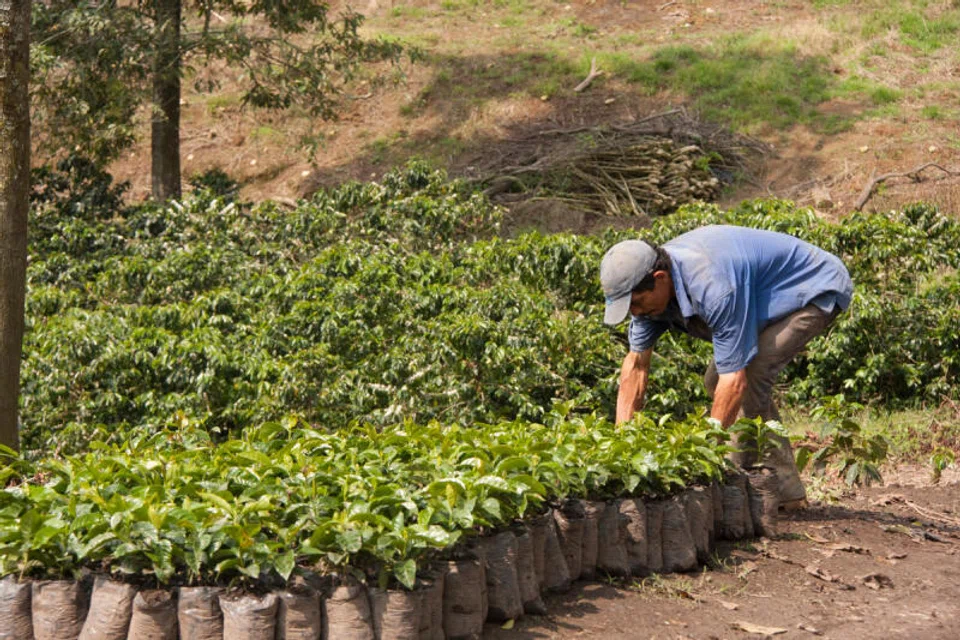
AGRI-FOOD giant Olam International O 32 posted a net profit of S$264.9 million for its second half ended Dec 31, 2021, from a loss of S$87 million a year ago.
This was mainly due to higher operating profit, as well as lower exceptional losses recorded for the period, the company said in a bourse filing on Monday (Feb 28).
Revenue for H2 rose 29 per cent to S$24.2 billion, from S$18.7 billion a year ago.
A second interim dividend of 4.5 cents per share was recommended for the half year, up from the 4 cents per share dividend declared a year ago. Details of the payment of the dividend will be announced later.
For the full year, net profit was up 179.4 per cent to a record S$686.4 million on strong operating profit growth and significantly lower exceptional losses compared to the year before. Revenue was up 31.2 per cent to S$47 billion, due to higher prices across most products and commodities in 2021.
In a call to discuss the company's latest financial results, group chief executive Sunny Verghese said that despite challenges such as the Covid-19 pandemic, the group is "on track" and its reorganisation plan is working well.
He added that the group has had a good start to this year so far, and is "cautiously optimistic".
The company had in 2020 said it would reorganise its business into 3 units to unlock long-term value. These include Olam Food Ingredients (OFI), which consists of the company's cocoa, coffee, edible nuts, spices and dairy businesses; Olam Global Agri (OGA), which comprises the grains and animal feed, edible oils, rice, cotton and commodity financial services businesses; and Olam International, which will focus on investing in start-ups involved in digital technology and sustainability after OFI and OGA are spun off.
Updating on its reorganisation plans, the company noted that OFI is set to list in the second quarter of 2022, with a concurrent primary listing in London and a secondary listing in Singapore.
Providing an update on the reorganisation, Verghese stressed that rejigging the entire group's portfolio was not an easy one.
"We had 250 entities across 67 countries," he said. "Taking all the assets, liabilities, cash, people from all of these entities and then deploying them into the new operating groups was a very complex and intricate programme." But the group is now in the "last phase of execution".
As for OGA, the company is exploring a sale of significant minority stakes in Olam Agri, and/or a potential initial public offering and demerger. Verghese said the time difference is strategic, as it would not be advisable to do 2 IPOs and demergers at the same time.
Each unit, upon the carve-out, has its own strengths, company executives said. A Shekhar, chief executive of OFI, said the unit is in "the front and centre of some very key structural consumer trends" and the reorganisation would bring together 5 leading platforms that are serving large consumption categories.
He said the business currently is a "sizeable business of relevant scale" with S$15 billion in sales. The runway is also solid - with a target addressable market across these 5 end-use categories of US$750 billion in size and growing at 5 to 6 per cent annually.
Meanwhile, one of OGA's strengths lies in its low overhead cost per tonne compared to its peers because of its "differentiated model". Verghese said many competitors are heavily invested in "origins" such as inland elevation facilities, storage facilities, port terminals and port storage facilities. "(This) makes it difficult for them to flexibly shift sourcing operations to countries that are becoming more competitive," he said.
"The markets that are also growing are very different from the traditional markets that have grown in the past... So there is a little bit of lack of degrees of freedom to shift their configuration of assets to be in the sweet spot of where the major exporters are now emerging from and where the new major sources of demand are also emerging from."
Looking forward, Olam noted that the economic outlook and prospects for the group for 2022 remains positive, with the industry continuing to see strong demand and tight commodity supplies amid supply chain disruptions, barring unforeseen circumstances.
As far as troubles between Ukraine and Russia are concerned, Olam is closely monitoring the developments there. The company has over 100 employees in Ukraine - all of whom are local hires and citizens - and 1,938 employees in Russia.
"Obviously, there is anxiety in all these places. These 2 are important markets for the world (in terms of) grain and oilseeds, dairy and agri-business markets," said Verghese.
For now, Olam is able to substitute some of its contracts which are based on wheat or corn from either country with "other competing origins" that have similar quality or value.
As at 1.48 pm, shares of Olam are trading at S$1.68, down 1.8 per cent or S$0.03.
READ MORE:
- Olam's demerger will enhance shareholder value, improve financial position, it tells shareholders
- Olam's reorganisation will help unlock units' full potential, says its CEO
- Olam adds raft of banks to IPO of US$18b food unit
TRENDING NOW

Knight Frank’s Tan Tee Khoon leaves firm, Nicholas Keong takes over auction business

Keppel Energy, Sembcorp Utilities and Tuas Power to supply biomethane in pilot project

GovTech retrenches another 38 staff in second round of layoffs
Take-up of new private homes dives 45% in Q3 as prices accelerate with 1.4% rise

