OUE Reit looks to unlock value in mature assets, eyes Sydney for higher-yield growth
Proceeds from a potential One Raffles Place sale could fund its further expansion in Sydney’s Salesforce Tower

[SINGAPORE] OUE Real Estate Investment Trust ( OUE Reit ) is stepping up capital-recycling efforts, as it looks to redeploy proceeds from potential sales of mature Singapore assets into higher-yielding investments such as in Australia.
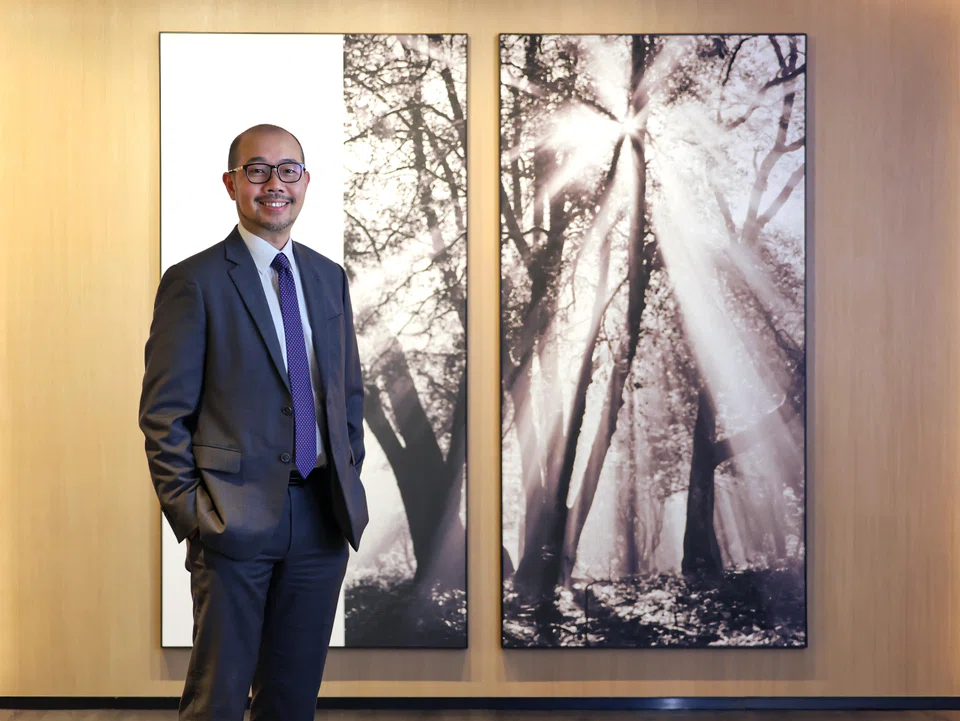
“We are trying to build a high-performance, capital velocity engine,” said Han Khim Siew, chief executive officer of the manager. “We are not here to collect and run legacy assets into the ground.”
A legacy asset in focus is One Raffles Place, a substantial office property in the Central Business District (CBD), which the Reit is exploring for a potential sale.
All the owners of One Raffles Place are understood to have come together, and have appointed CBRE and JLL as joint marketing agents to find a buyer for the asset. The indicative pricing (for 100 per cent interest) is projected to be in the S$2.3 billion to S$2.4 billion range, The Business Times reported earlier.
OUE Reit holds an 83.33 per cent interest in OUB Centre Ltd, whose 81.54 per cent beneficial interest in One Raffles Place is valued at S$1.9 billion as at end-December 2025.
One Raffles Place comprises two office towers – of 62 storeys and 38 storeys – and a six-level retail podium. The first tower was completed in 1986, while the second was completed in 2012. The retail podium received a makeover and reopened in 2014.
Referring to One Raffles Place as an “older, vintage, legacy asset”, Han said the property would require significant investment to modernise and faces increasing competition from newer offices, including Singapore Land Group’s premium Grade A tower The Clifford expected to launch in 2028.
A divestment of One Raffles Place would remove roughly 30 per cent of the Reit’s income, significantly affecting distribution per unit (DPU).
Capital redeployment
Despite the near-term income hit, a sale would allow the Reit to pare down debt – which carries a current cost of 3.9 per cent per annum as at Dec 31, 2025. The freed-up capital can also be redeployed into higher-yielding investments.
“Trapping capital in such mature assets just to maintain a headline asset under management number is not the correct thing to do. That is how you generate mediocrity,” he added, noting that disciplined capital recycling and portfolio optimisation could drive its stock price and DPU growth.
For financial year 2025, the Reit’s DPU rose 8.3 per cent to S$0.0223 from S$0.0206 in FY2024. The amount available for distribution grew 13.9 per cent on the year to S$123.8 million. The distribution yield was 6.2 per cent, based on the closing price of S$0.36 as at the last trading day of FY2025.
In March, the Reit completed its acquisition of a 19.9 per cent stake in the 55-storey commercial freehold Salesforce Tower for A$357.2 million (S$319.8 million). The acquisition is expected to be DPU accretive, generating an initial passing yield of about 5.8 per cent. This is compared with prime CBD offices in Singapore that trade at 3 to 3.5 per cent, said Han.
“Salesforce Tower was a strategic acquisition because it allows us to build a proprietary pipeline in Sydney,” he noted.
“We currently own 19.9 per cent, with the remaining 80.1 per cent held by other partners, some of whom plan to exit over the next one to five years. This gives us a natural moat, allowing us to increase our stake anywhere from 20 per cent to full ownership.”
The purchase is driven by potential upside in Sydney’s premium office segment, where supply in the core CBD remains limited, alongside the opportunity to diversify income streams and reduce concentration risk.
With a wave of new office supply set to come on stream in Singapore over the next few years, Han expects positive rental reversions to moderate, though it is still too early to say if this will lead to rental declines, which are likely to affect older, non-core assets more.
“We believe Singapore will increasingly experience the same bifurcation seen across other gateway cities, with demand concentrating in prime, high-quality assets.”
Expanding into Sydney, where new prime supply remains constrained, thus provides a hedge against such downside risks, he said.
Singapore still core
Following the Salesforce Tower purchase, OUE Reit’s portfolio value rose from S$5.8 billion to S$6.1 billion, with Singapore accounting for 94.9 per cent and Australia 5.1 per cent of total exposure.
If the Reit were to acquire up to 50 per cent of the building, its Australian exposure would rise to around 15 per cent, he added.
Still, Singapore remains OUE Reit’s “fortress”, with local office assets contributing about 50 per cent of income.
After selling Lippo Plaza Shanghai in 2024, the Reit’s portfolio comprises OUE Bayfront, OUE Downtown Office, One Raffles Place, retail mall Mandarin Gallery, and the Hilton Singapore Orchard and Crowne Plaza Changi Airport hotels in Singapore as well as Salesforce Tower in Australia.
For its hospitality assets, Han expects revenue per available room to continue growing amid a steady line-up of events and a lack of new hotel openings along Orchard Road.
New hotel supply is expected to grow at a measured pace of 1.7 per cent per annum between 2025 and 2027, below the pre-pandemic historical average of 4.4 per cent.
He also expects retail rents to remain elevated and leasing activity to remain resilient. For FY2025, Mandarin Gallery recorded a positive rental reversion of 12.4 per cent and average passing rent was S$22.45 per square foot per month.
Further divestments of mature assets are on the cards for OUE Reit, as part of its ongoing capital-recycling strategy.
“We take an agnostic view of all our assets. If we feel we have reached peak valuation and it is time to crystallise gains, and the market provides the liquidity to do that, we will do it.”
On the potential sale of Crowne Plaza Changi Airport, whose first term of master lease is expiring in May 2028, Han said the Reit’s portfolio of prime core assets has generated interest over the years.
He added that the Reit occasionally receives expressions of interests for its assets and such opportunities are evaluated as part of its ongoing asset management and capital-allocation strategy.
“If investors are looking for a manager that will hold legacy assets indefinitely, they should look elsewhere,” he said. “What we are here to do is drive returns, and we will do so through disciplined capital allocation.”