Raffles Family Office opens new Singapore office, launches foundation to formalise philanthropy push
The newly established RFO foundation reflects a generational shift in how Asia’s ultra-wealthy think about legacy
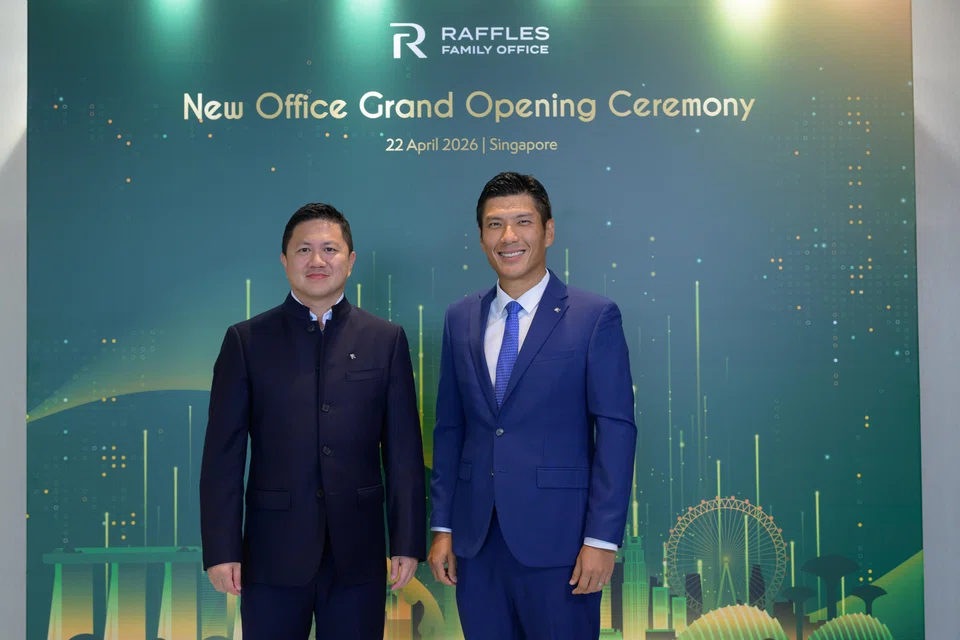
[SINGAPORE] Raffles Family Office (RFO) is formalising its philanthropic push with the launch of the RFO Foundation, as rising demand from next-generation wealth owners drives a shift towards more structured and purpose-driven giving.
Based in Hong Kong, the foundation – funded entirely from RFO’s balance sheet using portfolio dividend income – marks a move away from years of informal, ad-hoc donations.
The launch was announced alongside the opening of RFO’s new Singapore office at OUE Bayfront on Apr 22, which will house more than 100 employees.
The RFO Foundation brings the firm’s philanthropic resources into a dedicated entity within its multi-family office framework. This aligns its mission of providing education, talent development and industry knowledge exchange more closely with client priorities.
RFO has dual headquarters in Hong Kong and Singapore, serving ultra-high-net-worth clients across Asia.
“There is a gap in mindset in how the next generation wants to run a family business,” noted Kendrick Lee, CEO, Singapore, RFO. “For the previous generation, it was more of a delegation to private banks… (but now) they want to impose their identity on their own family office.”
In shaping this identity, the younger generation sees philanthropy as increasingly important, being a key vehicle to put their values into practice and contribute to causes in which they believe.
“Philanthropy is not something that we have started doing this year – we have been doing it for the past five to six years,” noted Kwan Chi Man, group CEO, RFO, adding that what changed was the scale of demand and the need to institutionalise it.
Talent is key
The foundation will focus on developing talent and leadership building, particularly through education and cross-border exchanges across Singapore, Hong Kong and South-east Asia.
Kwan noted that Asia is in the midst of a major intergenerational wealth transition, with the younger generation placing greater emphasis on social responsibility.
This shift in priorities raises a broader question: how do family offices channel philanthropic intent into something lasting and structured?
For RFO, the answer lies in building talent pipelines alongside philanthropic values, two goals it sees as closely linked.
Lee Wei Song Music Academy in Singapore was among the first to benefit from the RFO Foundation’s scholarship programmes, empowering young artists to create original music for social causes. This comes as the foundation’s structure is not jurisdiction-specific, which enables it to support causes across markets, including Singapore.
Succession, though, remains the deeper concern. “It is not just about the foundation, but how they run their own family office,” said Kwan.
The RFO Foundation is designed in part to demonstrate best practices – by showing the next-generation clients how a well-governed foundation works. Through this, RFO hopes to build trust and open the door to future collaboration between its own foundation and those of its clients.
Lee notes that when bringing generations together to make decisions, there would be a “mindset gap”. This makes the need of a third party like RFO relevant, where coming in from a professional standpoint takes emotions off the table, he added.
Governance is key
The current foundation is set up in Hong Kong as it builds on several years of philanthropic work by RFO already anchored there, but Singapore remains firmly on RFO’s radar for a future base.
Kwan noted that Singapore offers a very clear regulatory framework and attractive tax incentives for philanthropic structures.
This comes as Singapore is seeking to encourage charitable giving by family offices, with single-family offices in Singapore exceeding 2,000 as at end-2024, up 43 per cent on year.
“It is definitely in our pipeline,” he said, adding that Singapore aligns with the foundation’s long-term ambitions. “We will explore establishing in Singapore as the foundation expands its reach and scale.”
Regardless of locations, governance is the foundation’s cornerstone, he added. Intergenerational transference of wealth carries risks that are often under-estimated – not just structural, but deeply human.
“Governance is the number one issue – it is about the structures, how and who you put in place to run it,” Kwan said.
He noted that addressing that gap requires rigorous due diligence on beneficiaries, proper structures and a sustained investment in training the next generation to lead effectively.