In S-E Asia, can quick commerce become a key growth driver for food delivery platforms?
This approach improves rider utilisation rates and could catalyse subscription services

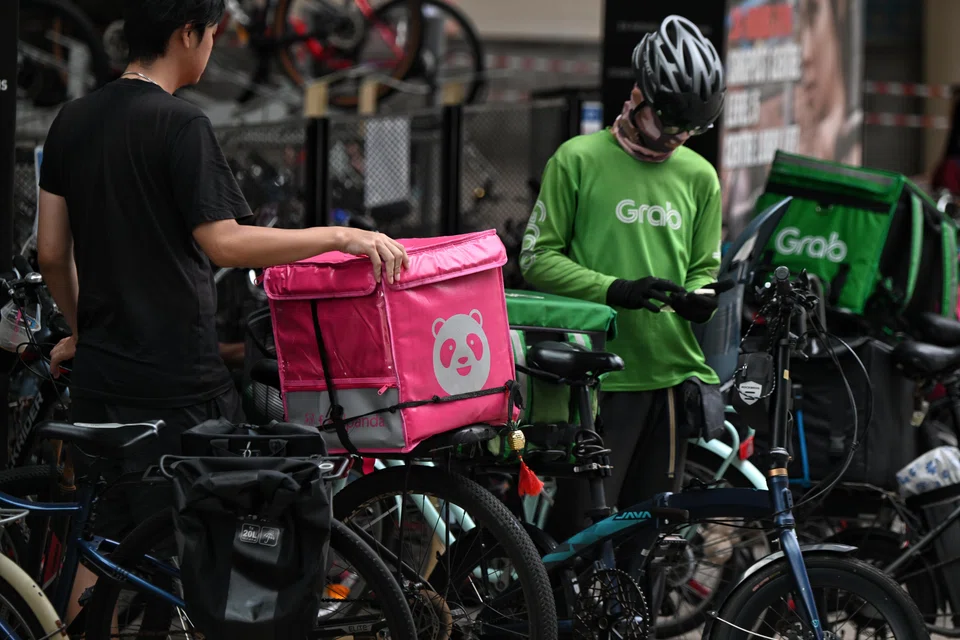
[SINGAPORE] Quick commerce is evolving in Singapore as food delivery platforms seek to improve unit economics, with customers moving beyond last-minute order top-ups towards larger, planned grocery purchases.
Quick commerce refers to the delivery of goods and services in an hour or less.
On foodpanda, Singapore shoppers have increased their monthly order frequency by 7 per cent since 2023. Customers also bought 8 per cent more products in each order between 2024 and 2025.
This led the food delivery platform to launch pandamart XL, a dark store or distribution centre exclusively for online deliveries. It has 30 per cent more products than the regular pandamart.
The two pandamart XL stores, in Kallang and Yio Chu Kang, allow foodpanda to support a wider range of grocery needs.
“The deeper and more diverse assortment allows customers to shop across fresh produce, everyday essentials, speciality items and more in a single order,” Axelle Guibert, director of quick commerce at foodpanda Singapore, told The Business Times.
“Better rider utilisation outside of peak mealtimes is what helped e-commerce platform Shopee roll out instant delivery in Indonesia and Malaysia. ”
Quick commerce evolved out of a need to improve rider utilisation outside of the lunch and dinner rushes. This approach has lifted rider utilisation rates by between 10 and 15 per cent, said Roshan Behera, partner at consultancy Redseer.
Another benefit, he added, is that quick commerce helps to engage riders and reduce churn with more jobs across the day, which builds platform affinity or loyalty.
Better rider utilisation outside peak mealtimes is what helped e-commerce platform Shopee roll out instant delivery in Indonesia and Malaysia.

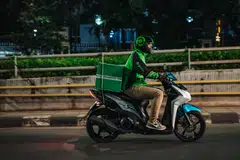
ShopeeFood riders were able to deliver orders for Shopee sellers as well, getting goods into customers’ hands within a matter of hours.
In 2025, ShopeeFood overtook foodpanda as the second-largest food delivery platform by gross merchandise value (GMV) in South-east Asia. This was due partly to foodpanda’s exit from Thailand in May.
In its remaining markets of Singapore, Malaysia and the Philippines, foodpanda remains second to Grab in terms of GMV. In Malaysia, foodpanda has captured 22 per cent of the GMV market share, ahead of ShopeeFood’s 11 per cent.
“In foodpanda’s other markets in Asia, we also observe the same trend of quick commerce increasingly serving both ‘urgent top-up’ and ‘planned weekly baskets’, not just last-minute buys,” noted Guibert.
As pandamart XL steps further into the grocery space with fresh produce, it also overlaps directly with grocery players on the food delivery platform.
But Guibert pointed out that the quick commerce offerings are designed to be complementary rather than cannibalistic of existing merchants. “This gives our customers greater convenience, choice and flexibility when shopping on the platform,” she added.
Chen Weihan, insights lead at consultancy Momentum Works, noted that customers in South-east Asia still prefer to see and touch certain products, and the logistics for returns are still not as robust as those of developed markets such as China.
Dark store model
Nonetheless, food delivery platforms offer a cheaper alternative to building out logistics infrastructure for grocery players, even with the cut taken by the platform.
“I think what we see is that supermarkets still remain a very profitable business, and generally people still like to go to supermarkets – we like to touch our fruits and vegetables,” said Chen.
Still, foodpanda’s push into private labels – it now has its own groceries brand, named bright – shows that it is at an advanced stage of the dark store model.
Typical dark store models start with brands that customers already know to build trust, as they figure out the unit economics, said Behera.
After trust and customer channels are built, there tends to be a push towards private label products – the margins of which could be twice as high as those of name-brand goods. “Typically, we have seen about 12,000-plus orders per dark store, which makes it okay from a unit economics point of view,” added Behera.
Another approach is to partner a grocery brand or acquire one, like what Grab did with Jaya Grocer in Malaysia.
There is still room for quick commerce to expand in South-east Asia, noted Behera. Part of its growth will come from consumers getting hooked on the experience, allowing platforms to bring in more categories as customers bite.
Subscription services push
Quick commerce could be a differentiating factor in pushing subscription services, giving customers more reasons to keep using a platform.
The more often customers use a platform, the more likely they will form a loyal user base – making it easier to convince them to sign up for subscriptions, said Behera. “It definitely is an enabler or catalyst towards subscription services,” he added.
And amid food delivery platforms’ pursuit of profitability, subscription services could persuade customers to spend more. A virtuous circle can be established, with discounted offers encouraging more spending by subscribers.
“Subscription services are a great way to retain customers and increase customer lifetime value, which has been proven by global leading platforms like Amazon Prime and Alibaba’s 88VIP,” said Li Jianggan, founder and chief executive officer of Momentum Works.
Grab’s subscription service, Grab Unlimited, has also posted good progress, with about 20 per cent of transacting users being subscribers as at the third quarter of 2025.
While foodpanda does not disclose pandapro subscriber numbers, Singapore managing director Bhavani Shankar Mishra previously told BT that it contributes to more than half of its business in the city-state.
Whether quick commerce ultimately becomes a core profit engine or just a supporting pillar will depend on platforms’ ability to scale subscriptions, manage costs and sustain customer demand in an increasingly price-sensitive region, analysts said.
Decoding Asia newsletter: your guide to navigating Asia in a new global order. Sign up here to get Decoding Asia newsletter. Delivered to your inbox. Free.
Copyright SPH Media. All rights reserved.