SIA deploys over 160 AI applications in push to become leading ‘digital airline’
To date, the carrier has identified more than 550 potential applications for generative AI use cases

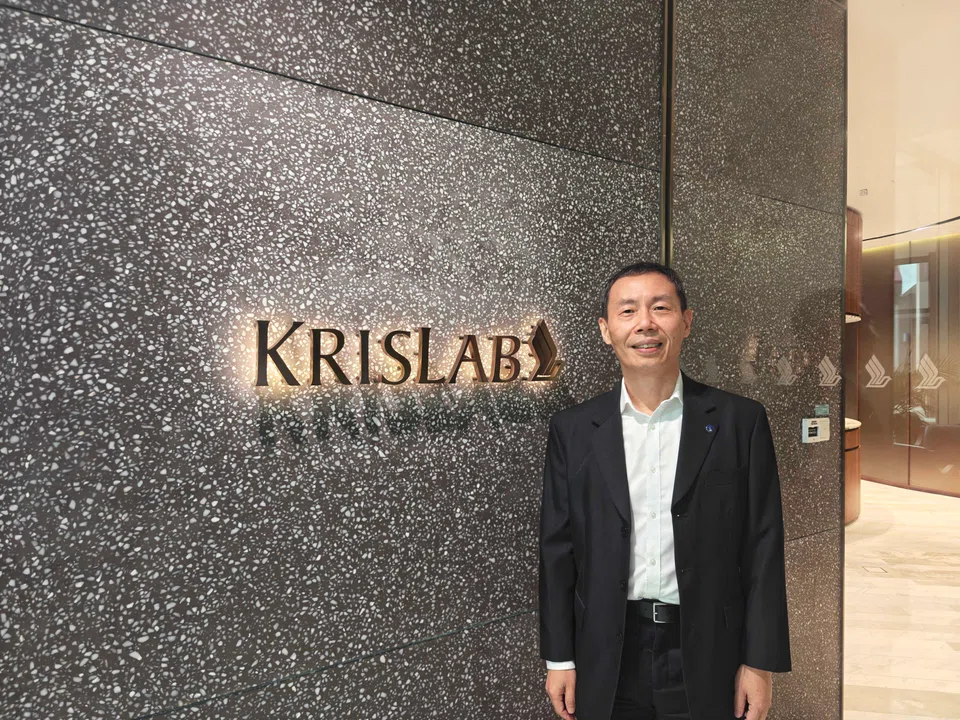
[SINGAPORE] Improved customer satisfaction and more efficient crew scheduling are among the benefits seen by Singapore Airlines (SIA) from its use of artificial intelligence.
The national carrier’s AI programme rests on a digital transformation that began in 2018. Then, CEO Goh Choon Phong identified AI as a “strategic value” and personally led the company-wide AI strategy.
A CEO-chaired committee was subsequently formed, while the board endorsed an AI blueprint covering business value and future-of-work, said George Wang, senior vice-president of information technology.
To date, SIA has identified more than 550 potential applications for generative artificial intelligence use cases, of which over 160 have been implemented across its business, as it seeks to become the world’s “leading digital airline”.
The carrier is already seeing gains from some of its AI deployments.
Its customer-facing AI chatbot Kris, which was integrated with a large language model, has nearly doubled its customer satisfaction score since its relaunch in July 2025, Wang noted.
Meanwhile, AI-assisted crew scheduling has saved the airline the equivalent of about 30 man-hours of operations time a day.
Customer engagement and crew scheduling
One front-end feature used to enhance customer experience is the “flight recommender” feature on the SIA website and mobile app, which suggests flights for users through a simple prompt.
This saves customers up to 30 minutes, Wang explained.
On the back end, SIA integrated its customer insights portal with its AI data analytics platform DataIQ to analyse large volumes of customer feedback and identify areas of improvement.
The group also deploys generative AI tools that summarise case histories and draft responses for customer-service agents to use.
“We see a faster resolution (time) for the customer, and at the same time there is a better, more consistent service for the customers,” Wang noted.
Besides customer engagement, SIA also uses AI in crew management. Wang pointed out that the tool has helped greatly in crew scheduling, which includes the assigning of flights, arranging for training hours, and accounting for rest times for the crew.
“We use AI to help the group stand by core decisions, and considering (the) many complex factors, like regulatory requirements, operational needs, and (other) considerations, they’re saving like 30 (man)-hours a day,” he said.
Wang added that this further allowed SIA workers to reduce the amount of manual work and instead focus on more strategic areas.
Robust adoption rates
The development of AI tools is done by a small team, said Wang, who declined to disclose the exact number of developers. Even as demand for in-house AI tools rises, SIA will remain “selective” in its hiring, he added.
“I am just being very realistic that scaling will not be infinite, and that we have to understand that there will be a limit,” he said.
This is further complicated by the particular expertise required to work in specialised domains – especially in the airline industry.
“You can have the best tech people, but if they don’t understand the domain, (they) will solve the wrong problem,” he said.
Internal adoption rates of AI remain robust.
In 2024, SIA implemented Jarvis, an internal generative AI tool that allows employees to build customisable AI workflows without coding.
The tool has seen a 95 per cent penetration rate – indicating that most ground staff have used it at least once. This usage is also sustained, as average monthly active usage of the internal AI tool stands above 60 per cent.
Non-technical employees have since used the tool to create 1,500 agents without the use of technical coding skills.
Achieving better outcomes in the long term
While AI is helping to improve operational efficiency and the customer experience, SIA is also investing in the future.
During the Covid-19 pandemic in 2020, with passenger numbers falling 97.5 per cent, the group doubled down on its digitalisation bet by establishing the SIA-NUS Digital Aviation Corporate Laboratory.
“We actually have a simulated cabin inside the NUS lab… and recruit volunteers to sleep in there,” noted Wang. This allows researchers to observe them and study how to optimise comfort.
The collaboration between SIA and NUS leverages multiple disciplines within the university – such as business, engineering and even medicine.
But this NUS collaboration is not a one-way street, as the university also stands to gain industry knowledge. “(NUS will) have a much deeper understanding about the airline, the business of the airline and the technology,” he added.
While the NUS collaboration focuses on outcomes two to five years from now, the collaboration with the Agency for Science, Technology and Research (A*Star) focuses on relatively shorter research periods of less than three years.
Through its collaboration with A*Star, SIA is able to improve on its predictive maintenance capabilities, which allows it to carry out maintenance preemptively. “We have worked with A*Star to help us to capture a problem before it happened,” Wang said.
The predictive maintenance solutions have successfully identified potential failures in advance, reducing significant downtime of SIA’s aircraft, noted A*Star on its website.
Asked if the rise of AI tools will lead to job displacement concerns within the national carrier, Wang said: “Ultimately AI is to support and augment our people and not really to replace them.”
That said, he acknowledged that AI will change the way people work, while also shaping many roles.
However, Wang noted that upskilling and providing training tools alone is insufficient for most employees. “Most people are better at learning by doing it. The pace of AI development is much faster than most companies can adopt.”