

SIA posts S$76 million Q1 loss despite record revenue as fuel cost jumps almost S$1 billion
Bottomline also dented by higher share of losses from associated companies, mainly Air India

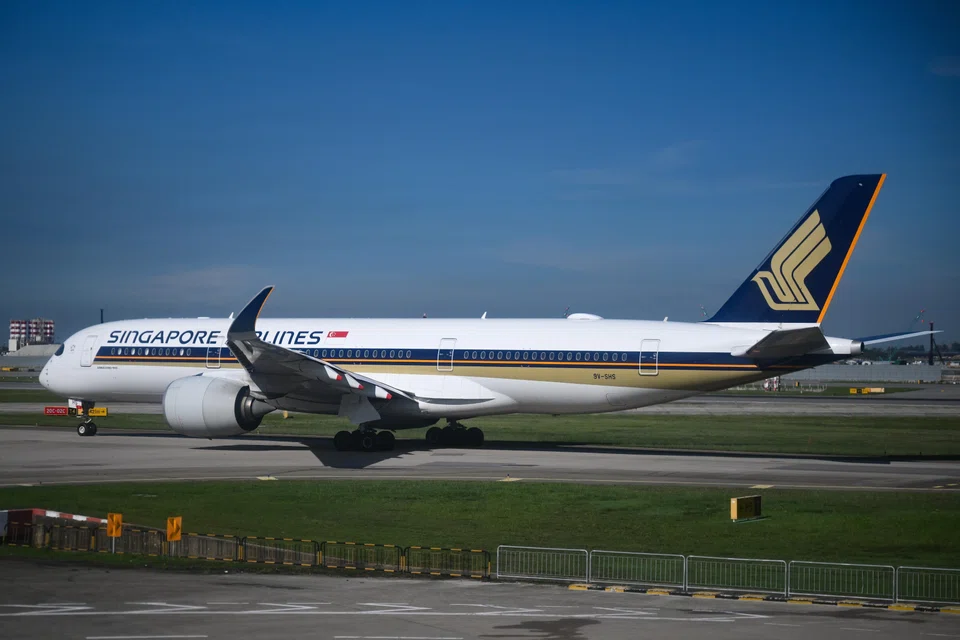
[SINGAPORE] Singapore Airlines (SIA) sank into the red with a net loss of S$76 million for its first quarter ended Jun 30, 2026, compared with a net profit of S$186 million in the previous corresponding period.
This was mainly due to a lower operating profit from a sharp 78.5 per cent jump in net fuel costs triggered by the Middle East conflict, as well as a higher share of losses from Air India, the national carrier said in a bourse filing on Tuesday (Jul 28).
Revenue for Q1 rose 19.3 per cent to a record S$5.7 billion, from S$4.8 billion the year before. This came from a strong demand for travel, sending passenger revenue up 18.6 per cent to S$4.6 billion; passenger yields rose 12 per cent, and cargo revenue, by 33.5 per cent.
Passenger yields rose to S$0.112 per revenue passenger-kilometre.
The group carried 10.9 million passengers during the quarter, up 6.3 per cent from 10.3 million in the corresponding period the year before.
Full-service carrier SIA carried 7.1 million passengers, up 4.1 per cent year on year; budget carrier Scoot carried 3.82 million passengers, up 10.8 per cent.
Group passenger load factor dipped 0.5 percentage points to 87.1 per cent, as the group’s capacity expansion of 5.9 per cent outpaced traffic growth of 5.3 per cent.
SIA recorded a passenger load factor of 86.2 per cent, down 0.4 percentage points from the preceding year.
Scoot’s load factor stood at 90.6 per cent, down 0.9 percentage points from Q1 FY2026.

The group’s cargo load factor rose 1.9 percentage points to 58.8 per cent. SIA noted that cargo demand “remains resilient across most key verticals, with semiconductor and data centre-related movements providing support”.
Group expenditure rose 27.9 per cent to S$5.6 billion, mainly due to a S$991 million or 78.5 per cent increase in net fuel cost to S$2.3 billion.
Given the sharp rise in fuel costs, the group recorded an operating profit of S$106 million, down S$299 million or 73.8 per cent from a year ago.
Of its outlook, SIA said demand for air travel remains robust, underpinned by seasonal travel flows.
However, macroeconomic and geopolitical developments, including the Middle East conflict, continue to add uncertainty to the airline industry’s operating environment.
The most immediate impact is on the price of jet fuel, the group’s single-largest expenditure item.
Jet fuel is typically priced on a lagged basis, and prices more than doubled following the outbreak of the Middle East conflict on Feb 28, 2026.
Prices remain volatile and elevated relative to pre-conflict levels, adding significant cost pressure on airlines globally,” SIA said in a statement.
“While SIA and Scoot have adjusted airfares and cargo rates to help mitigate this, these measures do not fully offset the impact of significantly higher fuel prices,” the group added.
Shares of SIA ended at S$7.77 on Tuesday, S$0.06 or 0.8 per cent higher, before the results were released.
Decoding Asia newsletter: your guide to navigating Asia in a new global order. Sign up here to get Decoding Asia newsletter. Delivered to your inbox. Free.
Copyright SPH Media. All rights reserved.






