

Singapore, Asia markets shrug off US Fed rate hike
Major Singapore Reits open slightly up or flat; broader market posts gains

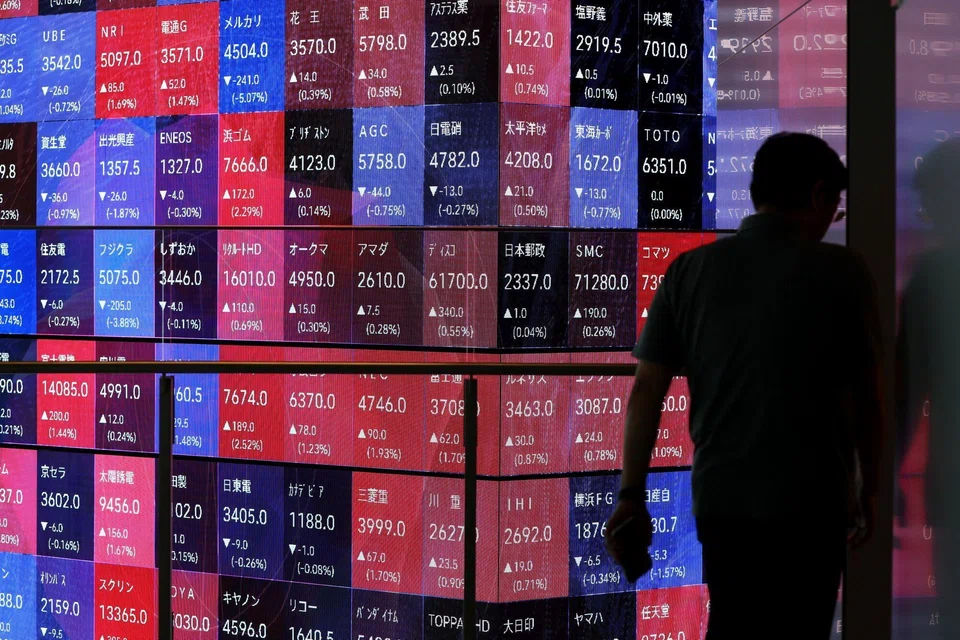
[SINGAPORE] Asia markets opened mostly higher on Thursday (Sep 17) morning, on the back of the US Federal Reserve’s first quarter-point rate hike in three years, announced the day before.
In Singapore, the Straits Times Index (STI) rose 0.4 per cent in the first five minutes of trading, and ended the session 0.5 per cent higher.
Rate-sensitive real estate investment trusts (Reits) opened lower, with UI Boustead Reit and Suntec Reit among the worst hit at 9.08 am, down 1.2 per cent and 0.7 per cent, respectively.
But they recovered by 9.20 am, though they still ended the day 0.6 per cent and 0.7 per cent lower, respectively.
Most other sectors, including banks, opened higher. Shares of DBS rose about 0.7 per cent, OCBC climbed 0.6 per cent and UOB was 1.3 per cent higher. They ended Thursday 0.2 per cent, 0.3 per cent and 1.6 per cent up, respectively.
The latest Fed decision, which saw the benchmark overnight interest rate raised by a quarter of a percentage point to the 3.75 to 4 per cent range, marks the first hike since 2023 to fight stubborn inflation stemming from soaring crude oil prices during the US-Israeli war on Iran.
In its accompanying statement, the Fed said its decision was unanimous and more tightening is likely in the near future to effect a timelier drop in inflation.
Regional indices also opened higher. South Korea’s Kospi was 0.4 per cent higher at 8.58 am. Meanwhile, Japan’s Nikkei 225 was up 0.2 per cent at 8.48 am Singapore time.
However, they ended the day mixed. Hong Kong’s Hang Seng Index lost 0.4 per cent, Japan’s Nikkei 225 rose 0.3 per cent, South Korea’s Kospi closed down 0.04 per cent and the FTSE Bursa Malaysia KLCI declined 0.3 per cent.



In the US, before the Fed’s announcement, the three major US stock indices had been gaining ground. After the announcement, Wall Street ended lower.
The Dow Jones Industrial Average fell 1.2 per cent, the S&P 500 lost 0.4 per cent, and the Nasdaq Composite lost 0.01 per cent.
The hike came largely in line with investor expectations.
“The Fed didn’t guide the market towards that decision,” Ipek Ozkardeskaya, senior analyst at Swissquote, said on Wednesday, with a clear verdict even before the decision was delivered.
“Investors guided themselves in the light of the economic data and geopolitical factors. And a 25 basis point (bp) hike is what investors collectively think should happen, and they’re positioned for it. Fed funds futures price in a more than 90 per cent chance of a 25 bp hike.”
Both the Fed and analysts noted that the US economy is strong enough for a rate hike, with resilient domestic spending, strong productivity growth and robust capital investment.
“The good news is that right now, and as we also see through the strong earnings growth of S&P 500 companies, the US economy remains robust (thank artificial intelligence investment and government spending),” Ozkardeskaya said.
“But the bad news is that the energy shock is now playing a nasty role,” she added.
“The correlation between oil and US Treasury yields is very tight today, near its highest level in seven years according to CNBC, showing that the bond market is reacting unusually strongly to moves in oil prices. That means that if oil prices stay high – or push higher – markets will be pricing not simply higher rates for longer, but higher inflation risk for longer.”
Decoding Asia newsletter: your guide to navigating Asia in a new global order. Sign up here to get Decoding Asia newsletter. Delivered to your inbox. Free.
Copyright SPH Media. All rights reserved.
TRENDING NOW

He built the Vingroup empire. Now South-east Asia’s richest man is handing some key roles to his sons
Quarter of Singtel special discounted shares sold ahead of CPF Board transfer

Why Tan Aik Keong of digital solutions specialist Agmo wants to make himself less indispensable

Asia needs new energy security architecture

