Singapore stocks continue losing streak on Friday; STI falls 0.6%
Thai Beverage leads the gainers on the blue-chip index; DFI Retail falls by the most
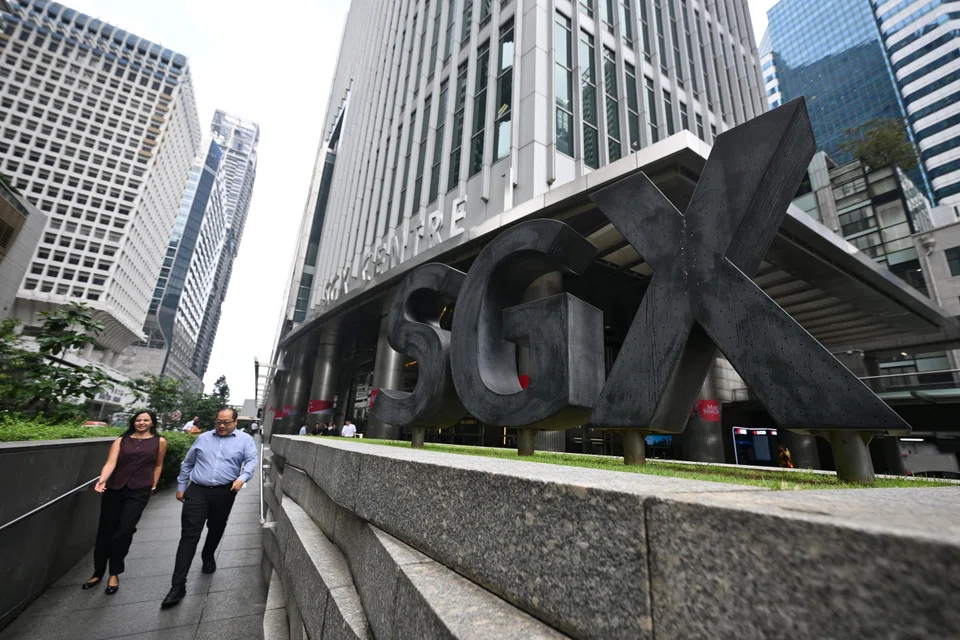
[SINGAPORE] Singapore stocks continued to falter on Friday (Oct 2).
The benchmark Straits Times Index (STI) lost 0.6 per cent or 32.85 points to finish at 5,634.82.
Thai Beverage led the gainers on Singapore’s blue-chip index, rising 1.2 per cent or S$0.005 to S$0.43.
The worst performer among STI constituents was DFI Retail Group , which fell 8.8 per cent or US$0.30 to US$3.10.
The three local banks ended mixed on Friday. OCBC rose 0.4 per cent or S$0.11 at S$31.66, while DBS finished 0.2 per cent or S$0.15 lower at S$77.21, and UOB finished 0.5 per cent or S$0.23 lower at S$43.11.
Within the iEdge Singapore Next 50 Index, PC Partner was the top gainer, rising 5.6 per cent or S$0.18 to S$3.38. UOB Kay Hian was the biggest decliner, falling 4.1 per cent or S$0.16 to S$3.72.
Across the broader market, gainers trailed losers 223 to 335, after 1.3 billion securities worth S$2.3 billion changed hands.
Hiap Seng Industries was the most actively traded stock with 159.4 million shares changing hands. DBS was the most actively traded stock in terms of value, with a volume of 4.5 million shares and a value of S$349.8 million.
Key regional indices were mixed. Hong Kong’s Hang Seng Index lost 2.6 per cent, Japan’s Nikkei 225 fell 0.9 per cent, South Korea’s Kospi was up 0.5 per cent and the FTSE Bursa Malaysia KLCI was flattish.
SEE ALSO
The jump in prices-paid figures on the US purchasing managers’ index affected US equities, while 10-year and 30-year US Treasuries hit multi-decade highs, said Jose Torres, senior economist at Interactive Brokers.
Buoyant labour statistics have bolstered yields and the US dollar further and hurt Wall Street sentiment.
Torres added that US President Donald Trump’s “statement that the US military could ramp up the bombing of Iran after the midterms generated geopolitical angst that propelled fuel charges”.
He explained that future attacks could “inflict new damage on energy infrastructure, at a time when Middle East producers have found workarounds to successfully send crude to export destinations”.
This article has been written with the assistance of AI and reviewed by a reporter
Decoding Asia newsletter: your guide to navigating Asia in a new global order. Sign up here to get Decoding Asia newsletter. Delivered to your inbox. Free.
Share with us your feedback on BT's products and services