

Singapore stocks end flat amid mixed regional showing
CapitaLand Investment leads the gainers on the Straits Times Index
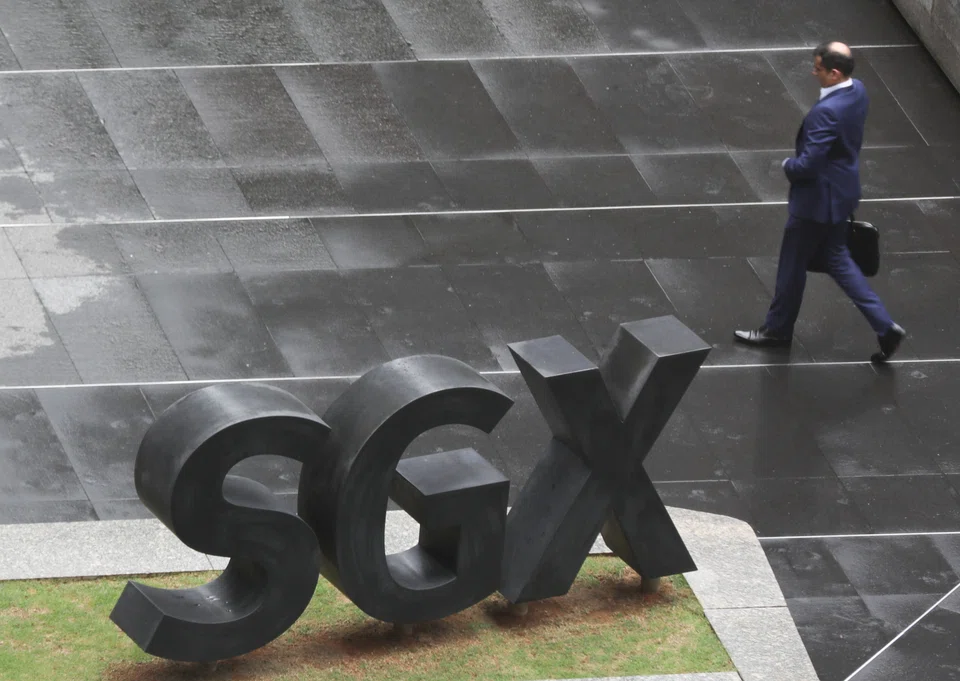
[SINGAPORE] Singapore stocks ended flat on Tuesday (Aug 4), with the benchmark Straits Times Index (STI) nudging down 0.03 point to 5,612.25.
CapitaLand Investment led the gainers on Singapore’s blue-chip index, rising 2.6 per cent or S$0.07 to S$2.73.
The worst performer among STI constituents was Sats , which fell 2.3 per cent or S$0.11 to S$4.70.
The three local banks ended mixed on Tuesday. DBS rose 0.1 per cent or S$0.05 to S$74.50 and UOB was up 0.5 per cent or S$0.21 at S$43.25, while OCBC finished 0.5 per cent or S$0.15 lower at S$28.72.
Within the iEdge Singapore Next 50 Index, Yangzijiang Financial was the top gainer, rising 4.7 per cent or S$0.01 to S$0.225. ESR-Reit was the index’s biggest decliner, falling 4.9 per cent or S$0.13 to S$2.50.
Across the broader market, gainers outnumbered losers 331 to 231, after 1.2 billion securities worth S$1.8 billion changed hands.
International Cement was the most actively traded stock on the Singapore bourse, with 100.5 million shares changing hands.
Key regional indices were mixed. Hong Kong’s Hang Seng Index lost 0.6 per cent, while South Korea’s Kospi was up 1.6 per cent and the FTSE Bursa Malaysia KLCI advanced 0.4 per cent.
Japan’s Nikkei 225 rose 0.3 per cent after the US Treasury’s historic intervention in the yen market.



Lilian Haag, senior portfolio manager and team lead for equities at DWS, noted that this was “the first coordinated intervention by Japan and the US since 1998”.
“US and Japan officials this time warned investors that they are determined to keep defending the yen,” she said. “It is a clear warning sign towards speculative investors to not extend the carry trade ever higher.”
Haag also noted that foreign-exchange interventions have historically not been sustainable, but the move could still mark a “turning point in US-Japan currency cooperation” and “should not be underestimated”.
“The weakening yen has also put the Bank of Japan under pressure to pull forward potential rate hikes,” she added.
This article has been written with the assistance of AI and reviewed by a reporter
Decoding Asia newsletter: your guide to navigating Asia in a new global order. Sign up here to get Decoding Asia newsletter. Delivered to your inbox. Free.
Share with us your feedback on BT's products and services
TRENDING NOW

Singapore updates renewable energy certificate standard to tackle greenwashing; unveils new solar efforts

Director of PR firm sacked for secretly recording internal meeting loses wrongful dismissal claim

Indonesia says gas export cuts to Singapore remain within contract terms

Time for MAS, SGX to scrutinise issue managers

