

Singapore stocks end higher amid mixed regional showing; STI up 1%
DFI Retail Group leads the gainers on the blue-chip index
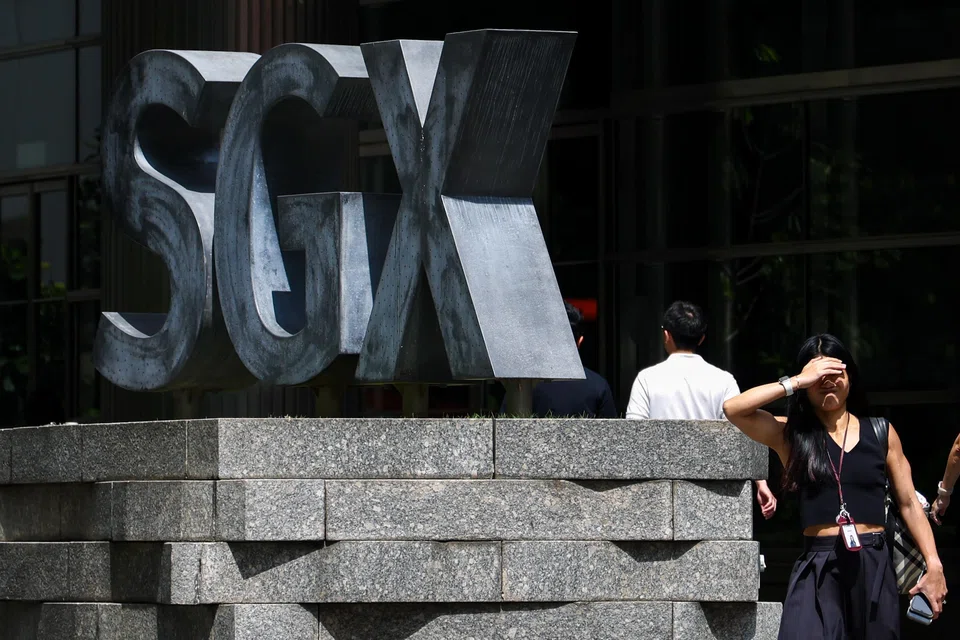
[SINGAPORE] Singapore stocks ended higher on Monday (Aug 31), amid a mixed showing from wider Asian markets.
The benchmark Straits Times Index (STI) gained 1 per cent or 55.43 points to finish at 5,755.36.
DFI Retail Group led the gainers on Singapore’s blue-chip index, rising 5.1 per cent or US$0.18 to US$3.71.
The worst performer among STI constituents was Seatrium , which fell 2.3 per cent or S$0.05 to S$2.15.
The three local banks ended higher. DBS gained 1.6 per cent or S$1.25 to end at S$77.40, OCBC rose 1.4 per cent or S$0.45 to S$31.52, and UOB was up 1.9 per cent or S$0.78 at S$41.56.
Within the iEdge Singapore Next 50 Index, NTT DC Real Estate Investment Trust was the top gainer, rising 3.2 per cent or US$0.03 to US$0.955, while Hong Leong Asia was the biggest decliner, falling 6.1 per cent or S$0.19 to S$2.93.
Across the broader market, gainers outnumbered losers 286 to 251, after 1.5 billion securities worth S$3.4 billion changed hands.
Key regional indices were mixed. Hong Kong’s Hang Seng Index and Japan’s Nikkei 225 were down 0.1 per cent, while South Korea’s Kospi inched up 0.5 per cent.
LGT private banking analysts noted that under current market conditions, energy prices remain elevated and equity-market outperformance persists. The US Federal Reserve could also turn hawkish if inflation proves sticky.

They added that a more severe escalation in energy risks or a revival of imminent Fed hike expectations could make for a more bullish US dollar.
“Conversely, sustained easing in US inflation or the emergence of downside risks to US growth would shift the balance towards a more bearish US dollar stance,” they said.
They added that a full and sustained greenback sell-off would likely require a clearer cyclical downturn in the US economy and a decisive dovish shift from the Fed – conditions they do not yet see as being fully in place.
Meanwhile, the LGT analysts also lowered their forecast of the USD/KRW currency pair, though they remained “tactical and cautious” on South Korean won longs.
“The medium-term outlook is constructive, supported by record current-account surpluses, resilient technology and memory exports, and a hawkish Bank of Korea bias,” they said.
“However, recent South Korean won strength appears to have moved ahead of near-term fundamentals.”
This article was written with the assistance of AI and reviewed by a reporter
Decoding Asia newsletter: your guide to navigating Asia in a new global order. Sign up here to get Decoding Asia newsletter. Delivered to your inbox. Free.
Share with us your feedback on BT's products and services
TRENDING NOW

DBS, OCBC, UOB rout lops billions off STI as inflation, rate concerns spook investors

Grab CEO’s wife Chloe Tong on life with Anthony Tan and finding her purpose

OCBC sheds S$8 billion in value as shares close nearly 6% down; analysts cautious on banks

Deal between tycoon friends sparks scrutiny of Philippine power sector

