

Singapore stocks end higher on Friday; STI gains 0.4%
Genting Singapore leads the gainers on the blue-chip index
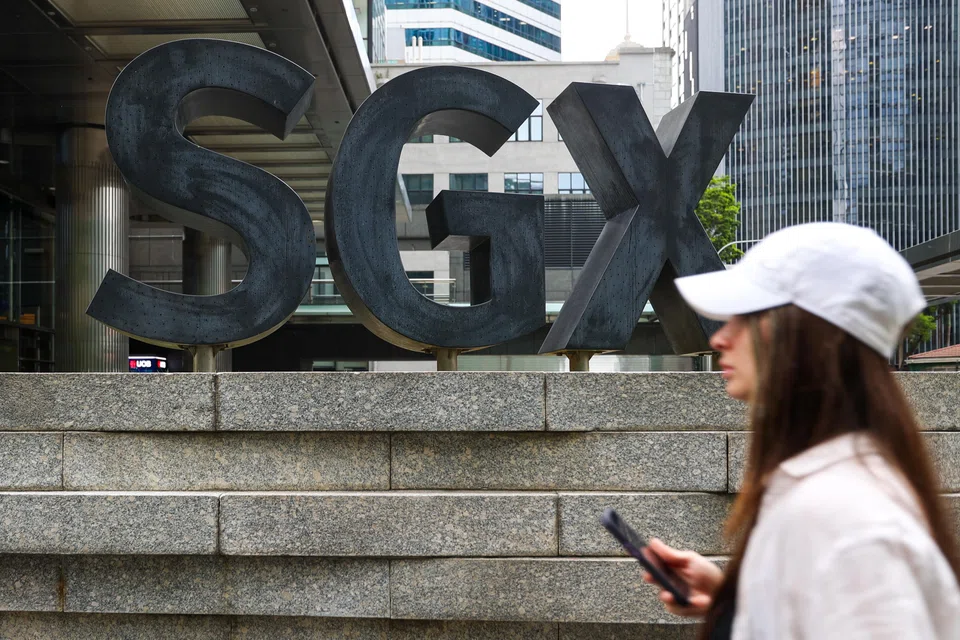
[SINGAPORE] Singapore stocks ended higher on Friday (Aug 14).
The benchmark Straits Times Index (STI) gained 0.4 per cent or 23.54 points to finish at 5,743.59.
Genting Singapore led the gainers on Singapore’s blue-chip index, rising 6.4 per cent or S$0.04 to S$0.665.
The worst performer among STI constituents was UOL Group , which fell 2.8 per cent or S$0.27 to S$9.28.
The three local banks ended mixed on Friday. OCBC rose 0.9 per cent or S$0.29 to S$31.79 and UOB was up 0.2 per cent or S$0.10 at S$41.80, while DBS finished 1.3 per cent or S$0.97 lower at S$75.53.
Within the iEdge Singapore Next 50 Index, First Resources was the top gainer, rising 7.6 per cent or S$0.28 to S$3.95, while Yanlord Land was the biggest decliner, falling 9.8 per cent or S$0.065 to S$0.595.
Across the broader market, losers outnumbered gainers 307 to 262, after 1.4 billion securities worth S$2.7 billion changed hands.
Genting Singapore was the most actively traded stock, with 156.5 million shares changing hands.
DBS was the most actively traded stock in terms of value, with a volume of 5.1 million shares and a value of S$383.1 million.
SEE ALSO






Key regional indices were mixed. Hong Kong’s Hang Seng Index lost 1.1 per cent, the FTSE Bursa Malaysia KLCI declined 0.4 per cent, Japan’s Nikkei 225 rose 0.6 per cent and South Korea’s Kospi was up 2.4 per cent.
Ipek Ozkardeskaya, senior analyst at Swissquote, said it is unclear if the Fed’s priority is to “tame inflation” or “make the market absorb lower rates as smoothly as it possibly can”, as it hopes to assist in easing the weight of growing interest payments on exploding US debt.
She added that Japanese Prime Minister Sanae Takaichi, who favours softer interest rates and robust government spending, is facing the fact that “interest rates in Japan must be lifted to ease the persistent selling pressure on the Japanese yen”.
The sustained pressure on the currency is “probably hurting the Japanese economy more than higher rates would”, she noted.
The latest news, she said, suggests that the Japanese government may now be supportive of a near-term rate hike.
This article has been written with the assistance of AI and reviewed by a reporter
Decoding Asia newsletter: your guide to navigating Asia in a new global order. Sign up here to get Decoding Asia newsletter. Delivered to your inbox. Free.
Share with us your feedback on BT's products and services
TRENDING NOW

Singapore to use ‘every legal and regulatory lever’ against companies linked to haze: Shanmugam
Far East Organization’s The Serra Residences sells less than a quarter of units released at average S$3,460 psf

DBS, OCBC, UOB face rate hike reality check

The only common thing in S-E Asia is that we all eat rice: Cisco’s Asean president

