Singapore stocks gain amid regional rebound; STI up 0.5%
Across the broader market, gainers beat losers 437 to 188 after 2.3 billion securities change hands
 Add BT as a preferred source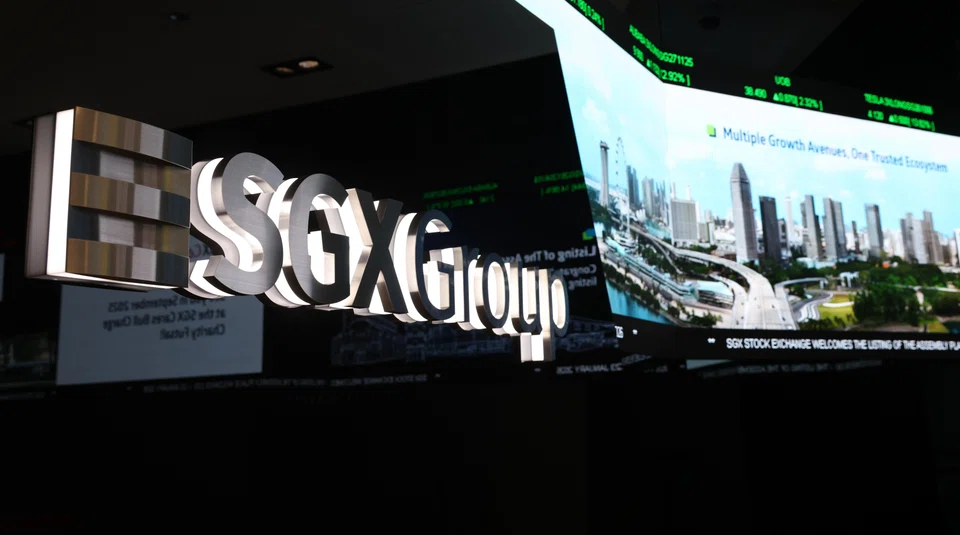
DeeperDive is a beta AI feature. Refer to full articles for the facts.
[SINGAPORE] Singapore stocks closed higher on Tuesday (Apr 14), mirroring a recovery across regional markets.
The benchmark Straits Times Index (STI) gained 0.5 per cent or 23.4 points to finish at 5,007.57.
Mapletree Logistics Trust led the gainers on Singapore’s blue-chip index, rising 3.3 per cent or S$0.04 to S$1.24.
The three local banks also ended higher. DBS gained 0.1 per cent or S$0.08 to S$57.60, OCBC rose 1.3 per cent or S$0.30 to S$22.88, and UOB was up 0.5 per cent or S$0.18 at S$37.60.
The worst performer among STI constituents was DFI Retail Group , which fell 2.6 per cent or US$0.11 to US$4.16.
Across the broader market, gainers outnumbered decliners 437 to 188, after 2.3 billion securities worth S$2.1 billion changed hands.
Navigate Asia in
a new global order
Get the insights delivered to your inbox.
Elsewhere in the region, key indices were positive. Hong Kong’s Hang Seng Index gained 0.8 per cent, Japan’s Nikkei 225 rose 2.4 per cent, South Korea’s Kospi was up 2.7 per cent, and the FTSE Bursa Malaysia KLCI advanced 0.5 per cent.
“After a weekend drenched in alarm bells and worst-case chatter, liquidity is thin, and emotion is doing most of the pricing,” said Stephen Innes, managing partner at SPI Asset Management.
He added that the market is showing that positioning remains “tilted towards caution on the surface while conviction quietly rebuilds underneath”.


Meanwhile, Nigel Green, deVere Group’s chief executive officer, noted that the current environment requires investors to make a “distinction between short-term market moves and underlying fundamentals”.
He elaborated that price movements are being influenced by “shifting expectations around diplomacy, while physical supply conditions are evolving more slowly”.
Investors should therefore be cautious about reading too much into a short-term decline in oil prices, he said.
“The structural risks tied to Gulf supply routes remain significant, and the market has yet to fully price the potential for disruption.”
Decoding Asia newsletter: your guide to navigating Asia in a new global order. Sign up here to get Decoding Asia newsletter. Delivered to your inbox. Free.
Copyright SPH Media. All rights reserved.