Singapore telco price war squeezes earnings, strengthens case for StarHub-M1 deal, say analysts
They say that consolidation has to be among the mobile network operators, not just the virtual operators

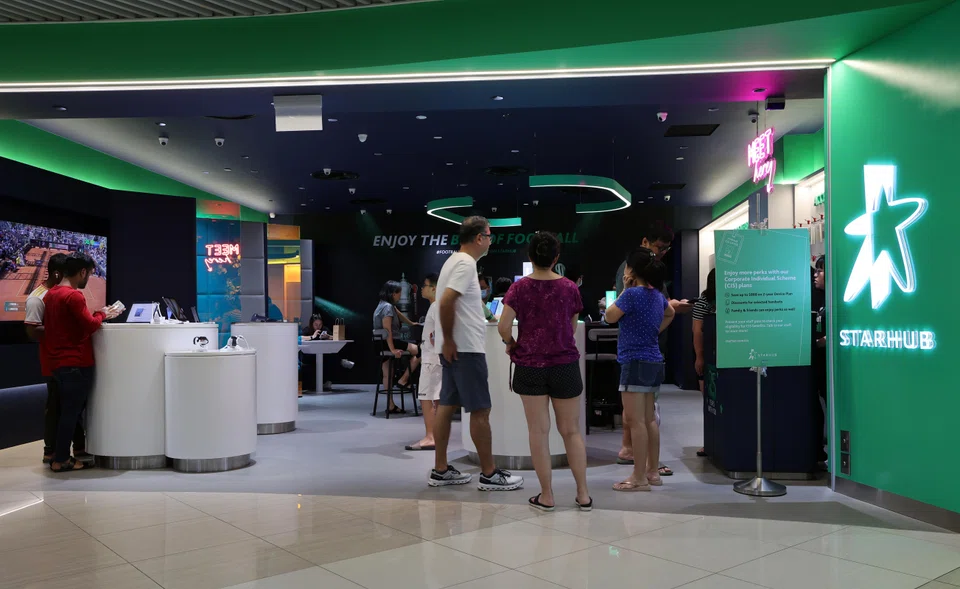
[SINGAPORE] Weakening local mobile-service revenue and mounting earnings pressure at StarHub and Singtel Singapore are strengthening the case for consolidation in the intensely competitive domestic market, said analysts.
For the incumbent telco operators to improve on their mobile service revenue, an industry consolidation is needed, said Chris Muckensturm, analyst at Bloomberg Intelligence.
“Absent meaningful industry rationalisation, we see limited scope for a sustained recovery in the incumbents’ mobile service revenue growth,” she told The Business Times.
StarHub’s mobile service revenue fell 10.5 per cent year on year to S$245.3 million in the first half ended Jun 30, from S$274.1 million.
Singtel Singapore’s mobile service revenue dipped 4 per cent to S$290 million in its first quarter, from S$303 million the previous year.
Singtel Singapore, which comprises both consumer and enterprise businesses, saw its revenue fall 3.1 per cent to S$901 million from S$929 million.
In contrast, group operating revenue rose 4.9 per cent to S$3.6 billion, from S$3.4 billion the previous year.
Singtel management shared in its recent annual general meeting held in July that its enterprise business accounted for more than half of Singtel Singapore’s revenue, but stopped short of sharing the exact revenue split.
Aggressive price competition in the consumer market is a key factor driving down revenue, said Hussaini Saifee, analyst at Maybank Research, pointing to mobile plans priced at S$10 to S$12, and broadband packages of as low as S$30 a month.
“Operators continue to prioritise subscriber acquisition over profitability,” he said.
The aggressive price competition has put a drag on the telcos’ earnings.
StarHub’s H1 earnings before interest, tax, depreciation and amortisation (Ebitda) – excluding Ensign, a cybersecurity joint venture with Temasek – fell 23.8 per cent to S$154.9 million for the period ended Jun 30.
Prem Jearajasingam, analyst at CGS International, noted that StarHub’s underlying net profit excluding Ensign fell 76.1 per cent to S$12.4 million, from S$51.9 million the previous year.
Meanwhile, Singtel Singapore’s Ebitda fell 4.6 per cent to S$363 million for the first quarter ended Jun 30, from S$380 million.
The Australian-listed parent company of Simba, Tuas Limited, is expected to announce its FY 2026 results some time in September.
The earnings pressure extends beyond the latest results.
StarHub’s Ebitda for FY 2025 for the period ended Dec 31, 2025, fell 12.3 per cent, while Singtel Singapore’s Ebitda for FY 2026 for the period ended Mar 31 fell 6.8 per cent.
S&P Global Ratings on Wednesday (Aug 19) upgraded Singtel’s issuer credit rating from “A/A-1” to “A+/A-1”, citing improved balance sheets.
Despite the improvement in rating, it singled out Singtel’s Singapore telco operations as a potential downside.
“We believe Singtel group’s business fundamentals will improve slightly over the next few years, excluding the telco operations in Singapore,” said the global credit rating agency.
“Singtel’s Singapore operations face pricing pressures for the consumer business as industry consolidation has stalled.”
Paul Chew, head of research at Phillip Securities Research, said: “The unsustainability becomes more obvious when operators turn loss-making.
“Operating four mobile operators in Singapore will only deliver weak returns to the industry.”
The other two players are Keppel subsidiary M1 and Simba, whose proposed S$1.43 billion merger fell through in May.
StarHub-M1 deal a catalyst
But for the industry to recover in the long term, consolidation would need to go beyond involving mobile virtual network operators (MVNOs) to the mobile network operators themselves, said analysts.
MVNOs are mobile service providers that do not own any physical network infrastructure, but piggyback on that of mobile network operators.
Consolidation among MVNOs means their number would come down.
“We see a potential StarHub-M1 consolidation reversing the industry average revenue per user (ARPU) malaise,” wrote the RHB equity research team in a report.
Blended ARPU for StarHub fell to S$20, from S$21 the previous year; mobile ARPU for Singtel Singapore fell to S$22, from S$23 the previous year.
Singapore’s mobile ARPU level is 15 to 40 per cent below that of its developed Asia-Pacific peers, noted a 2025 Maybank Research report.
The planned migration of MyRepublic mobile subscribers to the StarHub network, which extends on their 5G wholesale partnership since 2022, reinforces StarHub’s multi-brand strategy and “effectively strengthens its position ahead of a potential merger”, noted RHB.
StarHub also recently migrated customers from MVNO redONE to its budget brand, eight.
Moving MyRepublic’s 4G wholesale economics from M1 to StarHub would “modestly improve” StarHub’s potential negotiating position if M1 is valued on subsequently lower earnings, said Muckensturm.
“The move will simplify future network rationalisation through StarHub-M1’s shared 5G infrastructure,” she said, referring to their Antina joint venture, under which the two telcos share 5G standalone (5G-SA) infrastructure.
She added that the MyRepublic migration should lift StarHub’s high-margin wholesale revenue and Ebitda.
But Phillip Securities Research’s Chew cautioned against reading too much into the move. He told BT that the exercise would have been conducted “regardless of any potential acquisition”.
Cash and cost savings
While consolidation could fix pricing and potentially uplift revenue for the local telcos, both financial and regulatory hurdles would need to be addressed, said analysts.
To fund the potential deal, StarHub has S$516 million in cash and could monetise its remaining 39 per cent stake in Ensign, which Saifee estimated to be worth around S$322 million.
CGS International’s Jearajasingam put the value of the Ensign stake at S$266 million.
StarHub management has said that it intends to sell off its remaining stake in the cybersecurity joint venture by the end of 2026.
“The stake disposal, together with additional debt capacity, would help it secure firepower for a large merger and acquisition transaction,” added Muckensturm.
Both StarHub and M1 are also trying to lower their cost bases.
StarHub has committed to S$70 million in cost-saving initiatives. To date, it has achieved 10 per cent of its target, its management said.
Separately, Keppel, the parent company of M1, has also drawn up a three-year business plan to enhance the telco’s profitability and competitiveness.
M1 also seeks to achieve S$70 million of annual run-rate cost savings by 2028.
In the year to date, it has achieved a run-rate cost saving of S$4 million a year, and aims to achieve S$10 million a year by end-2026.
“(The cost saving) should help in (M1’s) negotiation if it can operate more profitably and competitively,” said Chew.
Regulatory question remains
The bigger uncertainty is whether regulators would support another attempt at consolidation among Singapore’s four mobile network operators.
In May, the Infocomm Media Development Authority (IMDA) said it had learnt that Simba may have used radio frequency bands it was not assigned to provide mobile services.
IMDA’s investigations are still ongoing, said the Ministry of Digital Development and Information in July.
Bloomberg Intelligence’s Muckensturm said: “Regulatory signalling would also be important, particularly given that the previous M1-Simba transaction stalled because of issues specific to Simba, rather than an objection to consolidation.”
Analysts also acknowledged that stricter regulatory requirements could also help ease market competition.
“The (StarHub) management felt that there was room for competitive pressures to ease once the fourth operator, Simba, was required to comply with cybersecurity and other rules that the incumbent operators had to follow,” noted Jearajasingam.
He added that the move to 5G-SA would also benefit the incumbent telcos. StarHub, which acquired the 700 MHz spectrum, would stand to benefit from the shift.
Maybank Research analyst Saifee said: “We believe stricter cybersecurity, resilience and 5G-SA requirements could gradually reduce smaller operators’ structural cost advantages and support a more rational market structure.”