

Singapore’s high-sulphur marine fuel market seeing supply squeeze: Argus
HSFO swap spread reaches record US$95 a tonne on Oct 7 before easing to US$88 a tonne the next day

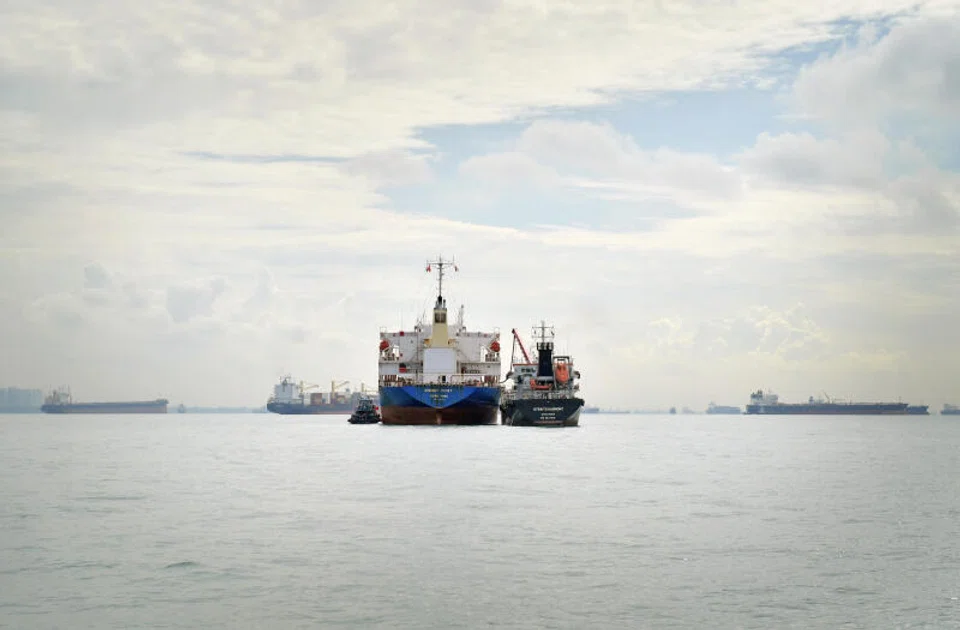
[SINGAPORE] A supply squeeze is developing in Singapore's high-sulphur marine fuel market as wars are disrupting supplies even as demand at the world's largest bunkering hub continues to rise.
Data from energy and commodity market intelligence provider Argus indicated that the east-west high-sulphur fuel oil (HSFO) swap spread – a key indicator of the forward price difference between Singapore and Rotterdam – reached a record US$95 a tonne on Oct 7, before easing to US$88 a tonne the following day.
The widening premium shows how much more the market expects fuel to cost in Asia than in north-west Europe, pointing to acute near-term tightness in Singapore, said Bob Wigin, fuel oil and oil products pricing analyst at Argus.
The premium for actual HSFO in Singapore over Rotterdam, meanwhile, is also at its highest since the start of the Middle East war, even though that differential is not itself a record.
Wigin commented that these figures show that this is not simply a futures-market move, as buyers are also paying more for scarce fuel in the spot market.
The tight supply is being driven by a sharp drop of supply from Russia and disruption to Middle Eastern tanker flows as shipping activities are affected in the war zones.
HSFO deliveries from Russia to Singapore plunged 75 per cent quarter on quarter in the third quarter to just 309,000 tonnes – their lowest level in more than three years.
HSFO bunker sales, on the other hand, increased 10.6 per cent year on year to 17.6 million tonnes in January-September in Singapore, adding to pressure on available supplies.
Trade flows are shifting, meanwhile, as buyers are exploring alternative, less established supplies from countries including India and Syria, said Wigin. This showed that geopolitical disruptions are reshaping established fuel trade routes.
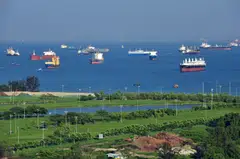
Singapore might have to compete to buy HSFO from other sources, possibly from Latin America, he suggested. It has sourced a lot more HSFO from the west coast of the US, for example, than it usually would because of the limited supplies from Russia and the Middle East now.
The implications for suppliers and traders in Singapore could be that they do more business in the low-sulphur fuel oil (LSFO) market until Russian supply of HSFO resumes.
The situation in Europe is not as drastic, as HSFO can be imported into Amsterdam-Rotterdam-Antwerp from other locations – such as South America and Mexico – that are not affected by the geopolitical conflicts.
HSFO is not the only marine fuel in short supply, though. LSFO east-west spreads for both physical prices and paper prices (used in financial contracts) have reached very high levels.
Notably, the attacks on Russian ports by Ukraine specifically affect HSFO output to the Asia-Pacific. The throttling of the Strait of Hormuz by Iran affects both the flows of HSFO and LSFO, Wigin noted.
Decoding Asia newsletter: your guide to navigating Asia in a new global order. Sign up here to get Decoding Asia newsletter. Delivered to your inbox. Free.
Copyright SPH Media. All rights reserved.
TRENDING NOW

High Court rules against Julius Baer’s Singapore trust arm in US$50 million family trust dispute
MSCI proposes standalone status for Indonesia; Jakarta stocks plunge 8%

Once staunchly pro-China, Malaysian Chinese businesses are now distancing themselves from Beijing

No chicken feed: How Malayan Flour Mills built an empire from flour to fowl

