

SingPost H1 profit up 183.7% at S$55.9 million on sale and leaseback of HDB shophouses
Revenue slips 1.3 per cent to S$185.9 million, mainly due to declining international mail volumes
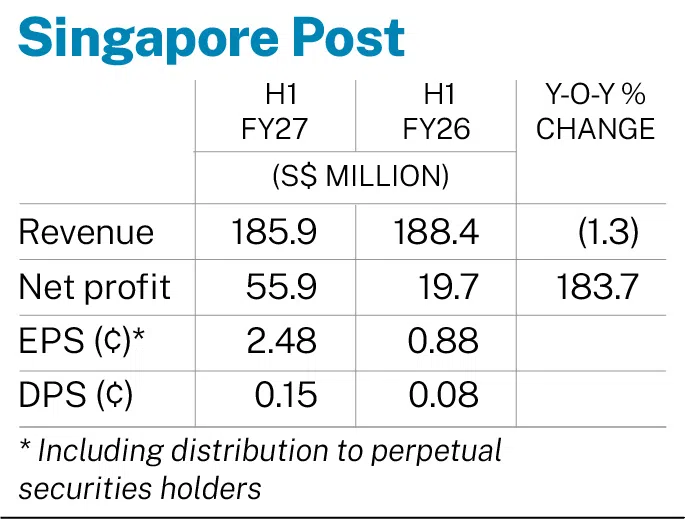
[SINGAPORE] Singapore Post (SingPost) announced on Friday (Nov 6) a 183.7 per cent rise in net profit to S$55.9 million for the first half ended Sep 30, 2026, from S$19.7 million a year earlier, largely driven by exceptional gains from property divestments.
Exceptional items amounted to S$44.4 million, compared with S$13.9 million in the year-ago period, largely reflecting gains from the sale and leaseback of 10 Housing & Development Board (HDB) post office shophouses.
But such exceptional gains are not likely to be repeated even as SingPost also announced cutting down post office branches to 30 from the current 40.
The 10 post offices will not be divested like the earlier batch, SingPost CEO Mark Chong told the media at a post-earnings briefing.
Instead, they will be leased out to boost income with part of the premises converted into self-service lobbies. This comes as SingPost is increasing such facilities by 10 to 50. The change in the numbers of post offices and self-service lobbies is targeted to be completed by the end of March 2027.
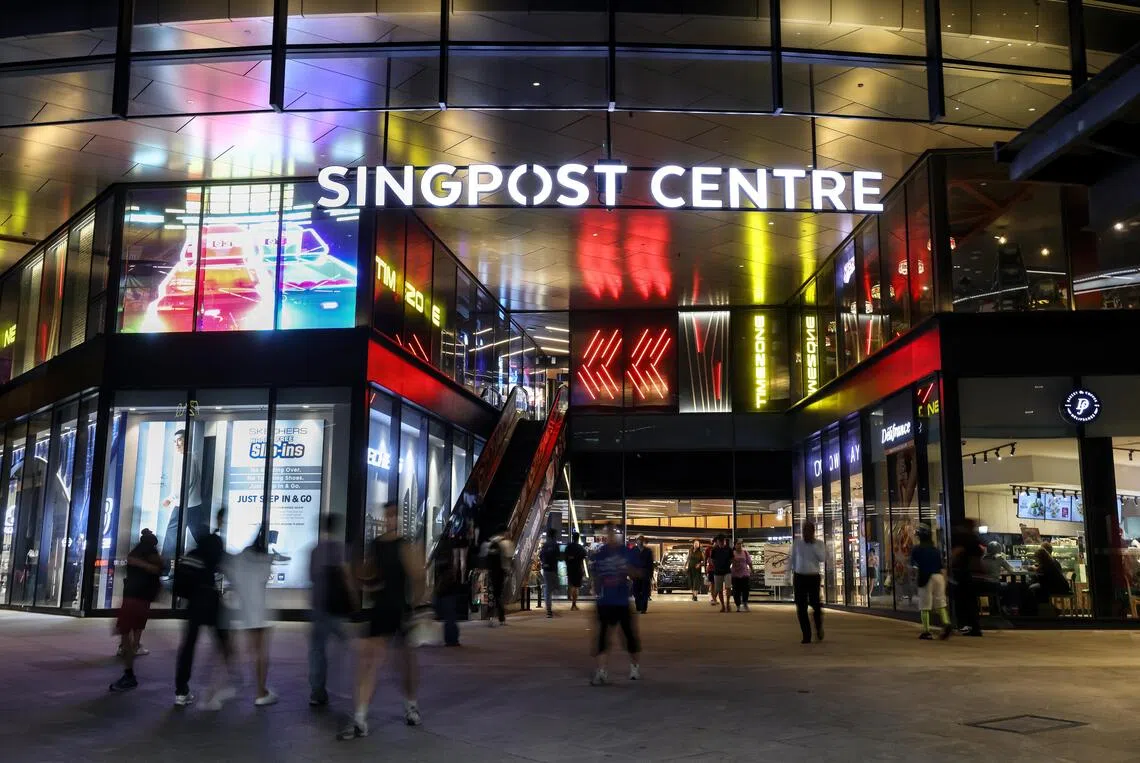
Meanwhile, the exceptional gains will go towards the cash pool, SingPost chief financial officer Isaac Mah said, as it is redeeming S$100 million of medium term notes maturing in March 2027. It is also expecting to spend under S$30 million to refresh the SingPost Centre retail mall.
The works are projected to start in 2027 and will be carried out at a “very gradual” pace, said Chong. “The intent is to really be very very phasal, minor disruption, because we also don’t want to disrupt the normal rental income streams that we have.”
SingPost is currently in discussion with Infocomm Media Development Authority to explore relaxing the regulatory requirements in order to have more flexibility in managing the costs of operating the postal service business.
Chong cited delivery deadlines and the number of street-side posting boxes as examples of regulatory requirements, and added that more information will be shared when details are finalised.
When asked if there is any discussion on financial support from the government, the helmsman who took the reins a year ago said: “I have no further comments.”
Financial performance
Revenue slipped 1.3 per cent to S$185.9 million from S$188.4 million, mainly due to lower international revenue amid a structural decline in letter mail volumes.
Underlying net profit more than doubled to S$11.5 million from S$5.5 million, supported by improved operating performance and a tax provision write-back.
Earnings per share from continuing and discontinued operations, excluding distributions to perpetual securities holders, rose to S$0.0224 from S$0.0063 a year earlier.
The postal services provider declared an interim dividend of S$0.0015 per share, up from S$0.0008 a year earlier. It will be paid out on Dec 4.
Operating profit rose 42.3 per cent to S$8.1 million as operating expenses fell 2.1 per cent to S$178.6 million.
“Our results reflect green shoots in the execution of our strategy. However, the operating environment continues to be challenging,” said Chong. “Amid structural letter mail declines and cross-border headwinds, maintaining operational discipline is key.”
Revenue by segment
The group’s logistics and letters segment recorded an 8 per cent decline in revenue to S$141.4 million, although its operating loss narrowed to S$2.5 million from S$3.4 million.
Domestic parcel delivery volumes grew 23.8 per cent year on year, helping to offset a 15.6 per cent drop in domestic letter mail volumes. International logistics revenue fell 28.6 per cent amid declining cross-border letter mail volumes.
SingPost’s domestic parcel delivery volumes rose because market share rose, CFO Mah shared.
Chong said a higher market share was achieved partly because SingPost has become “more competitive” with the use of its new automated parcel sortation system. “Secondly, I think the market has also grown because there has been the entry of new e-commerce players.”
He did not give names. But Chinese e-commerce giant Pinduoduo’s introduction of free shipping to Singapore in August with no minimum expenditure is attracting price-conscious consumers and intensifying competition.
The post office network segment narrowed its operating loss by 42.9 per cent to S$3.3 million, as revenue jumped 80.8 per cent to S$10.4 million, driven by retail partnerships, commercial product sales and higher rental contributions.
Meanwhile, the property assets segment recorded revenue of S$40.9 million, up 1.1 per cent, while operating profit dipped 1.4 per cent to S$22.6 million. SingPost Centre achieved full occupancy, with blended rental rate reversions of 7 per cent.
SingPost expects operating conditions to remain challenging amid structural declines in letter mail, cross-border headwinds and macroeconomic uncertainty.
Net cash from operating activities turned positive at S$5.9 million, reversing an outflow of S$28.1 million a year earlier. SingPost ended September with cash holdings of S$642.5 million.
Shares of SingPost closed 6.9 per cent or S$0.02 higher at S$0.31 on Friday after the financial results were released.






